📝 Study time lab
Note-taking reading time calculator
Estimate how long a reading assignment will take when you include careful reading, note-taking, recaps, review passes, and any deadline catch-up pace.
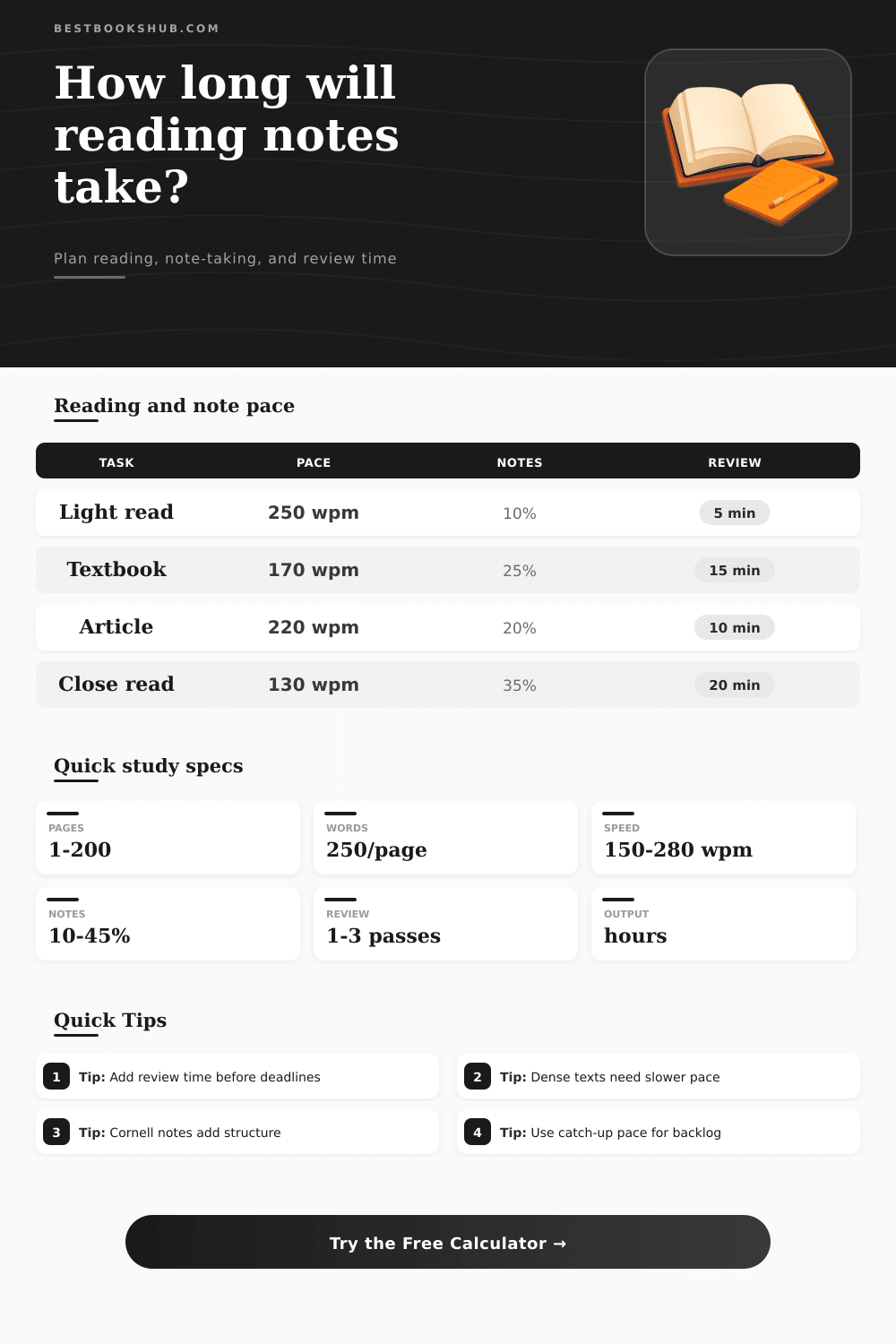
| Reading material | Typical wpm | Words per page | Notes add |
|---|---|---|---|
| Light nonfiction | 240 to 300 wpm | 250 to 320 | 5% to 15% |
| Standard textbook | 150 to 210 wpm | 300 to 450 | 20% to 35% |
| Scholarly article | 170 to 230 wpm | 500 to 700 | 15% to 30% |
| Dense theory or casebook | 100 to 150 wpm | 350 to 550 | 30% to 50% |
| Review skim | 280 to 380 wpm | 250 to 450 | 0% to 12% |
| Note method | Best use | Time multiplier | Output |
|---|---|---|---|
| Margin notes | Quick chapter reminders | 1.12x | Short cues |
| Outline notes | Lecture or exam prep | 1.22x | Headings and bullets |
| Cornell notes | Recall-focused study | 1.32x | Cues, notes, summary |
| Detailed synthesis | Research or thesis work | 1.45x | Claims and evidence |
| Assignment size | Example | Planned notes | Typical total |
|---|---|---|---|
| Short reading | 10 to 15 pages | Margin or outline | 35 to 70 min |
| Chapter study | 25 to 40 pages | Outline or Cornell | 2 to 4 hours |
| Article packet | 8,000 to 15,000 words | Claims and methods | 2.5 to 5 hours |
| Research block | 60 to 100 pages | Detailed synthesis | 6 to 12 hours |
DISCLOSURE: This post may contain affiliate links, meaning when you click the links and make a purchase, I receive a commission. As an Amazon Associate I earn from qualifying purchases.
There it is. It is on your desk. It comes with a silent warning: Read this. How long will it take? You have no idea.
You can look at the page count (thirty?) but on its own that’s nothing. That might be four hours of intense synthesis or twenty minutes of light skimming. That isn’t the issue. The issue is that each word represent an invisible cost, the cost of pausing to understand and highlight and then remember what we’ve just read.
How to Plan Your Study Time
Students don’t plan well because they treats their eyes as if they are cameras, simply taking pictures of words. What they ignore is that understanding require minutes and energy. How do you turn pages into clock time? You should of had an answer to this question. How many minutes does it take you to read one page?
This online tool will figure out the rest for you (so you don’t have to calculate conversions and coefficients). All you have to do is input your reading speed and how much you takes notes. It assumes you can read carefully and accurately at roughly one hundred eighty words per minute.
This number declines rapidly, however, as the content grow thicker. When I’m flipping through a legal casebook or technical proof, my eyes may be traveling across the screen at three hundred words per minute, but my brain is absorbing material at a tiny fraction of that rate. The calculator factors this in. So your estimate are adjusted downward based off text density.
But here’s the kicker: Taking notes doesn’t just add an additional 10 minutes of work per hour. (People think so.) It usually doubles your time. And if you pick a more detailed note-taking style, like a synthesis, it add nearly half again to your base reading duration.
Why? You are stopping to make connections, rephrasing information in your mind, and structuring arguments instead of simply writing words down. The tool itself handles this mental burden if you choose outline formats or Cornell notes. But those formats force you to recognize the tradeoff: Speed at the expense of depth. Read faster. Understand less. Slow down, take good notes… Create a study guide on-the-go.
Silent time sinks include review passes, such as reading the chapter once. Then you skimmed your notes. Then reviewed it by recalling key points without looking. How much time does each pass take? Each pass usually takes about fifteen minutes per section of material. Add those review blocks explicitly. Critical if retention is important (e.g., exams).
The tool calculates and will show you the pace you’d need to catch up if you had a deadline in three hours. It may tell you that you’re going to have to skim at two hundred fifty words per minute with minimal notes just to get through the material. With that knowledge, you can make a strategic decision about quantity vs. Quality.
But there’s also the question of breaks. Your mind can only focus intensely for so long before cognitive fatigue creeps in. Giving yourself five or ten minutes per hour to rest helps prevent that shutdown without wasting an entire day on it. These breaks are included in the total estimate provided by the tool. And they save you from the all-too-common trap of overestimating time, like planning two hours of uninterrupted reading when, at the end of the day, you’re tired and have finished only half what you need.
If you don’t know how fast you read, the reference tables on the page will provide a baseline. The key is knowing what it’s actualy measuring. It’s not how quickly you can read a line and look away again. It’s how quickly can you extract knowledge from text? I might have an hour to go through, say, a thirty-page chapter on a topic I’m already familiar with. Four hours if it’s a new, moddern, theoretical framework. By letting you adjust based off difficulty/difference of familiarity, the calculator closes this gap.
It replaces vague anxiety with a concrete plan. First, give yourself a reasonable guess at your reading speed. Next, add in however you plan on taking notes. Finally, tack on some buffer for reviewing stuff that needs to be on a test. Now look at the grand total. Does it fit inside your open window?
If not, you’re going to have to cut something out. Cut some of your review passes. Make your notes less detailed. Or you can resign yourself to only working through the most essential parts.
This is not planning: planning isn’t about cramming everything into your schedule. Planning is getting clear on where you’ll compromise if time becomes tight. And I promise, that insight is better than an additional hour of haphazard reading. A stack of papers turns into a plan for mastering those furnitures.