📚 Reading pace planner
Reading speed goal calculator
Turn a book deadline into a practical reading target with words per minute, pages per day, active reading days, buffer time, and a weekly pacing plan.
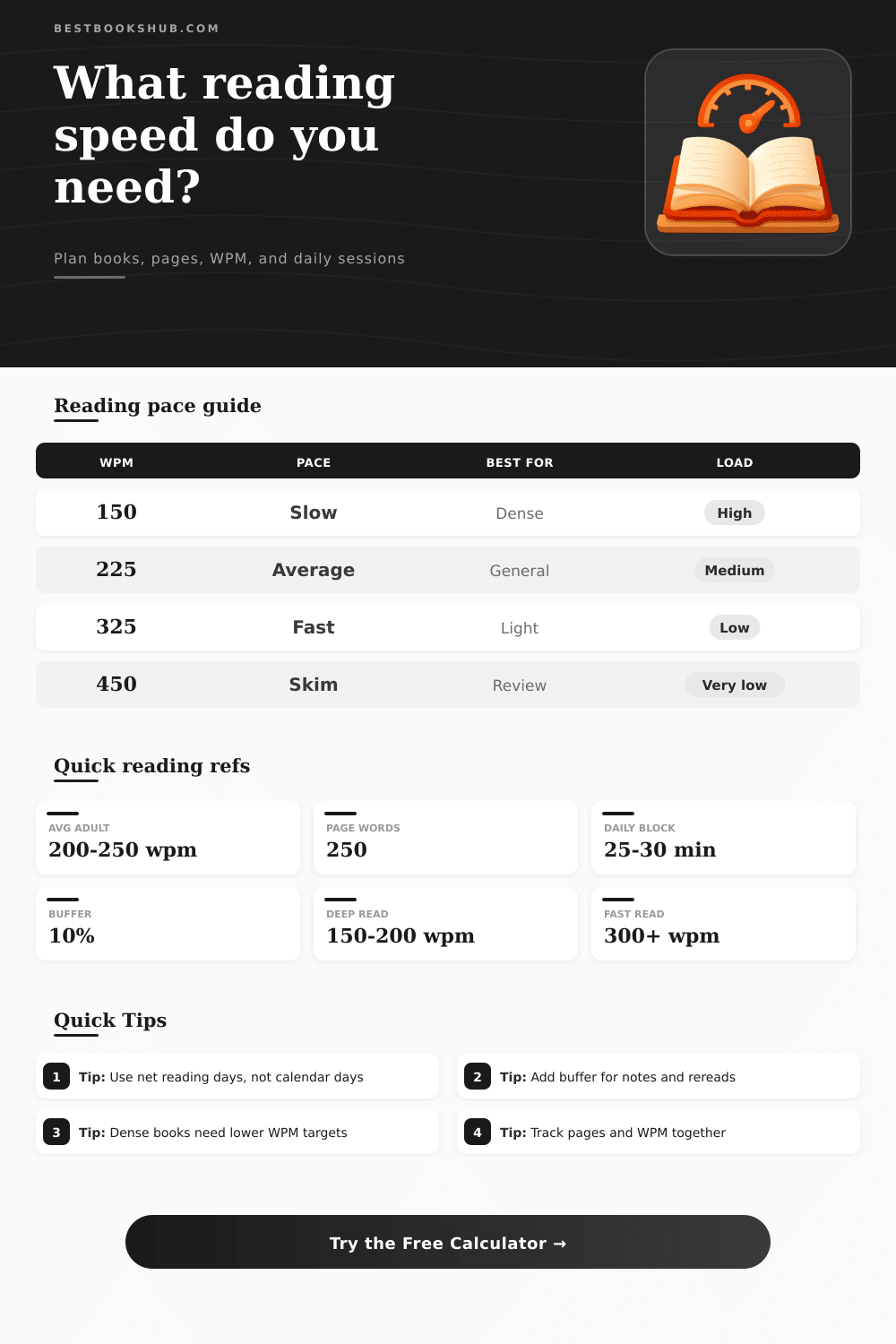
| Reading pace | Typical WPM | Best fit | 30-minute pages |
|---|---|---|---|
| Careful study | 125 to 175 WPM | Textbooks, philosophy, annotation-heavy reading | 15 to 21 pages at 250 words/page |
| Average silent reading | 200 to 250 WPM | General nonfiction, book club reading, essays | 24 to 30 pages at 250 words/page |
| Fast fluent reading | 300 to 400 WPM | Fiction, familiar topics, review passes | 36 to 48 pages at 250 words/page |
| Skim or scan | 450 to 700 WPM | Previewing, searching, second-pass review | 54 to 84 pages at 250 words/page |
| Goal type | Common target | Default words/page | Useful buffer |
|---|---|---|---|
| Book club novel | 280 to 380 pages | 250 words | 10% for missed days |
| Academic chapter set | 80 to 140 pages | 425 words | 20% for notes |
| Research stack | 30,000 to 60,000 words | 500 words | 25% for extraction |
| Yearly reading goal | 12 to 52 books | 250 words | 15% for life gaps |
| Daily reading block | At 200 WPM | At 250 WPM | At 300 WPM |
|---|---|---|---|
| 15 minutes | 3,000 words / 12 pages | 3,750 words / 15 pages | 4,500 words / 18 pages |
| 30 minutes | 6,000 words / 24 pages | 7,500 words / 30 pages | 9,000 words / 36 pages |
| 45 minutes | 9,000 words / 36 pages | 11,250 words / 45 pages | 13,500 words / 54 pages |
| 60 minutes | 12,000 words / 48 pages | 15,000 words / 60 pages | 18,000 words / 72 pages |
DISCLOSURE: This post may contain affiliate links, meaning when you click the links and make a purchase, I receive a commission. As an Amazon Associate I earn from qualifying purchases.
You want to read something, but you put the book down after three chapters because it is more work than you thought. This is the space for planning. You don’t have to read the pages faster; you just need to learn how to manage your time so reading feels possible again.
The problem is most people think about how much they can read in terms of days on the calendar… Which is a trap. Some days you’re tired, life happens and even when motivated, it’ll take you longer to get through a book if its dense. The right plan includes both extra energy needed to understand what you’re reading as well as rest day. After entering these parameters, the calculator do the work for you. You don’t have to keep track of all these number.
How to Plan Your Reading Time
The biggest variable is not the number of books you wish to complete but rather the amount of time you’re willing or able to dedicate every day. A half hour a day doesn’t sound like much. Until you add that up over a month’s time, and it equals fifteen hours of uninterrupted reading. That’s more than enough time to read a thick novel, provided the book pace itself correctly.
Because we all begin at a different place, the tool require you to enter your current reading speed, measured in words per minute. Maybe you can chug along at one-fifty words per minute when you’re reading a technical manual and still understand what’s going on. Maybe you’re racing through a thriller at three-hundred. The calculator use that starting point to figure out how much you need to churn out. You won’t be setting an unrealistic speed goal just to hit some arbitrary end date.
It’s also important to realize that there’s a distinction between “calendar” days and “active reading” days. You may think you have a month to get through a book, but if you’re going to take one rest day every week, in reality you’ll only have something like twenty-six days of actualy turning pages. Not accounting for rest days make your daily page goal too high, impossible to reach!
This is illustrated in the reference table on the page, which explains how various reading formats impact time needed and word density. For example, academic books has few words per visual line but are very dense and require a lot of mental effort, so you will still read slowly despite low page counts. With fiction, it flows more quickly because the narrative pulls you along. Combining these together and not adjusting your expectation levels is one common reason people fail their reading goals.
Another question: How much do you plan to engage with it? Do you have something to take notes on or to reread difficult parts? If so, you should of set aside time for those activities. Otherwise you’re reading in a surface level way; stuff goes into one eye and out the other; nothing sticks. Give yourself an extra 10% (for light notes) or 20% (for study material).
That’s a reasonable cushion of “I messed up here.” Some chapters will zip past, others will need a second read-through. You won’t fall behind just because you hit a tricky section; instead, you can adapt as needed without feeling like you are lagging. This modified estimate will show up in your daily targets, they’ll account for both turning pages AND thinking about them.
It’s better to set a daily page goal that feels just a little bit easy than a goal that feels heroic. Heroic goals buckles under the pressure of a busy work week or a late night. If you set a page goal at a pace that you can sustain over time; then you’ll keep up with it for weeks and months. And consistency beats intensity any day of the week in terms of developing a reading habit.
Perhaps you’ll look at your target speed and think: “Huh, I don’t read nearly as fast as that.” That’s fine! Practice makes you more efficient without giving up on understanding what you’re reading. Remember, we want sustained exposure not intermittent binging. And when the plan works with your life instead of fighting against it, then it ceases to be a chore and becomes a routine.
The bottom line: This isn’t about getting through the book, this is about savoring it enough to want to pick up another one. Planning helps you stop worrying about finishing the book before your next book club meeting. Instead of not knowing how you’ll do it and worrying about it constantly, you gain a clear plan for how to get it done, at least for today. And then tomorrow.
Today’s structure is made to be adapted. When you get too tired, skip something; when you find yourself loving the writing, take some extra time. It’s made so that the pressure is off, allowing you to get into the story (or the concepts) instead of keeping track of time. Let the structure hold the stress while you hold the book. Make it work for you, starting small, adapting along the way.