📖 Reading pace lab
Adjusted reading speed calculator
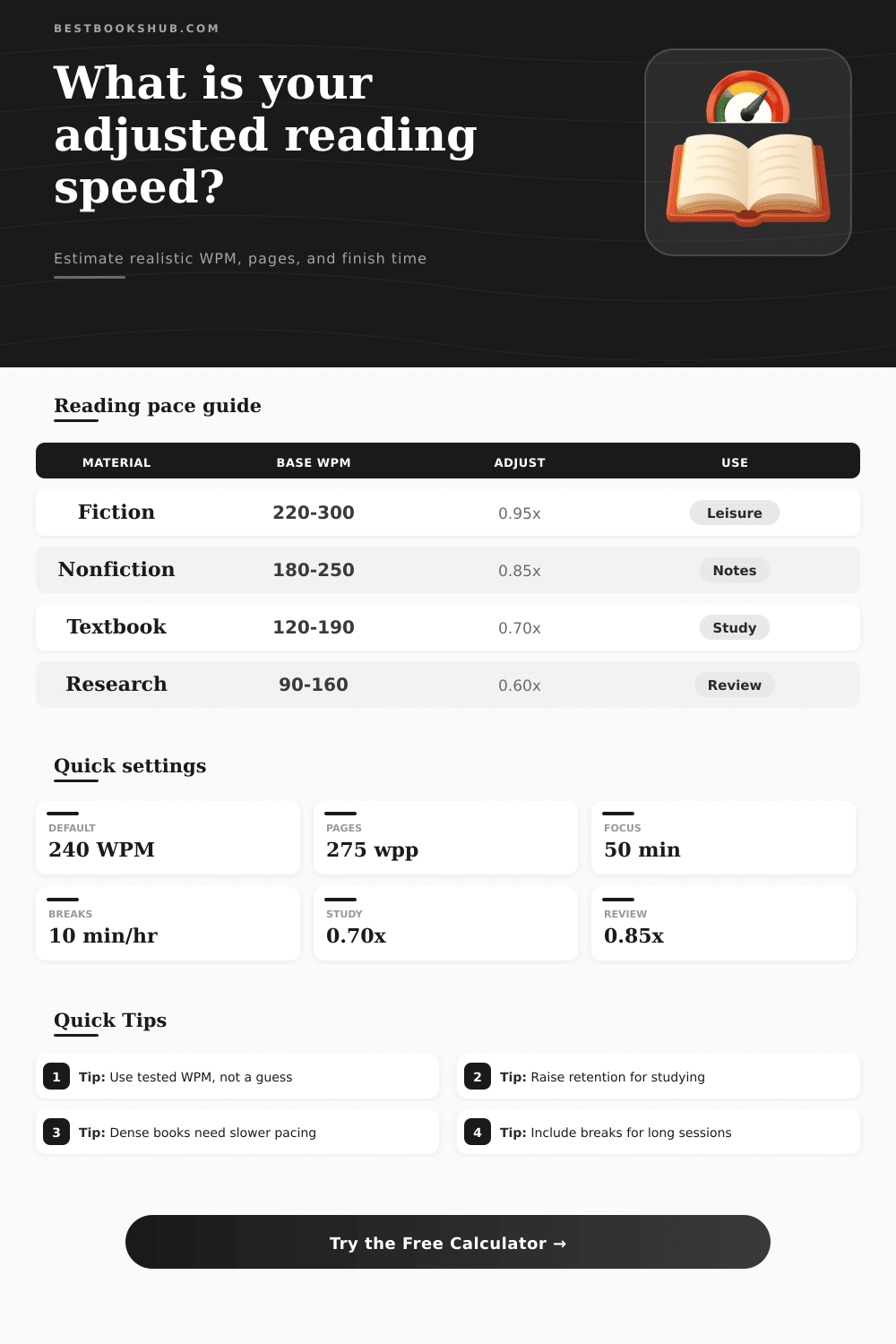
Estimate a realistic reading pace after material difficulty, comprehension target, reading purpose, format, breaks, and page density are applied.
| Condition | Typical multiplier | What changes | Best use |
|---|---|---|---|
| High retention target | 0.72-0.82x | More rereading and mental recall pauses | Study, exams, book clubs |
| Dense or technical prose | 0.58-0.84x | Terminology and sentence complexity slow pace | Textbooks, research, law |
| Notes while reading | 0.64-0.76x | Writing time is folded into effective reading speed | Academic and professional reading |
| Phone or PDF screen | 0.88-0.92x | Navigation and line tracking add friction | Articles, reports, travel reading |
| Skimming familiar material | 1.10-1.18x | Lower detail capture allows faster scanning | Previewing, rereading, summaries |
| Format | Words per page | At 180 WPM | At 240 WPM |
|---|---|---|---|
| Large print or airy layout | 200-240 | 45-54 pages/hour | 60-72 pages/hour |
| Typical paperback | 250-300 | 36-43 pages/hour | 48-58 pages/hour |
| Dense nonfiction | 300-375 | 29-36 pages/hour | 38-48 pages/hour |
| Textbook page | 400-500 | 22-27 pages/hour | 29-36 pages/hour |
| Academic PDF page | 550-750 | 14-20 pages/hour | 19-26 pages/hour |
| Plan | Daily time | Realistic net time | Good target |
|---|---|---|---|
| Commute reading | 25 minutes | 22-24 minutes | 10-20 pages |
| Lunch break session | 35 minutes | 30-33 minutes | 15-30 pages |
| Focused study block | 50 minutes | 40-45 minutes | 12-28 pages |
| Weekend long read | 120 minutes | 90-105 minutes | 45-90 pages |
| Deadline sprint | 180 minutes | 125-150 minutes | 60-130 pages |
DISCLOSURE: This post may contain affiliate links, meaning when you click the links and make a purchase, I receive a commission. As an Amazon Associate I earn from qualifying purchases.
Do you know how fast you read? If I asked you to time yourself on a random page in a book once, you’d tell me that you churn through about 240 words per minute. That sounds like a handy number… until you realize you’re trying to apply it to some technical manual or dense textbook chapter when you’re half-asleep and still recovering from work.
The truth is that raw speed is an empty number: you need to account for the frictions of actualy reading conditions. Plug in your own set of constraints into the calculator above and let it do the math for you… Saving you from underestimating just how long something difficult might actually take.
Why Real Reading Time Is Different
Understanding isn’t free. Switching from recreational reading to something that needs term definitions or cross-references mean your brain is multitasking. It is no longer just decoding symbols, it is creating mental models and filing them away. Your actual speed plummets accordingly. If the content has a big retention effect, your pace might fall as low as 72% of your normal rate. Ouch! But true. Typically when I attempt to read at novel-pace with my pen out making structured notes, I end up with crappy notes and crappy reading. By allowing you to set your goal (skim for a gist vs. Annotate heavily), the tool takes into account this penalty.
Most underestimate how important format is. When reading on the go via a phone there’s a lot of small text. You have to constantly scroll up and down, which create micro-pauses that add up. Even if you’re sitting at home with a computer and switch from print to a PDF, that’s an additional barrier; navigating is no longer naturaly and requires manual effort. This tool accounts for these physical barriers by estimating your finishing time with the drag of material included.
And it takes into account breaks. When you think “I’m going to read for two hours,” don’t assume this will be 120 minutes of straight-up focus. Your brain needs to pause and reset attention; otherwise you’ll set overly optimistic deadlines.
Another factor that skews conventional estimates is page density. While some pages are sparsely-written with plenty of white space, others jam seven hundred words into a single page. An airy font will make you believe you’re reading more quickely (when you aren’t) if you measure your progress in terms of pages read. This chart explains it well; no matter your word-per-minute speed varying page layout will change your pace per hour. It is a minor detail but it is important for planning purposes.
A big part of that is also just being familiar with the topic itself. You’re more able to skim stuff that you know, focusing on what’s unfamiliar. That speeds up the process (it feels like cheating, but it’s really efficient processing). When you dive in on something totally foreign, however, you have to carefully read through each sentence. That changes how much mental effort the material take. The tool adjusts to match, so your estimated daily progress accounts for that.
All of this boils down to: A reading plan isn’t so much a question of will as it is one of logistics. How many pages does your brain have left to handle when you’re exhausted? How many do you actualy have time for before bed, or work, or whatever else distracts you? That’s where the calculator comes in, it gives you a firm sense of your daily page goal, based off the concrete facts of your reading environment (device, type of text) and mood (how focused are you?). No guessing! It is just a real number to base a plan around.
This way, instead of throwing up your hands at a vague goal like “I want to read more,” you have something tangible: I owe myself x amount of pages each day. And that’s the difference between quitting on a book or finishing it, not just knowing the words, but actually understanding them. You should of planned better!