📚 Reading rhythm planner
Reading break interval calculator
Plan when to pause during a reading session by combining pages, pace, format, eye strain, note load, and preferred break style.
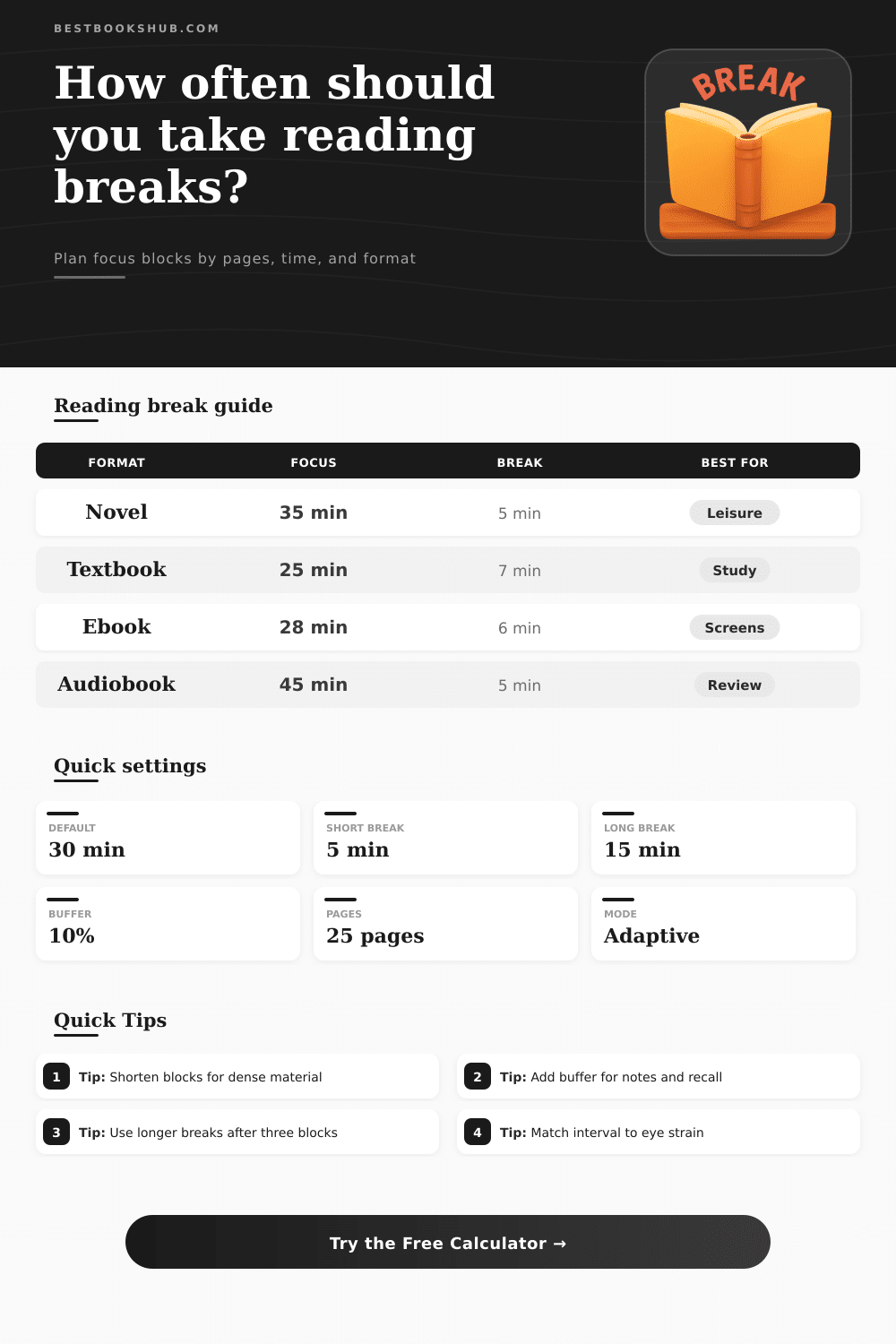
| Reading format | Base interval | Pace adjustment | Break note |
|---|---|---|---|
| Paperback or trade book | 35 minutes | 1.00x pace | Balanced breaks usually work well. |
| Hardcover seated reading | 35 minutes | 1.03x pace | Posture reset helps longer sessions. |
| Textbook or academic book | 25 minutes | 1.35x pace | Shorter blocks support recall. |
| Ebook on screen | 28 minutes | 1.08x pace | Add eye resets between blocks. |
| Comic or graphic novel | 40 minutes | 0.75x pace | Visual scanning can run longer. |
| Research papers and notes | 22 minutes | 1.45x pace | Plan recall time after each block. |
| Audiobook with review notes | 45 minutes | 1.00x pace | Pause for summary notes. |
| Children's readalong | 18 minutes | 1.15x pace | Use frequent short resets. |
| Density level | Interval effect | Break effect | Use case |
|---|---|---|---|
| Light and familiar | +8 minutes | No change | Rereads, novels, easy nonfiction. |
| Moderate focus | No change | No change | Most everyday reading sessions. |
| Dense or technical | -7 minutes | +2 minutes | Textbooks, theory, instructions. |
| Exam-level retention | -10 minutes | +4 minutes | Active recall and test prep. |
| Session size | Suggested rhythm | Typical breaks | Best fit |
|---|---|---|---|
| 30 to 45 minutes | One focus block | 0 to 1 | Short chapter or article. |
| 60 to 90 minutes | Two or three blocks | 1 to 2 | Course reading or book club prep. |
| 2 to 3 hours | Four to six blocks | 3 to 5 | Deep study or weekend reading. |
| 4 hours or more | Grouped cycles | 6 or more | Research days with long recovery breaks. |
DISCLOSURE: This post may contain affiliate links, meaning when you click the links and make a purchase, I receive a commission. As an Amazon Associate I earn from qualifying purchases.
What this means is, when you’re reading you might see words but not be absorbing them. Why? Reading is something you do that takes mental energy. And lots of folks plow through fatigue and believe they are making forward progress if they can make themselves endure. That’s usualy not true.
Know what your attention span looks like with different material. It’s easier to read a novel then a legal brief. It will help you plot out a rhythm that matches the text. This change your process from guessing to planning.
Why You Need Breaks When Reading
For dense academic text, it reduces focus block length. After a certain amount of attention, retention drop off sharply. Because our eyes gets strained by screen-based reading, we need to pause sooner than when reading on paper. Don’t try to remember these ratios. Simply understand that your brain responds different than digital noise versus print.
There’s a difference between reading for fun versus reading for understanding. You don’t want interruptions in the middle of a mystery novel. When studying for an exam, breaks aid memorization, you’re strengthening what you learned. The calculator switches between modes: light familiarity vs. It switches to exam mode. Increasing the density increase buffer time for recalling and taking notes. Reading summaries require more work than just plain reading.
Don’t forget friction of thought, or else your schedule will lag behind. You’ll rush the last few chapters, eager to get it done. Have a plan that accounts for the extra work of thinking.
Paper doesn’t suck as much as digital interfaces for draining your attention. Scrolling and blue light is all forms of mental effort. Even when you think you’re totally focused, you might be tired in your eyes by the 25th minute. And we’re recommending shorter blocks than normal print based off not on willpower but on physiology. Letting your eyes rest help them continue seeing clearly. Dry-eyed staring result in comprehension errors. You can read the words but miss the underlying concept. A break lets your recognition filter reset itself.
For longer sessions, use structured recovery. After three strenuous blocks of work, a five minute break isn’t always enough. You need a chance to move around and get distracted. That’s why I created the long recovery option. This includes a fifteen-minute buffer. Use this as an opportunity to completely leave your desk. Get up and walk. Stretch out. Rest your body. Don’t pull out your phone, it doesn’t provide any real mental rest.
These breaks are included in overall schedule time on the calculator. Having a sense of “when” you’re done will decrease anxiety. The point isn’t to read fast but to be consistent: Burning out means missing spots, and filling those gaps would of require more time than resting would have. Planning when to rest acknowledges that your brain has its limits. It allows you to make progress in bite-sized chunks, turning something difficult into small victorys.
You’re reading to understand the text, not simply to cross off a line on the spine. When you structure your schedule around comprehension, information has time to sink in. You’ll walk away from table with a better grasp of the material. You’ll also feel less drained by it so you can pick up where you left off.