Pomodoro Reading Planner Calculator
Plan a book, chapter set, or study reading goal by converting pages into focus blocks, breaks, daily targets, and a printable reading schedule.
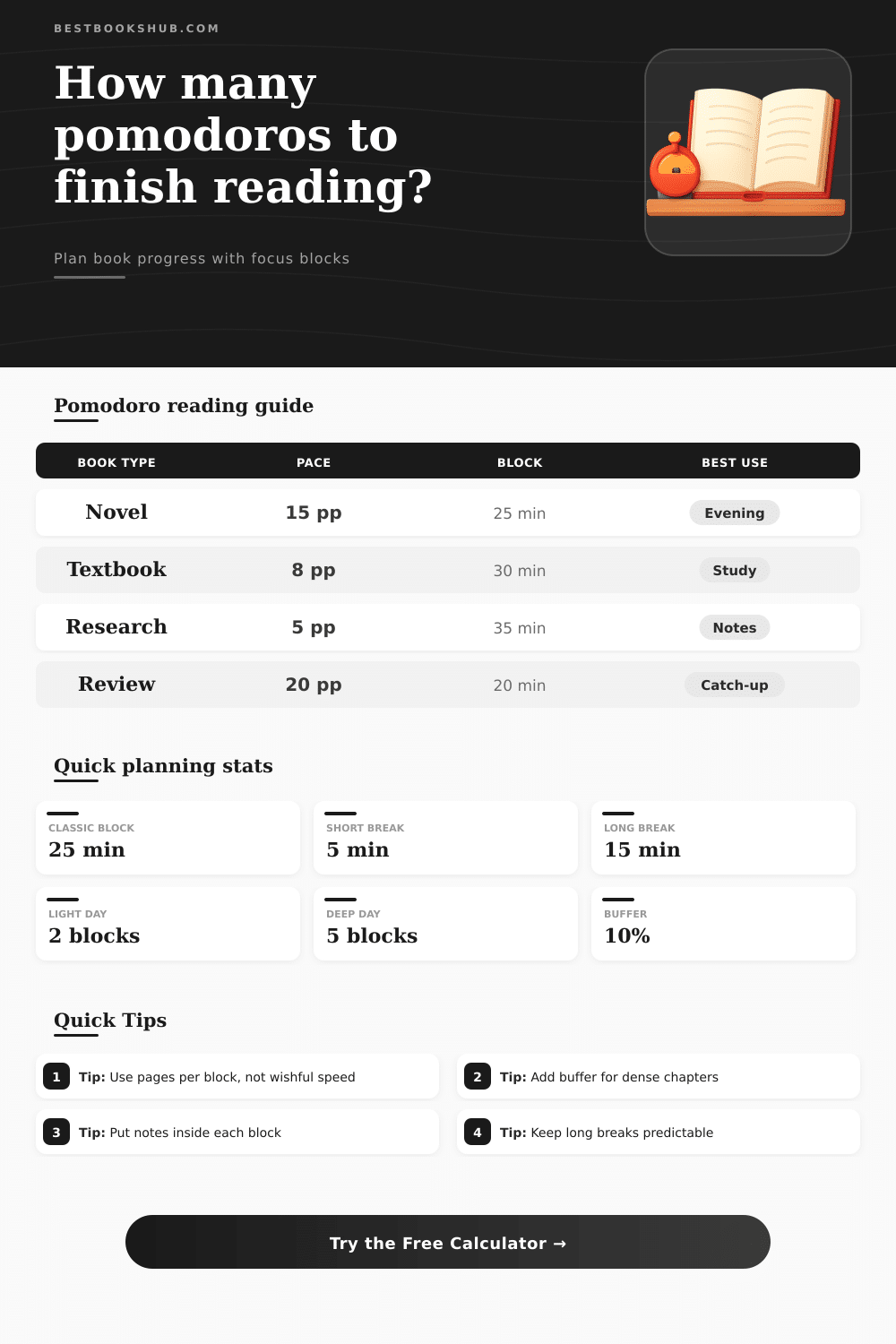
| Reading material | Typical pace | Best block length | Note adjustment |
|---|---|---|---|
| Fiction or memoir | 12-18 pages per 25 min | 25 minutes | Light notes keep 90% pace |
| General nonfiction | 8-14 pages per 25 min | 25-30 minutes | Margin notes keep 78% pace |
| Dense nonfiction | 6-10 pages per 30 min | 30 minutes | Use 15-20% buffer |
| Textbook or technical | 5-9 pages per 30 min | 30-35 minutes | Detailed notes keep 65% pace |
| Academic articles | 4-7 pages per 35 min | 35 minutes | Quote capture keeps 55% pace |
| Daily blocks | Classic schedule | Reading load | Good use case |
|---|---|---|---|
| 1 block | 25 min + no break required | Light progress | Habit maintenance |
| 2 blocks | 55 min with short break | Small chapter set | Weeknight reading |
| 3 blocks | 85 min with short breaks | Moderate assignment | Book club catch-up |
| 4 blocks | 130 min with long break | Deep reading day | Study session |
| 5 blocks | 160 min with long break | Heavy push | Deadline sprint |
| Book goal | Pages left | Blocks needed | Plan shape |
|---|---|---|---|
| Short novella finish | 120 pages | 8-10 blocks | 2 days at 4-5 blocks |
| Book club section | 180 pages | 13-16 blocks | 1 week at 2-3 blocks |
| Dense nonfiction half | 220 pages | 28-36 blocks | 2 weeks at 3 blocks |
| Textbook unit | 90 pages | 13-18 blocks | 5 days at 3-4 blocks |
| Research packet | 75 pages | 14-20 blocks | 4 days at 4-5 blocks |
Is there a book stack on your nightstand? It’s there because you purchased it with best intentions. This time it would of been different: you would read it. But here’s the thing. It’s almost never about not wanting to do it. It’s about the false idea that you’ll always have more time, and struggle of getting started. That’s why most people fail to achieve their reading goals, by treating reading as some sort of vague aspiration instead of something they schedules.
DISCLOSURE: This post may contain affiliate links, meaning when you click the links and make a purchase, I receive a commission. As an Amazon Associate I earn from qualifying purchases.
Enter the Pomodoro planner calculator, which converts your desire into concrete chunks of time that you can fight for in your calendar. The basic premise is to read in focused blocks of time with quick breaks in between. Break up your reading. That’s the easy part. Things get a bit more complicated if material is dense or requires notes. Enter: a tool that does all the math for you. It turns pages-per-day into something that feels achievable rather than an exercise in wishfull thinking.
How the Pomodoro Planner Helps You Read More
And the first piece is your pace. Fifteen pages of fiction in twenty-five minutes? Sure. Can you read fifteen pages of a textbook filled with diagrams at that same pace? Not happening. Your reading material determine how many pages you’ll read during each block. The calculator will ask what kind of reading you do and adapt its “expected pages” formula accordingly. That way your plan doesn’t implode after day two.
One drawback of note taking is that each pause take away from your momentum. Time (and focus) = pause. You may think you’re being productive by highlighting every sentence. Remember, there’s a note load setting on the planner that makes sure it adjust its pace to reflect reality. When you’re skimming for plot, you’ll be faster then when you’re jotting down quotes and summarizing. The planner recognizes this and changes to match, which is important because it allows you to keep your daily goal reachable.
Consistency is more valuable than perfection, and having a plan that recognizes slow days is preferable to having a perfect plan you ultimately abandon in frustation. Breaks are structural supports, not something to be ignored. Short breaks occurs within each block, and longer ones every few cycles (to reset your attention span). Without them, you’ll notice your brain begin filtering words even though your eyes keep moving. You will find yourself rereading the same paragraph over and over.
Total calendar time, including these breaks is displayed, which is crucial for planning your schedule. Reading four blocks sounds like two hours of effort, but with breaks it takes almost three hours of your evening. Knowing this in advance prevents you from overcommitting. Fiction moves more quickly than academic journals, so the benchmarks are clearly laid out in the reference tables. Learning new stuff take longer than reviewing old notes, but don’t worry about that; just use the benchmarks as a starting pace until you’ve got some of your own.
If you do have some, take an honest reading from your data by conducting one actual focus session (no distractions) and count the number of pages you can get through. Plug that into the equation because underestimating your speed will leave room for improvement, whereas overestimating will leave you feeling like crap every night. And lastly: Build in some flexibility, since you may get behind a chapter or two (or miss a day entirely). To avoid derailing your entire project, add a buffer by tacking on ten to twenty percent more time onto your overall estimate. This shock absorber sucks up setbacks without toppling your entire project.
And when you do sit down with this plan, what you’re doing is executing a strategy, one that honors the way attention works (not placing a bet on willpower). Set a timer, put the phone in another room, and read until it goes off. Instead of collecting dust, your nightstand stack will finally begin to shrink.