📚 Meeting agenda planner
Book Club Discussion Time Calculator
Estimate a realistic discussion length from group size, intro rounds, question depth, member airtime, side conversations, breaks, voting, and wrap-up time.
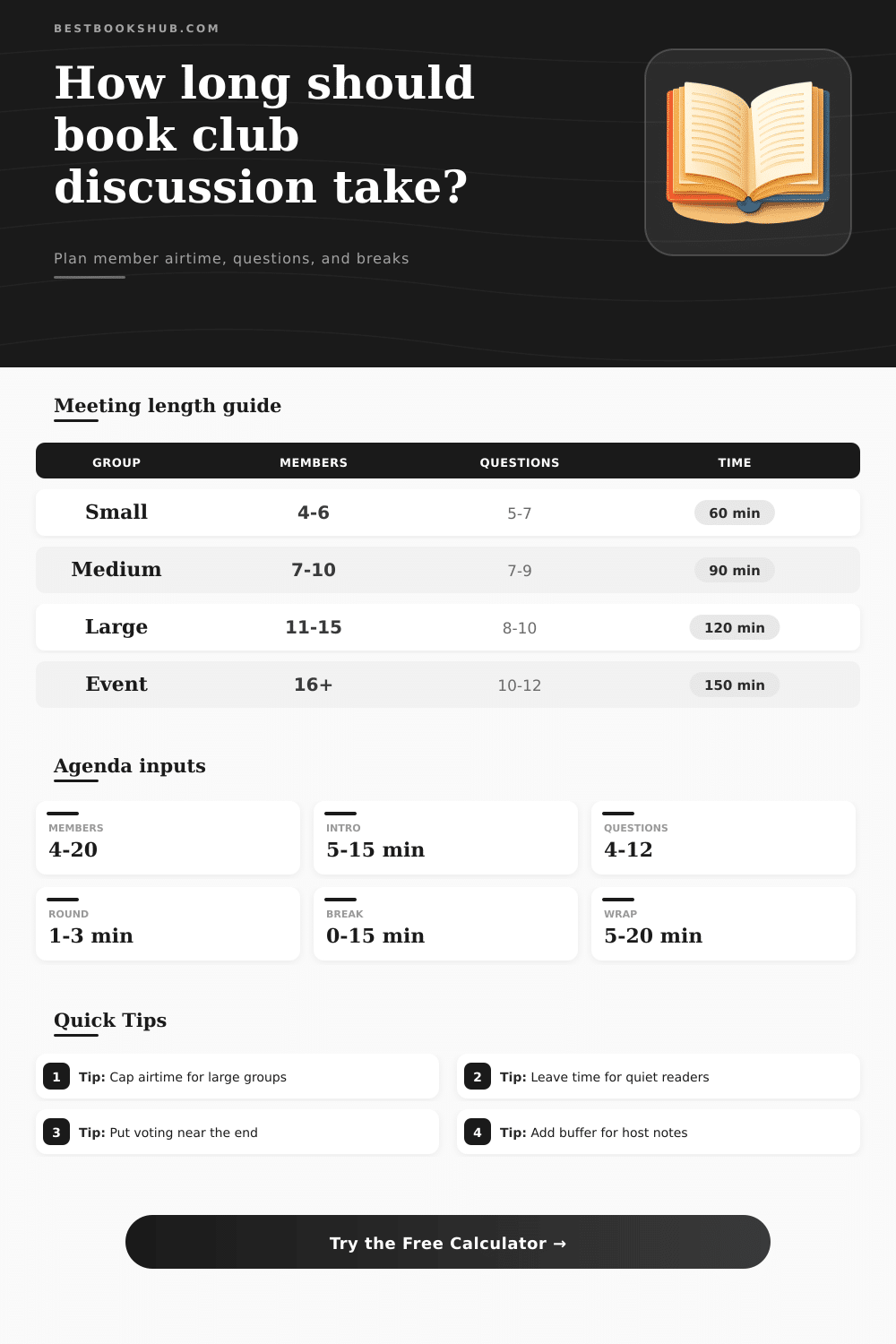
| Meeting format | Typical members | Question count | Recommended window |
|---|---|---|---|
| Quick lunch discussion | 4 to 8 | 3 to 5 questions | 45 to 60 minutes with little social buffer. |
| Monthly home book club | 6 to 10 | 6 to 8 questions | 75 to 105 minutes with time for ratings and next pick. |
| Deep-dive literary discussion | 5 to 12 | 8 to 12 questions | 105 to 150 minutes when close reading is expected. |
| Library or public event | 12 to 25 | 6 to 10 questions | 90 to 150 minutes with stricter facilitation. |
| Question depth | Minutes each | Best use | Timing note |
|---|---|---|---|
| Light reaction | 4 minutes | Favorite scenes, quick ratings, first impressions. | Good for short meetings or large groups. |
| Balanced discussion | 6 minutes | Theme, character, plot, and reader response prompts. | A reliable default for most clubs. |
| Deep exchange | 8 minutes | Symbolism, structure, ethics, and disagreement. | Use fewer questions to avoid rushing. |
| Seminar pace | 10 to 12 minutes | Close reading, passages, or facilitated debate. | Best when the host actively redirects tangents. |
| Agenda block | Typical time | Use when | How to keep it balanced |
|---|---|---|---|
| Welcome and context | 3 to 15 minutes | Members arrive, host frames the book, or guests need orientation. | Name the stop time before moving into questions. |
| Opening check-in | 30 seconds to 2 minutes each | You want every reader to speak at least once. | Ask for one word, one quote, or one rating. |
| Main discussion | 45 to 100 minutes | The club wants theme, character, craft, and reaction time. | Prioritize must-ask questions before optional prompts. |
| Wrap-up and next pick | 5 to 20 minutes | Ratings, next date, voting, snacks, or host handoff are needed. | Separate logistics from final book reactions. |
DISCLOSURE: This post may contain affiliate links, meaning when you click the links and make a purchase, I receive a commission. As an Amazon Associate I earn from qualifying purchases.
One of the biggest pitfalls with any book club is bad time-keeping. The host wants to ask some good questions about novel’s theme and protagonist’s moral ambiguity. But halfway through, they’ve gotten three people to talk. Everyone else in the group look at their watch and keeps smiling politely. What happened? No one accounted for the fact that it will take twelve people eight different opinions on a single paragraph.
Book club discussion time calculator eases this anxiety and turns an uncertain hope into real schedule. It helps ensure meetings don’t blow past midnight, and everyone get their chance to chime in.
How to Plan Your Book Club Time
But here’s the thing: Group dynamics are nonlinear. Two people do not equal two minutes of talk. Because they create a new geometry for the conversation. The way it works: You give it your expected number of members and their expected level of participation. The tool accounts for the fact that not everybody will be talking all the time, or staying absolutely quiet. Seventy-five percent participation feels lively; more than that gets chaotic. This prevents host from underestimating amount of airtime required to check in with everybody.
That round-robin intro can be quick. But if you omit it, then you’ll think you still has plenty of time to dive into the deeps. You won’t. That early airtime establishes the atmosphere; it lets quieter readers get a word in edgewise before meat of the convo begins.
Most clubs come unstuck on this one: the depth of their questions. Sure, planning five questions seems like it’ll be easy to run through them in an hour. But if the questions themselves are open-ended (“What’s X trying to get at?” “What do you think it means when Y does Z?”), then they’ll eat up all that time and more. The calculator helps you distinguish between light reactions and seminar-style debates. More time, fewer questions? That suggests you’re going for the former; a few minutes per question is a generous amount (since you can keep things moving) if you prefer a quick discussion over lunch. Before you even begin the discussion, you have to pick the appropriate average minutes per question to determine what type of conversation you realy want to have.
The silent killer of any meeting schedule are side conversations. At an informal home gathering, people will drift into the kitchen to get some snacks (or to mutter about irrelevant plot points) as the host speak. It’s not pessimistic to add a buffer for tangents, it’s realistic. Ten percent provides enough slack so natural social friction doesn’t cause the conversation to spiral out of control, but it still gives space for side conversations to happen. Otherwise, every minor tangent seem like a derailment. If there’s slack in the schedule, then the conversation just flows and the host won’t feel compelled to act as the traffic cop, cutting across every pleasurable exchange.
Wrap-up time and breaks deserve same respect as the main discussion. When there’s good momentum going in the middle of the night, rushing through the final round of voting can kill it. You need roughly ten minutes to vote on what you’re reading now and discuss what you’ll read next; this amount of time don’t feel like work. And if you don’t have it, then the decision portion will bleed over into your socializing time, prolonging the end of the evening. These logistical pieces are included when you get the total meeting time from the calculator so you know exactly how much time you’ve got for actual literary analysis versus the administrative chatter.
Planning a book club meeting is all about finding your balance between spontaneity and structure. You need just enough framework so that things don’t fly off the rails, but still have the flexibility to allow for interesting tangents. This isn’t a replacement for the human part of facilitation, after all, it won’t make people more willing to talk! But it takes the guesswork out of how long each of these will take.
How do I know if we’ll have time for discussion at all? That’s what makes the difference between a meeting that feels rushed and forced, and a night with friends that you remember having fun. It should of been more organized, but it was still better than most.