📚 Shared reading planner
Group Read Deadline Calculator
Turn a shared book deadline into pages per reading day, member time, checkpoint pages, catch-up margin, and a practical group pace warning.
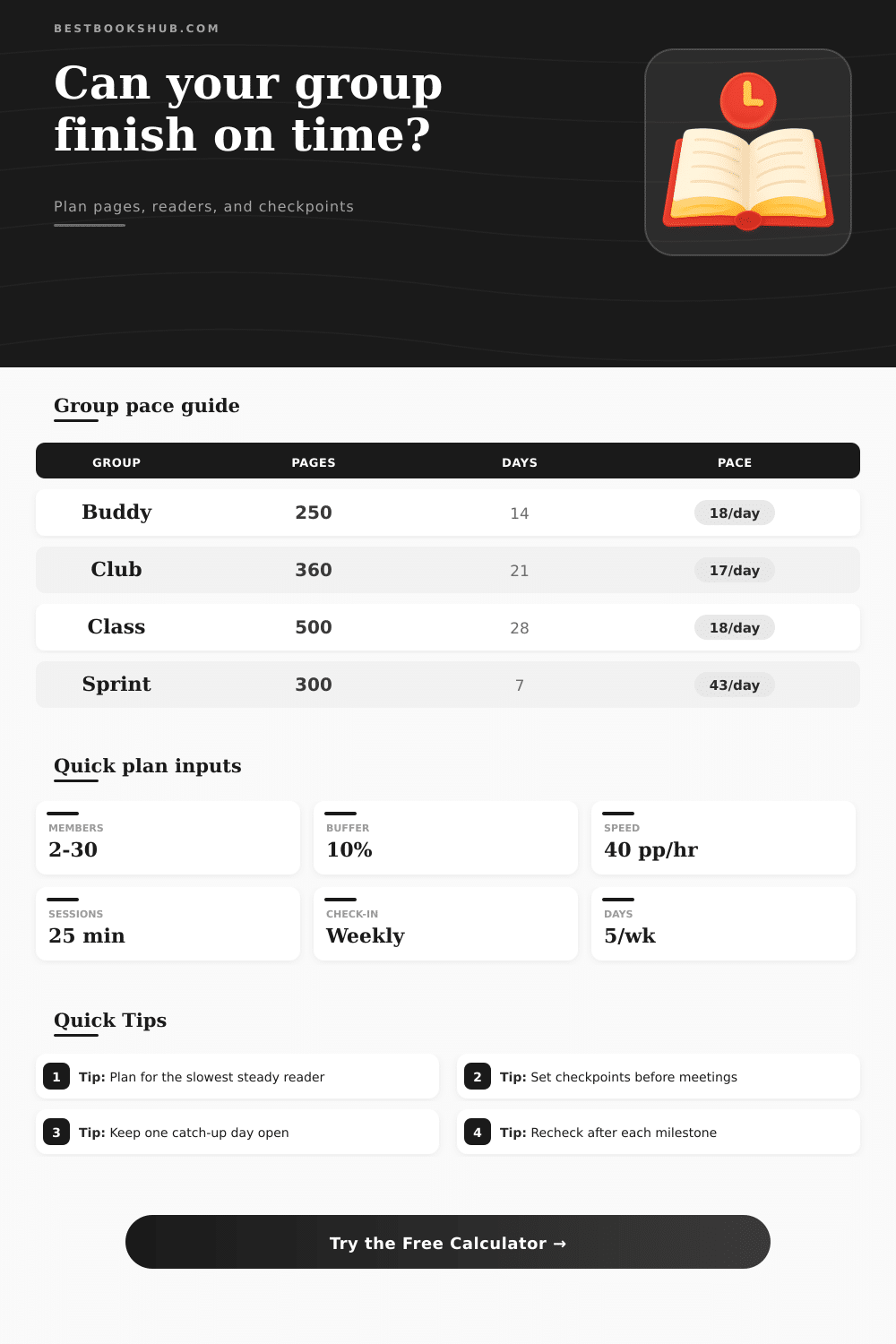
| Group format | Typical members | Deadline window | Planning method |
|---|---|---|---|
| Buddy read | 2 to 3 readers | 7 to 21 days | Use short check-ins and a modest buffer because scheduling is simple. |
| Monthly book club | 6 to 12 readers | 21 to 35 days | Plan for the slower steady reader and set one weekly milestone. |
| Class seminar | 10 to 30 readers | 14 to 42 days | Use firm page checkpoints so discussion can track assigned sections. |
| Research circle | 4 to 10 readers | 14 to 56 days | Add density and annotation factors before judging the schedule. |
| Weekend sprint | 2 to 8 readers | 2 to 5 days | Use daily page targets and no vague catch-up assumptions. |
| Book type | Planning speed | Group slowdown | Best buffer |
|---|---|---|---|
| Light fiction or reread | 55 to 75 pages per hour | 0% to 15% | 5% schedule buffer. |
| Standard novel or nonfiction | 35 to 55 pages per hour | 15% to 30% | 10% schedule buffer. |
| Dense literary text | 25 to 40 pages per hour | 30% to 50% | 15% schedule buffer. |
| Academic or technical book | 15 to 30 pages per hour | 30% to 50% | 20% schedule buffer. |
| Pages remaining | 7 reading days | 14 reading days | 21 reading days |
|---|---|---|---|
| 200 pages | 29 pages/day | 15 pages/day | 10 pages/day |
| 320 pages | 46 pages/day | 23 pages/day | 16 pages/day |
| 450 pages | 65 pages/day | 33 pages/day | 22 pages/day |
| 600 pages | 86 pages/day | 43 pages/day | 29 pages/day |
| Checkpoint rhythm | Best for | Page target style | Host note |
|---|---|---|---|
| Every 3 days | Sprints and short books | Small page batches | Useful when missed days quickly compound. |
| Weekly | Most clubs | Chapter or section targets | Easy to pair with group messages or meetings. |
| Every 10 days | Longer novels | Large section targets | Works when readers dislike frequent check-ins. |
| Every 2 weeks | Slow reads | Part-level targets | Needs extra reminder time near the end. |
DISCLOSURE: This post may contain affiliate links, meaning when you click the links and make a purchase, I receive a commission. As an Amazon Associate I earn from qualifying purchases.
There’s a particular sort of social anxiety that book clubs engender, and you know exactly what I mean: it begins with coffee and pleasantries until someone says we should discuss previous chapter, and then that awful pause follows as people look around wondering who read it. Half have yet to reach page forty; they’re the ones staring at their shoes. The other half read past the three thematic annotations and they’re chomping at the bit to take charge.
You can’t realy blame anyone for being lazy. Usually, it just comes down to poor pacing. Typically, a group will select a random end-date and assume people will pace themselves between today and whenever-that-is. Human attention span do not align with calendar dates. After you plug in your page count and desired finish date, it spits out the answer (above).
How to Plan Your Book Club Reading
No more guesswork on conversions and coefficients, the calculator does the math for you. It also breaks it down into manageable daily targets that account for real life. Small changes in your assumptions have large swings in terms of whether or not your goal is feasible, so think carefuly about how you set them.
Density factor are probably the most important input here. A fast feel feels fast if your chapters is short and your book is a light novel. But that same book with dense footnotes can drain your reading speed, big time. If you treat a technical manual like a beach read, your daily page target will look achievable on paper while actualy requiring three hours of focus every evening. Your daily page target looks achievable on paper… But actually takes three hours of focused reading every night. That’s the kind of mismatch that makes people give up halfway through.
But there is an important caveat with the buffer percentage. Ten percent might sound like plenty, but then you remember: life happens. Work demands, sick kids, an extra low-energy week; all will eat away at zero margin schedules, wiping them out in no time flat. The tool accounts for catch-up days, and thus the last meeting isn’t just a summary meeting for those who fell behind. You’re effectively purchasing time insurance against natural friction in adult schedules.
It also factors in group dynamic. If it’s a big seminar class, you can’t expect people to move along based off peer pressure; it just won’t happen as much when people are anonymous and responsibility is spread thin. With a little buddy read, social shame is personal and instant. This is expressed in the page’s table of references, which recommends various planning styles depending on format. Checkpoints with teeth tend to be most effective if there isn’t one person hosting who can keep tabs on everyone. In small circles, a looser, week-to-week check-in tends to do the trick.
The most common error is under-planning based off your own reading rate. Don’t do that. Plan for the slowest member of your crew (whoever that happens to be) who’s consistently present and reading steadily. Not that you should of drag the whole group down to a snail’s pace, but you need to recognize that people reads differently. For instance, if you usually read at sixty pages an hour, but your buddy read at only thirty, don’t aim for fifty-five, they’ll fall off the wagon in two weeks flat.
To make up for it, the calculator lets you input a “planning factor for slower readers,” which will force you to sacrifice some speed now so you can catch up later. Daily counts aren’t as important as checkpoints. Ten pages per day sounds like nothing and can be easily skipped. Page 50 by Tuesday is concrete. If I miss my checkpoint I see the gap and adjust before it’s too late. Seeing the hole helps us avoid panicking. It lets us make small changes that add up, instead of thinking only in terms of passing or failing.
That becomes your final output: a risk meter showing how much time you need compared to what members have in their day. When this goes up, don’t just look away. Instead, add another day for reading (or trim down on the finish line goal and ask members to skim the remaining pages). You want to protect the quality of the discussion over perfect coverage. Members will get far more out of a shared experience if they arrive with a full enough picture to contribute fully. Don’t sacrifice the conversation because you’re afraid it isn’t pacing perfectly.
Set the pace, trust the buffer, and have fun with the book, even if you peek at your shoes as the questions begin.