📚 Reading backlog lab
TBR shrink rate calculator
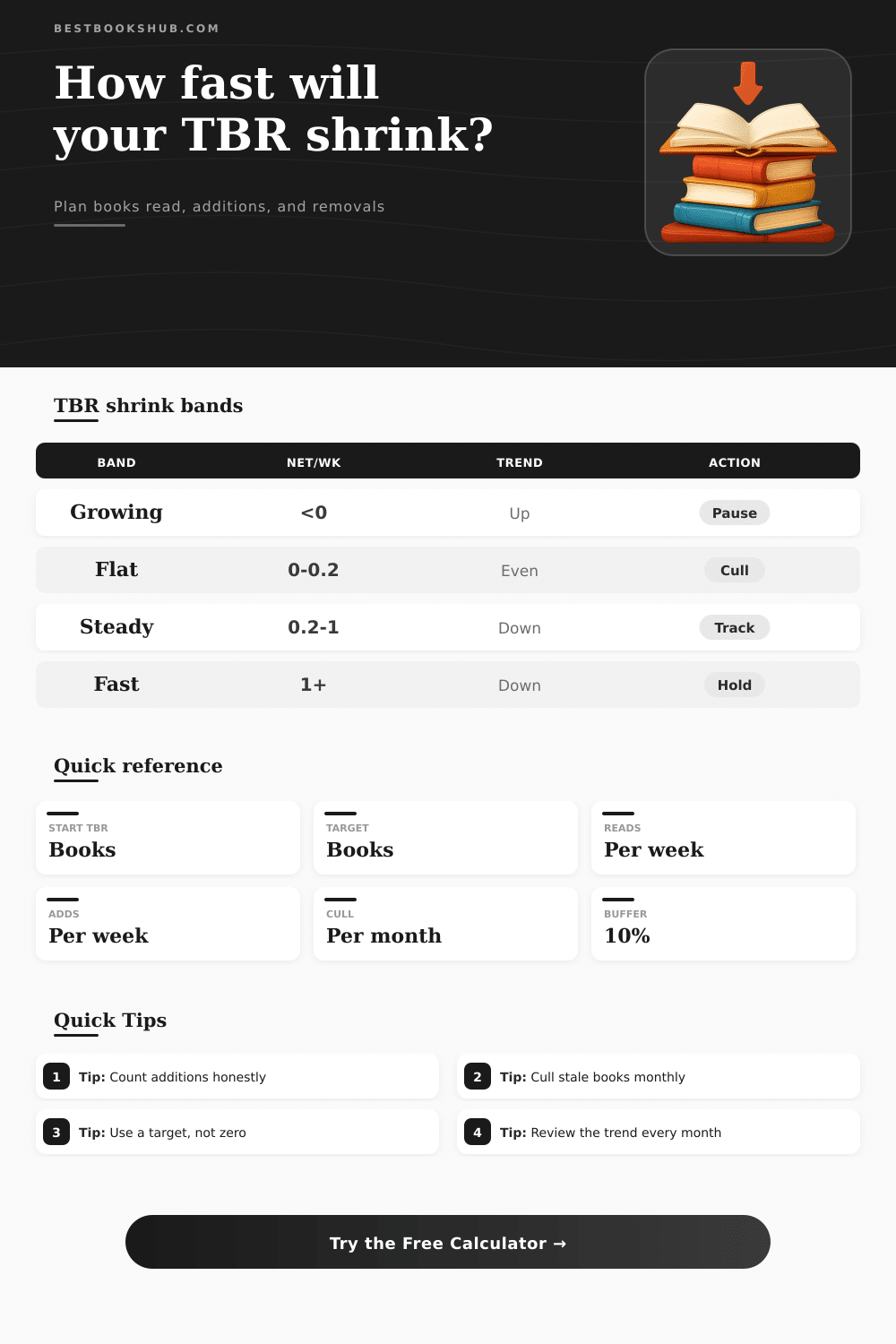
Estimate whether your to-be-read pile is shrinking, holding steady, or growing by balancing completed books, new additions, removals, and a realistic target shelf size.
Use weekly rates for reading and buying. The calculator converts monthly removals into a weekly shrink contribution.
| Net weekly shrink | Monthly change | Meaning | Practical adjustment |
|---|---|---|---|
| Less than 0 | TBR grows | Additions exceed completions and removals. | Use a buying pause or raise cull rate before adding reading pressure. |
| 0 to 0.2 books | About flat | The pile barely moves over normal life noise. | Set a monthly review and remove stale titles that no longer fit. |
| 0.2 to 1 book | 1 to 4 books down | Steady, sustainable shrink for most readers. | Keep the pace and avoid compensating with extra acquisitions. |
| 1 book or more | 4+ books down | Fast shrink that can work for short resets. | Check whether the reading rate is realistic past one month. |
| Reader profile | Finished per week | Additions per week | Likely TBR trend |
|---|---|---|---|
| Casual reader | 0.5 to 1.0 | 0.2 to 0.6 | Shrinks if monthly culling is consistent. |
| Book club reader | 1.0 to 1.5 | 0.5 to 1.0 | Stable when club picks replace impulse additions. |
| Reviewer queue | 2.0 to 4.0 | 1.5 to 4.0 | Often flat unless incoming requests are capped. |
| Student term | 1.5 to 3.0 | 0.2 to 0.8 | Shrinks quickly, but pages are usually harder. |
| Shelf reset | 1.0 to 2.0 | 0 to 0.2 | Fast shrink during a planned no-buy window. |
| Planning horizon | Good use | Watch point | Best metric |
|---|---|---|---|
| 4 weeks | No-buy month or short library cleanup. | One unusually busy week can distort the result. | Books actually removed from the pile. |
| 13 weeks | Seasonal reading target or quarter reset. | New releases can inflate additions. | Net shrink per week and projected TBR. |
| 26 weeks | Half-year shelf audit and reading goal check. | Interest changes make old targets stale. | Target date plus page load. |
| 52 weeks | Annual backlog planning. | Long estimates need a bigger buffer. | Monthly trend, not exact final date. |
DISCLOSURE: This post may contain affiliate links, meaning when you click the links and make a purchase, I receive a commission. As an Amazon Associate I earn from qualifying purchases.
The problem with a large to-be-read pile isn’t the books themselves. Not at all. What’s wrong is that most people believe it’s solvable by willpower. You’ve got one of those new releases and swear to read through three backlist before diving into it. And then something else happens. Again.
The shelf become a warehouse rather than an inventory; your stack of unread books becomes a backlog. When you’re struggling with a big TBR, most readers assume they just need to read more. They couldn’t be more mistaken. If you don’t consider how fast new books enters your collection, reading faster will only make the problem worse.
Control Your Book Flow, Not Just Your Reading Speed
The calculator does the math for you as soon as you input your habits and pace. You won’t have to guess whether your strategy is just busy-looking and ineffective or actualy getting results.
Consider it like this: Imagine that you have a reservoir. There’s a tap running in one end, and there’s an outflow on the other. Regardless of how quickly you’re bailing water with a cup, the reservoir will stay full if the tap are turned all the way up.
What does the tool ask? How many books do you add per week vs. How many finished book do you have each week? That’s your net flow. Your habit-forming happens in tiny increments every day. Cull once a month and it becomes a single contribution per month. Contribute too little and you won’t notice until the next release land.
Take the example of a book club reader versus a casual one. One reads two books a week, gets them from publisher (multiple copies) or purchases additional titles related to their discussion. Although they have great reading statistics, their TBR never seems to shrink. The other person reads half a book per week and maybe adds a couple of titles a month to their pile. If they remains steady, this will eventually lead to a drop. Neither is doing anything wrong. They’re balancing their equation out.
If you find that your shrink rate is negative, then it means you’re inputting more than you’re outputting. That doesn’t necessarily mean you should start reading quicker. Maybe you just shouldn’t buy anything for awhile. The overlooked tool in reading management is a buying pause. This give you instant headroom and requires no superhuman endurance.
On the page, I have a reference table that shows this. It demonstrates that a brief pause will change the trend from growing to steady. If your shelves aren’t emptied during the pause (e.g., four weeks), then at least the bleeding has stopped. Paired with regular removals, the net shrink rate becomes positive. Think of this as keeping the outlet open and shutting down the inlet, the water level naturaly falls.
Trying to get down to no books typically burns you out. The naked bookshelf deprives you of your buffer zone: if someone gives you a book, or you just have to buy one on impulse, what then? Set yourself a level that is reachable. You might be fine with thirty or even forty books that can keep things ticking over but still don’t cause a sense of psychological pressure.
The calculator will show you a projected date that includes room for leeway and life’s interruptions, it’s not a pipe dream. It won’t make you read fast. It will help you stay sane.
2) Format
Most people don’t realize how much this affect speed. Ebooks and audiobooks are lighter (in both weight and format). Because they don’t take up any physical space, it is easy to buy too much. Academic materials and textbooks are harder to process. They slow your completion rate no matter what their page count is. Your average pace will swing wildly if you bounce between formats.
For planning purposes, use one dominant format during the planning period. You’ll get accurate estimates; the tool accounts for these differences with an option to specify your main reading medium.
Don’t just review your stats when it’s too late, do it monthly. Reading is a rhythm that gets disrupted by life noise. One crazy week messes up all your long-term predictions. Do you really throw out what you won’t ever reread? If you don’t, then your culling input is higher than it should of been. These numbers are easy to bullshit on. Be honest with them and they’ll change everything.
The goal isn’t to clear the shelf. It’s to control the flow. When you know how many things you take in vs complete, you stop feeling guilty about the pile. And it transforms from something that gives you anxiety into a straightforward logistical issue. You’ve got the info. All you’re missing is the discipline to ease back on the inlet.