⏱ Sprint drafting lab
Writing Sprint Word Count Calculator
Plan timed writing sprints from your target words, sprint length, break rhythm, drafting speed, current progress, and safety buffer.
Load a realistic timed-writing setup, then edit the goal, progress, sprint length, break time, pace, and buffer.
| Sprint | Target words | Cumulative | Clock mark | Use |
|---|
| Sprint length | At 12 WPM | At 24 WPM | At 36 WPM | Best use |
|---|---|---|---|---|
| 10 minutes | 120 words | 240 words | 360 words | Warmup, notes, recovery blocks. |
| 15 minutes | 180 words | 360 words | 540 words | Scene starts and tight schedule gaps. |
| 25 minutes | 300 words | 600 words | 900 words | Classic focused drafting block. |
| 45 minutes | 540 words | 1,080 words | 1,620 words | Longer flow state or chapter work. |
| Project target | Typical goal | 25 min at 20 WPM | Sprints | Planning note |
|---|---|---|---|---|
| Flash scene | 750 words | 500 words | 2 | One quick pass plus wrap-up. |
| Essay section | 1,200 words | 500 words | 3 | Use breaks for source checks. |
| Novel chapter | 2,500 words | 500 words | 5 | Split by beats or scenes. |
| NaNo daily goal | 1,667 words | 500 words | 4 | Add buffer for slower scenes. |
| Focus profile | Pace factor | When to choose | Target behavior | Watch point |
|---|---|---|---|---|
| Warmup | 0.75x | Starting cold or drafting notes. | Lowers words per sprint. | Do not judge final pace from this. |
| Steady | 1.00x | Normal planned writing session. | Uses entered WPM directly. | Best for repeatable goals. |
| Hard scene | 0.65x | Research, emotion, or structure is heavy. | Protects against inflated goals. | May need extra cleanup time. |
| Fast outline | 1.15x | Clear beats and little checking. | Raises expected output. | Stop before accuracy drops. |
DISCLOSURE: This post may contain affiliate links, meaning when you click the links and make a purchase, I receive a commission. As an Amazon Associate I earn from qualifying purchases.
When you have a deadline, and your document isn’t written yet, it causes some panic. There’s no clear plan, and now you has a big job to do with no roadmap. Will an hour get you finished? Or will it leave you spinning your wheels? Structured writing sprints fix that. They transforms overwhelm into time blocks for writing.
The reason most of us don’t write is not that we can’t write. It’s because we don’t schedule the amount of time needed for those block. We tend to overestimate how fast we’ll be able to draft and underestimate how difficult drafting are. It’s all about the numbers. You put them in. The calculator does the math.
How Writing Sprints Help You Finish
You enter your total word goal and subtract whatever you have already written, giving you a clean number to work against. It starts by forcing you to define your target clearly, which is harder than it sounds because we often confuse what we want with what we can produce. That way you really has a chance of knowing what you’ll accomplish and it gets rid of a bunch of wishful thinking. You plug in how many words you need to hit, minus what you’ve got, and you get an exact number to aim for.
This is where everyone fails. They assume their typing speed on one website equals their drafting speed in real life. That is a bad assumption. Writing prose takes thought. Checking facts, moving around complex scenes, all of this make you go much slower then your typing speed ever was. The pacing input allows you to plug in your actual drafting pace. This way, the output reflects what will actualy happen, instead of what you hope will happen.
It has customizable profiles so you can take fatigue and focus into account. If you’re working on a particularly heavy research scene or some emotionally hard scene, you’ll set yourself a more challenging profile. That reduces how much they expects out of you per minute. There is no use in setting an unreachable goal and giving up early. It may sound like a minor tweak to the settings but it makes all the difference to your mental stamina.
Before you’ve even sat down to write, you allow yourself grace. You also factor breaks into your overall timer. Twenty-five minutes of writing followed by a five-minute break isn’t wasted time. It’s important maintenance that ensures your brain doesn’t give up and go mushy halfway through. You’ll see that ignoring this rest time in your schedule will make you spend three hours fiddling around when you could of spent two hours making solid progress.
Now it shows you precisely how long it will take and how many sprints that entails. If the time is longer than you have, then you instantly know you’ll need to increase your pace, trim some words, or lengthen the session. Without any doubt, there’s no more fuel for the fire of procrastination. You won’t fret over whether you’ll get it all done; you will just execute the plan you can plainly see before you.
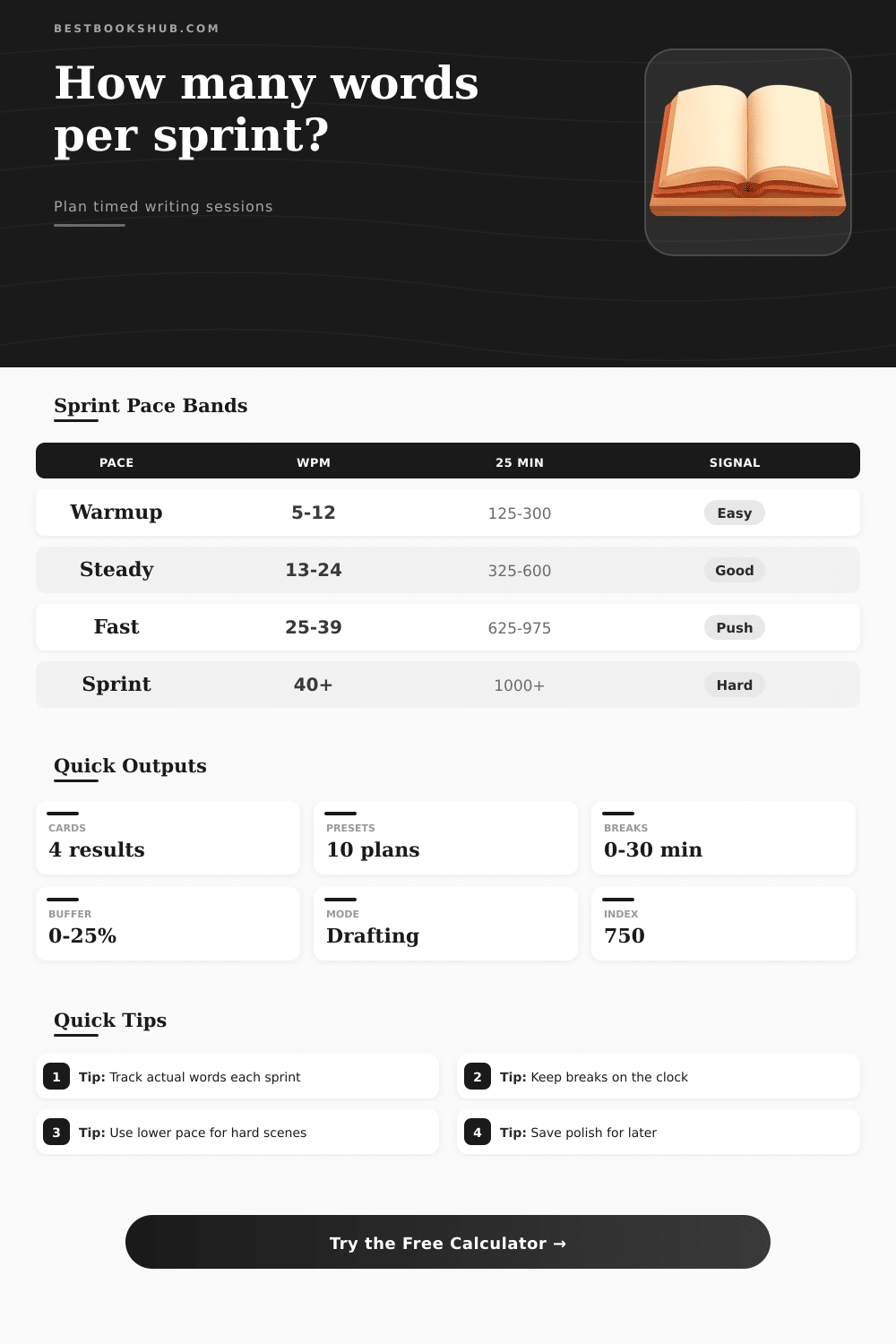
To show this further, the page contains some reference tables showing how varying sprint lengths affect output at different speeds. For instance, doing a twenty-five minute block at warmup pace produces much less than one performed at a steady pace, emphasizing the importance of establishing a flow state as fast as possible. That’s not to say this is just a speed sprint. No, a writing sprint is a way of creating a structure around which it can be done when you don’t feel like it.
Writing becomes one measurable variable (time) rather than another (output). The emotional load of what you’re doing leaves the page. You aren’t wrestling with the blank screen anymore; you’re putting stuff into pre-designed slots on a schedule you made yourself. The challenge doesn’t go away, but now there’s a route up it. And that’s the distinction between looking at the wall and being on top of it.