⏱ Timed drafting lab
Sprint Speed Calculator
Measure writing sprint speed from starting words, ending words, deleted words, sprint minutes, break time, focus type, and a personal target pace.
Load a realistic writing sprint, then adjust the word counts, active minutes, break minutes, focus profile, and target WPM.
| Repeat plan | Active time | Break time | Projected net | Clock mark |
|---|
| Pace band | WPM range | 25-minute output | Best use |
|---|---|---|---|
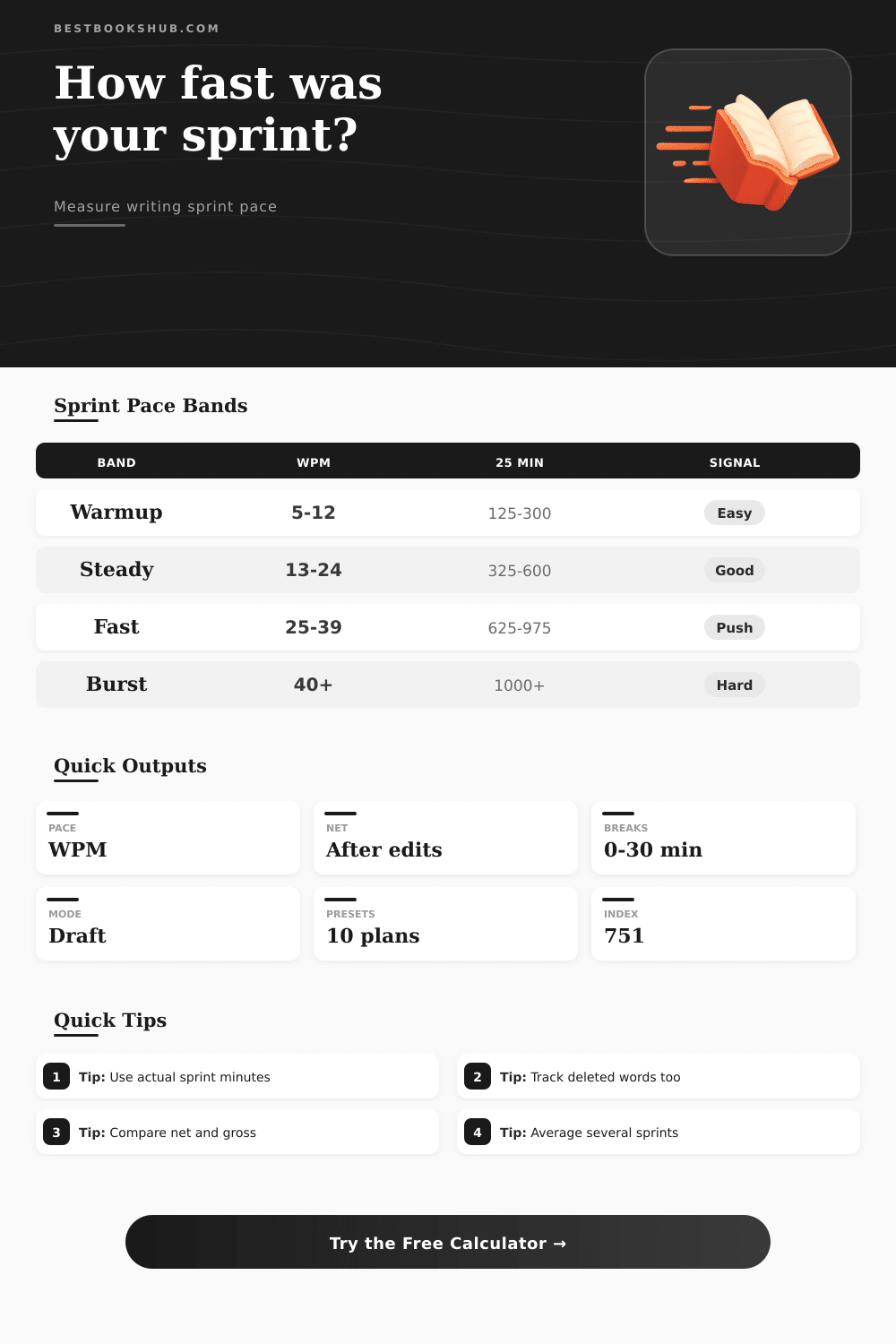
| Warmup | 5 to 12 WPM | 125 to 300 words | Starting scenes, journaling, unclear notes, or cautious revision. |
| Steady | 13 to 24 WPM | 325 to 600 words | Most sustainable drafting when quality still matters. |
| Fast | 25 to 39 WPM | 625 to 975 words | Outlined passages, familiar arguments, and clean momentum. |
| Burst | 40+ WPM | 1,000+ words | Voice draft, low-edit freewrite, or deadline push. |
| Sprint length | At 15 WPM | At 25 WPM | At 40 WPM |
|---|---|---|---|
| 10 minutes | 150 words | 250 words | 400 words |
| 20 minutes | 300 words | 500 words | 800 words |
| 25 minutes | 375 words | 625 words | 1,000 words |
| 45 minutes | 675 words | 1,125 words | 1,800 words |
| Speed basis | Formula | What it reveals | When to use |
|---|---|---|---|
| Net WPM | New words / active minutes | Clean draft growth | Daily target planning and word-count goals. |
| Gross WPM | New plus deleted words / active minutes | Total drafting motion | Revision, rewrites, and churn-heavy scenes. |
| Session WPM | New words / active plus break minutes | Real clock pace | Calendar planning with breaks included. |
| Target ratio | Net WPM / target WPM | Pace fit | Comparing today with your usual sprint pace. |
| Writing context | Expected drag | Useful target | Planning note |
|---|---|---|---|
| Fresh scene | Medium | 15 to 25 WPM | Track net words and leave line edits for later. |
| Dense essay | High | 10 to 18 WPM | Research checks lower output but improve accuracy. |
| Rewrite pass | High | 8 to 16 WPM | Deleted words matter, so compare net and gross. |
| Dictation draft | Low | 35 to 70 WPM | Plan cleanup time after the fast pass. |
DISCLOSURE: This post may contain affiliate links, meaning when you click the links and make a purchase, I receive a commission. As an Amazon Associate I earn from qualifying purchases.
Don’t mistake writing speed for a character flaw. When you’re not cranking out pages, you’ll think something went wrong with your brain. Your discipline dissapears. But that’s not true. Writing fast isn’t an indicator of talent. It’s an indicator of friction. Plug some numbers into the page and see how math works out. Don’t confuse the number of words with anything other than friction. Don’t confuse the number of words you actualy typed with the number of words that remains in draft.
Planning also misses the distinction between gross and net output: gross speed counts all the characters you type before you backspace; net speed counts only those that survive the process. If you’re editing a sloppy first draft or trying to rewrite something dense and argumentative, gross speed are important. Even a session with no net gain (in fact), especially such a session, can reflect productive work. Maybe you eliminate three hundred words to make one sentence clearer, which appears as failure on a net chart but reflects high-effort editing work. That’s why the calculator records your deletions separately.
Your Writing Speed Is Normal
Five to twelve words per minute is usually considered the warmup period. It might seem slow, but it’s your brain waking up for writing. If you try to write quickly right out of the gate, you tend to get blocked and start self-editing, killing your momentum. By taking a low-stakes ten minutes to clear mental clutter, you don’t judge what comes out. Then as friction goes away, a steady band forms.
Most sustainable prose lives somewhere between thirteen and twenty-four words per minute. That’s fast enough so that ideas flow freely but slow enough to have some quality control over what happens on paper. This is good for drafting every day when you have a deadline months away. To write 40+ words per minute, certain things must be true. Voice dictation works, and so does outline-style writing where you know each beat ahead of time. Otherwise, you can probably only keep up for a few minutes before slowing down to a crawl, no matter which method you’re using.
And even with a magic calculator that tells you how many sprints you’ll need to reach your word target, it doesn’t take into consideration the fact that you’ll slow down during your fourth sprint of the day compared to your first. This happens regardless of technique. When you factor in the time spent on breaks, they do more than just stop fatigue; they give the prefrontal cortex a chance to reboot. Without rest, your productivity diminishes and you end up spending an hour cranking out something you’ll need to rewrite anyways.
But how fast should anything be written? Speed depends on context. You could write thirty words per minute if you’re in a new scene where you know what’s going to happen. You could write ten words per minute if you’re doing some research-heavy essay about a complicated subject and has to check your facts along the way. Writing slowly isn’t wrong; in fact, it can be a sign of harder work. Thirty words per minute and ten words per minute aren’t comparable things, they don’t require similar mental resources.
This tool lets you choose a focus profile to provide context, which helps you remember that. To establish a good baseline, run through a few sprints over multiple days. Don’t let a freak high or low day skew your judgment; use all those numbers and take an average. That’s your true pace. It doesn’t matter that you had one really good day or one really bad day; it matters that you’re consistent across the entire length of the manuscript. Long manuscript > freak intensity.
After you’ve established your average net speed, you’ll be able to plot out a realistic timetable. Two-thousand words per chapter? Five-hundred is your average sprint? That means X number of concentrated sprints in front of you. No more “will I ever finish?” There’s no mystery to it anymore: just count ’em down to the sprints until completion.
Fast is good if fast is part of the narrative. Fast is bad if fast means putting out crap. Slow is good if slow is precise. Slow is bad if slow is a way of wasting time. The calculator is for managing time, not quality. Plan your work; set the timer; turn it off and write. Whether you watch the clock tick or not, the clock will tick.