✍ Writing pace lab
Words Per Writing Session Calculator
Estimate clean words per session, total sessions needed, weekly output, and finish dates from your writing pace, focus, break pattern, and project target.
Load a realistic writing block, then adjust every field. Presets cover careful drafting, fiction sprints, academic work, revision, dictation, and deadline sessions.
DISCLOSURE: This post may contain affiliate links, meaning when you click the links and make a purchase, I receive a commission. As an Amazon Associate I earn from qualifying purchases.
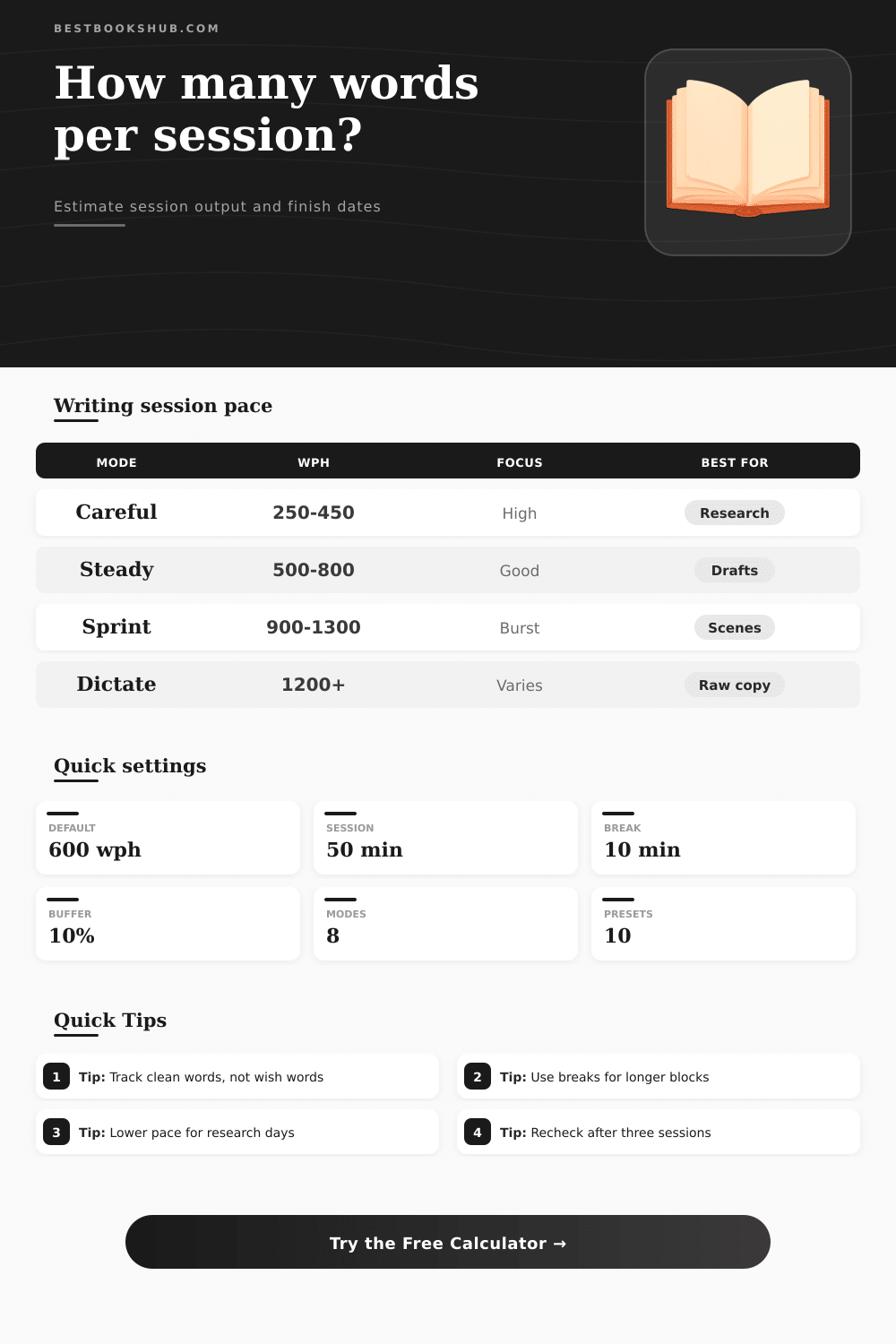
Use these tables to choose realistic pace, session length, and project assumptions before setting a writing target.
| Writing mode | Typical WPH | Quality rate | Best use |
|---|---|---|---|
| Careful drafting | 250-450 | 90-98% | Dense argument, citation work, difficult scenes |
| Steady drafting | 500-800 | 85-95% | Normal first drafts, chapters, essays |
| Timed sprint | 900-1300 | 75-90% | Outlined scenes, momentum blocks |
| Dictation draft | 1200-2500 | 60-85% | Raw drafting followed by cleanup |
| Session length | Net writing | Break cue | Planning note |
|---|---|---|---|
| 25 minutes | 20-24 min | After block | Good for busy days and low friction starts |
| 50 minutes | 42-48 min | 10 min after | Classic focus block for repeatable drafting |
| 90 minutes | 75-82 min | Midpoint break | Useful for deep work with a clear outline |
| 150 minutes | 120-135 min | Two breaks | Best reserved for weekends or deadline pushes |
| Project type | Target band | Difficulty factor | Session advice |
|---|---|---|---|
| Blog post / article | 800-2500 words | 0.90-1.00x | Short blocks can finish the draft quickly |
| Book chapter | 2500-6000 words | 1.05x | Use 3-8 sessions with check-in points |
| Novella / novel | 30000-90000 words | 1.20-1.35x | Protect cadence more than daily heroics |
| Thesis section | 5000-20000 words | 1.28x | Lower pace for source handling and revision |
| Weekly rhythm | Sessions | At 600/session | At 1000/session |
|---|---|---|---|
| Light habit | 2/week | 1200 words | 2000 words |
| Steady habit | 4/week | 2400 words | 4000 words |
| Workweek plan | 5/week | 3000 words | 5000 words |
| Draft sprint | 7/week | 4200 words | 7000 words |
Okay, so you probably didn’t get past Day Three (Chapter A Day). On Day One, you felt heroic. Day Two brought fatigue. Day Three convinced you that writing wasn’t for you. Data entry, yes. What about writing? No. Talent and discipline didn’t fail you here. Arithmetic did. Talent failed you here. Arithmetic failed you.
Writers fails because they mix up their intention with the work’s actual output. Sure, you might intend to write a book. But how many words per hour do you write? Until you know the answer, you’re flying blind. Why is this important? Because it’s math, baby; and math converts anxiety into data.
Use Math to Help You Write
Now, to use it: After plugging in a realistic length for each session, along with a realistic pace, the calculator does the rest (above). And the point here is, speed alone doesn’t matter much unless you know what it’s relative to. One thousand words per hour sounds pretty good… until you realize you had an outline so fleshed out you could type it up with both hands tied behind your back. Two hundred fifty words per hour? Seems like sloth time compared to a sprinter’s pace… except you was actually thinking carefully while you wrote, which tends to result in better copy, even if it took longer.
And that’s where the tool comes into play. By separating your pace from your focus efficiency rate and your quality rate, you can account for all those factors. It’s not just a guess at how long something will take. It’s a model for what your writing life is actualy like.
What are some of the factors that aren’t sexy but has an outsized impact? One is warm-up time: did you take ten minutes to reread what you wrote yesterday before you got back into the flow? Those words don’t count towards amount of new stuff you’re writing. That’s why the calculator leaves out any time you spent warming up or taking a break from working. It ensures that you’re not mistakenly thinking, “I’ve got this block of 50 minutes and I’ll write for 50 minutes.” Chances are pretty good that you won’t.
Another factor is the quality rate: Are you writing fast, but then deleting forty percent of it because it turned out to be nonsense? Your net output will be less than somebody who took longer to write but didn’t delete a single sentence. A reasonable word rate hold you accountable for how much junk you have to throw away.
Most folks don’t realize how important project type is. Writing a blog post feels like a linear rush different than, say, a novel chapter or a thesis section. The reference tables in the tool outline these difficulty factors. The tool has all this laid out in its reference tables, it’ll adjust your estimate accordingly if you’re working with complex citations vs. Raw scene drafts. Because, yes: typing speed decrease as cognitive load increases. You’ll write fewer words per hour if you must toggle back and forth between writing and fact-checking.
Your deadline shifts further into the future. Add up the weeks and see how they turn out. Then glance at the end-of-week output and estimated finish date. Say you were expecting next year, but actually wanted it done in two months. Bam! You need to adjust how many sessions you have each week (or how long they are), and the calculator just showed you that.
You can either write faster, which is hard to control, or write more often, which is a scheduling problem. Scheduling problems are easier to solve than talent deficits. Talent deficits are harder to adjust for then scheduling issues. For most writers, admitting that moderate, steady sessions will always beat infrequent bursts of inspiration should of been a given.
A bit of grace for this schedule comes from the buffer setting. Add 10 percent cushion and guard yourself against that week when life gets in the way and you skip two days. This one’s really important: Quit using willpower as a crutch to get through this writing project. Willpower is for getting started. Use math to cross the finish line.
Knowing that you have a precise number of words to write at each sitting take the burden off vague dread and puts it onto tangible goals. Now when you crack that document open, you don’t have to produce a masterpiece, you only have to write another six hundred words. And that little change is what turns quitters into September finishers.