✍ writing habit planner
Daily Writing Streak Calculator
Estimate current streak strength, daily word targets, catch-up load, finish dates, and buffer days for book drafts, essays, journals, and long-form writing projects.
Load a realistic writing scenario, then adjust the targets to match your current project and weekly routine.
| Daily target | 30-day output | 90-day output | Best fit |
|---|---|---|---|
| 100 words/day | 3,000 words | 9,000 words | Habit starts, journal notes, poetry drafts |
| 300 words/day | 9,000 words | 27,000 words | Essays, blog batches, low-pressure book drafts |
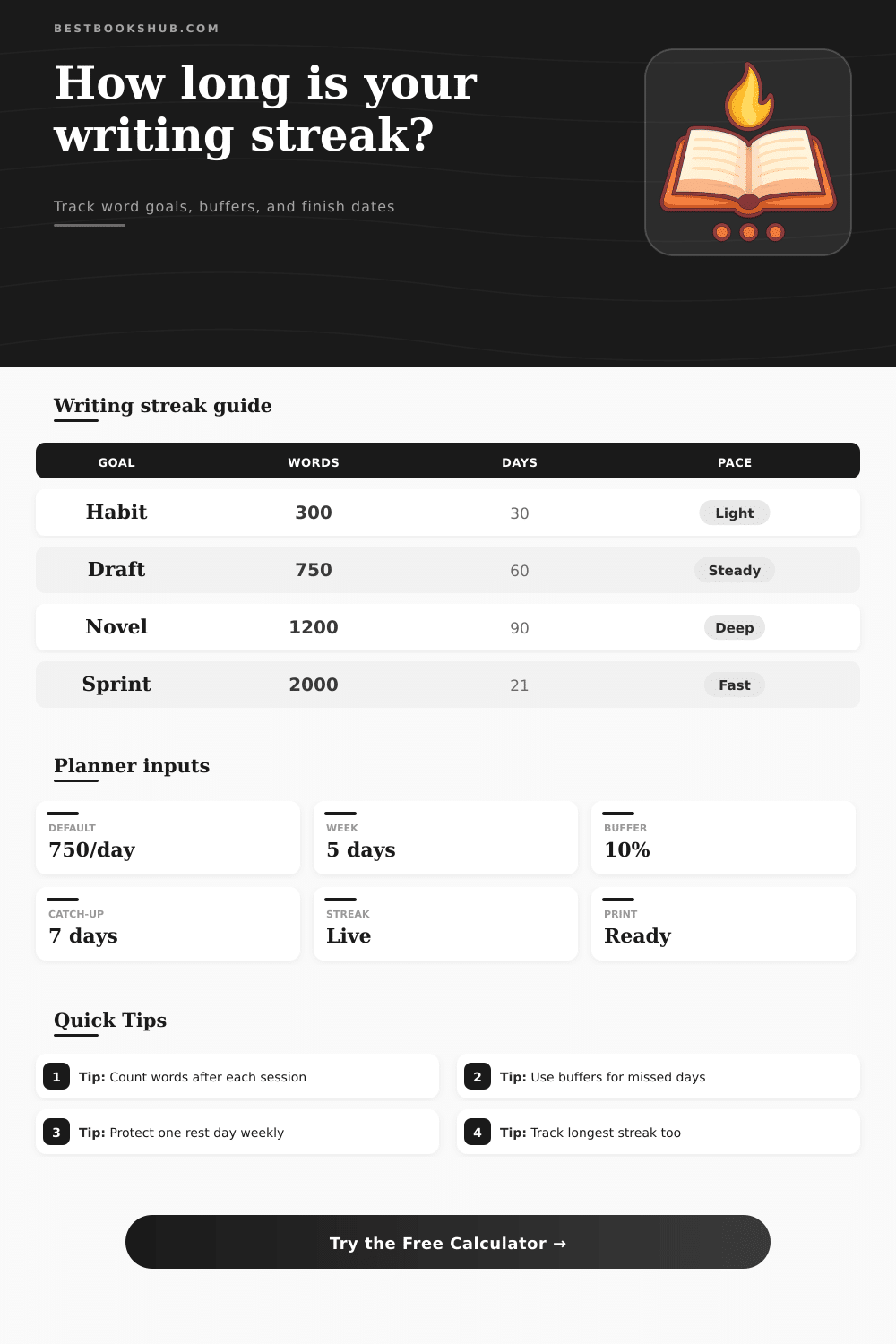
| 750 words/day | 22,500 words | 67,500 words | Steady manuscript drafting or thesis chapters |
| 1,667 words/day | 50,010 words | 150,030 words | Novel sprint pacing and challenge months |
| Project type | Typical word goal | Suggested streak rule | Buffer note |
|---|---|---|---|
| Daily journal | 100-500 words | Minimum action works well | Keep the threshold easy enough to repeat. |
| Essay or article | 1,500-6,000 words | Planned days only | Use a short catch-up window after missed days. |
| Nonfiction chapter | 5,000-12,000 words | Strict or planned | Add buffer for citation checks and restructuring. |
| Novel draft | 50,000-100,000 words | Planned days only | Reserve recovery days after heavy scenes. |
| Thesis chapter | 8,000-20,000 words | Planned days only | Revision days often need separate tracking. |
| Streak mode | Day counts when | Good for | Risk |
|---|---|---|---|
| Strict daily | The full target is met each calendar day. | Short challenges and habit resets | One missed day breaks the chain. |
| Planned days | A scheduled writing day meets the target. | Workweeks, classes, book deadlines | Requires honest scheduling. |
| Minimum action | A tiny fallback target is met. | Long-term habits and busy weeks | Can preserve streaks without enough draft output. |
| Freeze days | A protected day is spent instead of counted. | Travel, illness, deadlines elsewhere | Too many freezes hide a slipping routine. |
DISCLOSURE: This post may contain affiliate links, meaning when you click the links and make a purchase, I receive a commission. As an Amazon Associate I earn from qualifying purchases.
There’s something relieving about breaking a writing streak. There’s something wonderful about knowing that for days you’ve been waiting to make up your mind, and then finally, you do. And on the day you don’t write, you tell yourself: I’ll do it tomorrow. By the third day, discipline has begun to slip away. It becomes something you intend to do rather than something you actualy do, as it competes against email and laundry.
What separates the writer who writes every day from the one who doesn’t is not typically time. It might not even be talent. Most often, it’s structure. More precisely, it’s the capacity to accept forgiveness within context of a structure. Writing well all the time are impossible, but building a framework where failure is acceptable is possible. That’s possible.
How to Keep Writing Every Day
After plugging in your current progress and your daily target, calculator above does math. No need to guess which conversion factor or coefficient works best. You still have to figure out what “success” looks like for your project. But there’s no anxiety about whether you’re doing enough. Maybe you’re writing a novel, so fifty thousand words is your definition of success. Maybe you’re keeping a journal, and consistency trumps volume. Either way, the inputs make you put that difference in open, where it belongs.
Want to write seven hundred fifty words a day? Great! But let’s adjust finish date if you can only write three days a week. Because most writers fail on their aspirational schedule different than their actual schedule. You want to write every day. Your life has meetings. A plan that matches reality eliminate the guilt that normally comes when we break the chain.
Let’s talk about buffer days. This is such an underrated feature. People don’t realize how important it is until they are drowning in missed deadlines. Buffering isn’t lazy, it’s managing risk. There are days when your brain refuse to engage with dense citations. Those are the days you need a safeguard so you maintain momentum but don’t force something that requires many rewrites. That’s why the reference table on the page break down various project types and suggests what kind of streak rule you might use for each type.
You don’t mix it up because then you gets confused. Choose a lane and run with it till you’re at draft. Intuition also trips up when we try to catch up. We missed two days? Our first impulse is: Write twice as much (or three times!) today. But that burns you out, results in crappy work, and makes it more likely you’ll quit altogether. Spread the deficit out across the next seven days.
The tool will do math for you and let you know whether you’re catching up at a reasonable pace, or should of adjusted your deadline accordingly. If the catch-up suggestion puts you into thousands of words per day, it’s a sign you’ve got too high a target for your life-style. Time to lower the bar. Small but steady output trumps a heroic gesture which fizzles after two weeks.
Even if it is boring, protect your identity as a writer if you want long-term success. You may need several months to get back into the groove of things and write well. That’s okay. Your quality isn’t measured by the streak. Your quality is measured by your presence.
If you’re keeping track of how many days in a row you’ve written (and your longest previous streak) you allow yourself to begin anew without thinking you are losing out on anything. Broken chains are simply data. They indicate where you should tweak the plan: maybe add a few more buffer days. Maybe lower your word count per day. Perhaps accept that five days per week work fine for now.
Finally: This isn’t about reaching some arbitrary number on some arbitrary day. It’s about creating a life that allows for writing to flow naturaly, with no negotiation required. Let the projections serve as your guide, not your law. Celebrate if you finish early. Adjust your buffer if you’re running behind. Remember: The numbers exist to keep you honest, not to become the reason you stop putting pen to paper. Pick up the pen again when it snaps or when the chain breaks. Just don’t break the chain.