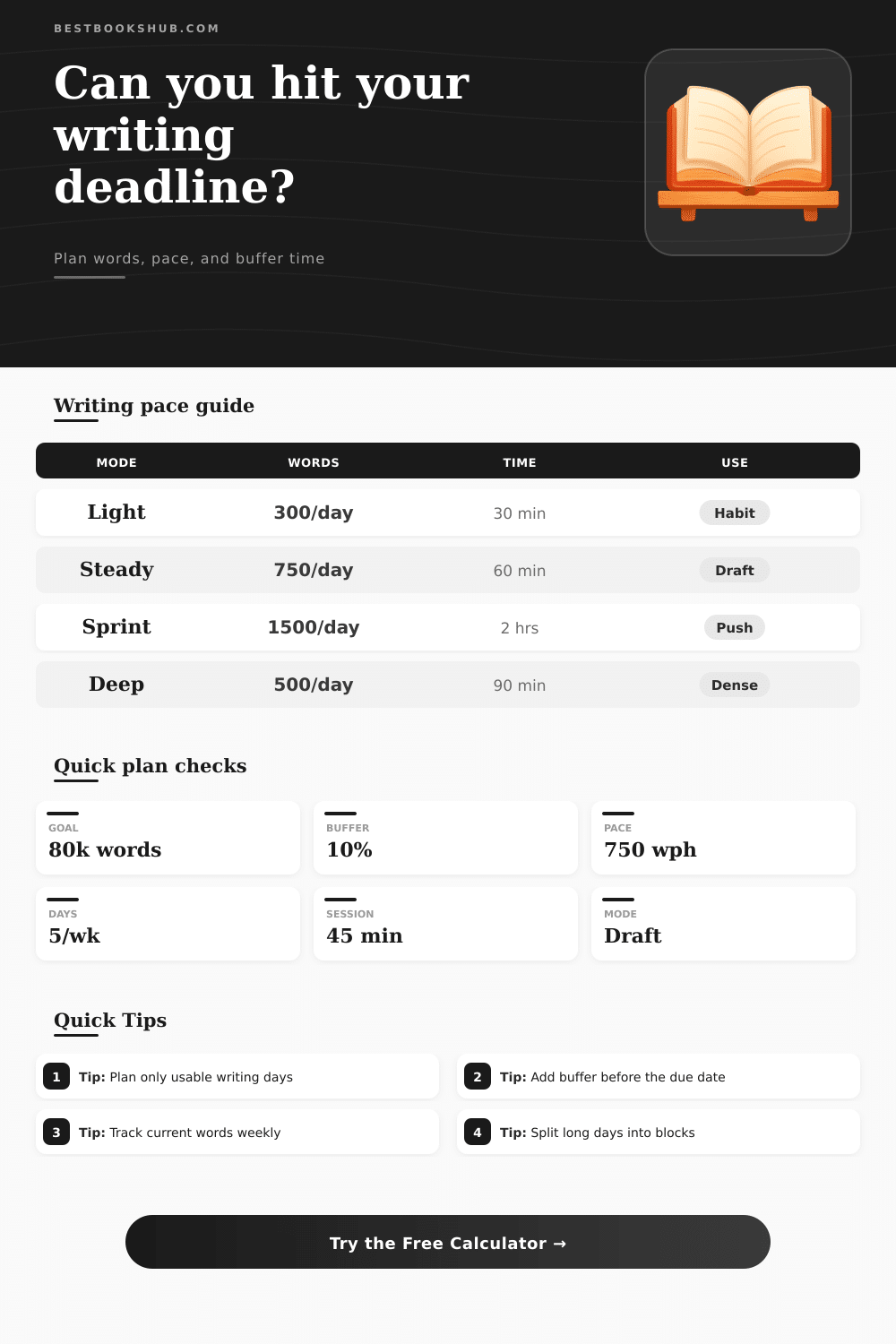
✍ Writing deadline lab
Writing goal deadline calculator
Turn a target word count, current progress, writing pace, weekly availability, and deadline into a daily word goal with buffer, sessions, and catch-up warnings.
| Writing situation | Typical net pace | Words in 45 min | Best planning use |
|---|---|---|---|
| Warm daily habit | 300 to 500 words per hour | 225 to 375 words | Low-pressure consistency and journal-style drafting. |
| Focused first draft | 600 to 900 words per hour | 450 to 675 words | Most fiction, nonfiction, blog, and chapter schedules. |
| Fast sprint draft | 1,000 to 1,600 words per hour | 750 to 1,200 words | Short bursts when the outline is already clear. |
| Research-heavy prose | 250 to 600 words per hour | 190 to 450 words | Essays, theses, technical notes, and sourced chapters. |
| Revision or polishing pass | 200 to 500 net words per hour | 150 to 375 words | Use when adding, cutting, rewriting, or finalizing text. |
| Deadline pattern | Suggested buffer | Session size | Why it helps |
|---|---|---|---|
| Blog post or newsletter | 5% time buffer | 25 to 45 minutes | Allows one cleanup pass before publishing. |
| Essay or class report | 10% time buffer | 45 to 60 minutes | Leaves room for citations and paragraph repair. |
| Chapter or book section | 10% to 15% time buffer | 45 to 90 minutes | Protects against scene gaps and structural edits. |
| Thesis or dissertation | 15% to 20% time buffer | 60 to 90 minutes | Accounts for sources, supervisor feedback, and rewrites. |
| Catch-up sprint | No or 5% buffer | 30 to 60 minutes | Useful only when the deadline is close and fixed. |
| Words remaining | 7 writing days | 14 writing days | 30 writing days |
|---|---|---|---|
| 5,000 words | 715 words/day | 358 words/day | 167 words/day |
| 15,000 words | 2,143 words/day | 1,072 words/day | 500 words/day |
| 30,000 words | 4,286 words/day | 2,143 words/day | 1,000 words/day |
| 60,000 words | 8,572 words/day | 4,286 words/day | 2,000 words/day |
DISCLOSURE: This post may contain affiliate links, meaning when you click the links and make a purchase, I receive a commission. As an Amazon Associate I earn from qualifying purchases.
There’s a distance from the date on the calendar to the manuscript in your head. And there’s something called “the gap” in between.
The gap is full of unknown day-to-day effort. When you look at the number 80k and realize it isn’t just a number, it’s a mountain with no rope and no gear and no idea whether or not your boots is even tied correctly, that’s when panic sets in.
How a Calculator Helps You Meet Your Writing Deadline
Word count isn’t an abstract goal; it is mathematical equation of output over time. That’s why most writers miss their deadlines. They don’t understand word count as a mathematical equation. They understands it as an abstract goal. It is thing they want to reach.
The calculator helps by taking that vague anxiety and transforming it into a specific daily target. That’s the real work, knowing what those numbers represent.
That’s why one of the first traps writers step into is believing they can sustains at their top sprint speed. Maybe there was this afternoon where everything came together, and you hammered out fifteen hundred words in two hours. It felt wonderful in the moment. But it’s a lousy foundation for scheduling. It overlook plot holes, distractions, and fatigue.
Plug your drafting pace into the calculator and be truthful. What do you end up doing on a Tuesday afternoon when you’re tired and the phone keeps buzzing? Seven hundred fifty words an hour sounds slow by comparison to your best day ever. But it’s reliable. And reliability is difference between finishing and quitting.
The other part is what a “writing day” is to you. How many days do you want to schedule? The calendar lets you choose. That’s key because it makes you face the fact that there’s more to life than drafting. Sure, you might say you work seven days a week, but if you end up only working on four, your goal goes through the roof. Your buffer vanishes.
If you understand that your energy isn’t constant, it’s best to budget for three good days rather than one hour each day. It’s about cooperating with your body, not fighting it. Depending off this input, the calculator will change the number of days per week that count toward total. It helps you see that there aren’t actualy endless writing sessions until the clock runs out. It removes the illusion that you’ll magically find more time. What’s left? You have what you’ve got.
Until you do, every minute of buffer time seems like wasted space. Ten percent doesn’t sound like much, but when spread across a three month project, that’s almost two weeks of extra breathing room. It swallows up sick days and sessions missed. It catches sudden bursts of inspiration. For example, you might think, “Chapter Three suddenly makes no sense, I should rewrite it.” One bad week wrecks your whole schedule if there isn’t any cushioning.
The chart on the page explains this in clear terms. Different projects requires different levels of safety margin. A blog post might be able to get by with just five percent. Something dense and historical might need far more, since the pressure to revise is so high. You can’t draft fast and then debug immediately afterward. The buffer allows for that mental shift.
It lets me know if I’m ahead of (or behind) expected curve. It is good to know you are at twenty-thousand words, but it is more important to know whether or not you are ahead of where you should of be by now. The calculator will tell you what pace you need to write each day to catch up if you’ve fallen behind. And it frequently demonstrates that it’s easier to stay on track then it is to play catch-up.
It puts a price tag on procrastination. It makes it clear when your word-count number goes from five-hundred to two-thousand words per day. That motivates. It is harsh and cannot be argued with. It forces you into deciding, before it’s too late to barter with your professor/your editor; whether you want to write an extra amount each day … or push back the deadline.
In conclusion, however: A deadline isn’t something to fight; it’s something that contains your creativity. Structure doesn’t murder art; structure enables art. Removing the overwhelming choice of infinite options allows you to begin thinking about one scene at a time. With a clear idea of what has to get done today, you no longer worry about entire book. So you go and work on the next thing. And the arithmetic gets handled by the tool instead of by you, allowing you to focus on the writing.
Your mountain becomes hills, manageable hills… And you know that if you keep chipping away at them, you’ll reach the end. All that matters after you’ve got your target in sight is that you show up. Not that you have to write brilliantly every single day, but simply that you write something. Monitoring and measuring that amount will make the difference between the books we finish and the ones we abandon.
The clock is running down, and now you know precisely how far you must sprint to outrun it.