📖 Manuscript schedule lab
Draft completion date calculator
Estimate when a book, thesis, essay, or long-form draft will be finished from your current word count, writing pace, active writing days, sessions, and buffer.
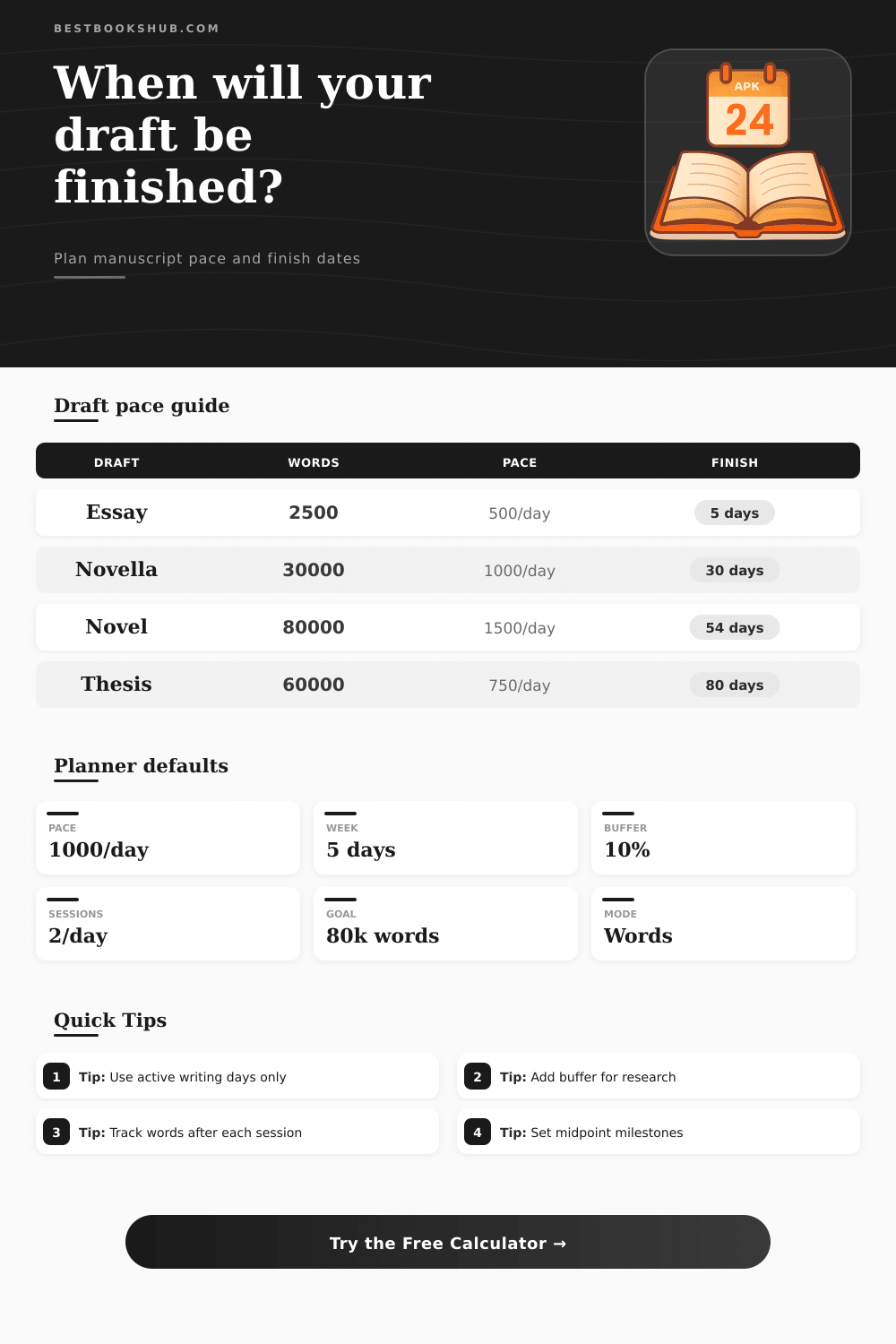
| Draft type | Typical target | At 500 words/day | At 1,000 words/day |
|---|---|---|---|
| Short essay or article | 1,500 to 3,000 words | 3 to 6 writing days | 2 to 3 writing days |
| Book chapter | 5,000 to 8,000 words | 10 to 16 writing days | 5 to 8 writing days |
| Novella | 25,000 to 40,000 words | 50 to 80 writing days | 25 to 40 writing days |
| Full-length novel | 70,000 to 100,000 words | 140 to 200 writing days | 70 to 100 writing days |
| Thesis or dissertation section | 40,000 to 80,000 words | 80 to 160 writing days | 40 to 80 writing days |
| Active days per week | Best fit | Calendar effect | Planning note |
|---|---|---|---|
| 2 days | Weekend drafts | Slowest calendar finish | Use larger sessions and a generous buffer. |
| 3 to 4 days | Part-time writing | Moderate finish span | Works well for academic or job-adjacent drafting. |
| 5 days | Workweek rhythm | Balanced finish span | Leaves room for rest, reading, or outlining days. |
| 6 days | Deadline push | Fast without daily load | Good for book drafts with one recovery day. |
| 7 days | Daily challenge | Shortest calendar finish | Use lower daily targets if fatigue rises. |
| Adjustment | When to use it | What it changes | Practical effect |
|---|---|---|---|
| 0% buffer | Clean plan, known schedule | No extra time | Useful for short drafts with little uncertainty. |
| 10% buffer | Normal book drafting | Adds schedule cushion | Protects against missed sessions and slower scenes. |
| 20% buffer | Busy weeks or research | Adds larger cushion | Better for writers balancing work, school, or travel. |
| Difficulty factor | Research, citations, rewrite | Raises required writing days | Models slower output without changing the word goal. |
| Known days off | Planned breaks | Adds calendar days | Keeps the finish date honest before vacations or exams. |
DISCLOSURE: This post may contain affiliate links, meaning when you click the links and make a purchase, I receive a commission. As an Amazon Associate I earn from qualifying purchases.
Until you set benchmarks for how far along you are in writing a book, it’s easy to feel like you’re wandering aimlessly. Most authors starts out setting ambitious due dates and a vague amount of words they’ll write. They figure their willpower will eventually string enough word together from where they are now to reach the end of there manuscript. It doesn’t work out that way very often.
The calculator above will do that work for you after you plug in what you want to achieve: no more guessing if you’ve set a reasonable goal or if you’re being unrealistic about what you can accomplish every day. But here’s the thing: When it comes to how many words can be written in one sitting, most people aren’t realy limited. What most people is limited on is maintaining pace for months at a time without burning out.
Plan Your Writing Goals
I’ve heard plenty of stories from people who began enthusiastically, writing two thousand words per day for several days straight, then fell flat after other life demand came into play. That mistake happens frequently because we base our plans off peak productivity instead of realistic baselines. Yes, there will be days when you’re exhausted. Or sick. Or stumped on what to do next with your story. Build that into the plan.
Don’t add an extra month to every project as some kind of white flag, waving it around like, “See? I’m defeated!”. Add ten percent or more to your schedule as a shield to protect yourself from missing days and slow spots while still leaving room to keep moving forward without halting altogether.
How do you want to spend your time? How much can you get done if you work in a few small bursts or one large chunk of time? This is where the tool comes in. It lets you tweak based on several short writing sessions or just one longer block. From the research I’ve read, it’s usually best to have two concentrated writing periods instead of four half-assed ones.
There is a cognitive cost when you stop and restart. Your quality often holds up better if you split those two thousand words into chunks with a break in between rather than doing one continuous six-hour sitting. When you break it up into little intervals with breaks in-between, you tend to maintain quality better. That’s what the tool reflects… It lets you divvy up your day’s goal into small, attainable chunks instead of something daunting.
Intuition also doesn’t apply when it comes to difficulty factors. It’s not the same thing to write a first draft as it is to write a thesis chapter with citation requirements, or a memoir with emotional precision. An academic argument subject to peer review take longer than writing fiction about someone’s emotions. You have to factor in the friction involved.
For example, if you’re writing something with a lot of complex structuring/research, then you should of slowing down the expected time. Otherwise, you end up creating schedules that sound nice on paper but crumple beneath the load of actualy doing them.
For part-time authors (or weekend warriors), the problem is that you have fewer days in the week when you’re working. Even if you spend the same number of hours writing, it take more time on the calendar. To adjust for this, the tool assumes that your words has to be spread over more days in the week.
So, while you might get away with 1,000 words per day if you’re working five days a week, when you’re down to three, you’ll need a bigger daily word goal in order to hit your end date, unless you want to wait a lot longer. It’s a question of how hard do you want to push vs. How long do you want it to last? Push hard for less time. Or light up the candle at both ends, stretching it out longer but taking it easier each day.
If the end date is months away, set yourself some milestones. Crossing that 25% mark will feel like a win, and there are still three quarters to go! Those markers give you those psychological wins that keep you moving along. Otherwise it’s easy to lose steam in the middle of the draft, who knows how much longer that is going to take?
The page lays it all out in terms of timeframes based on manuscript length and pace. But at its core, planning isn’t just about time management; it’s also about expectation management. Inspiration is uncontrollable. Your system is controllable. Acknowledge the obstacles before they occur. Include some buffer time and rest days. One missed week doesn’t mean the whole project go off track. Don’t try to force the timeline when you see it stretching farther out than you’d like. Consistent effort on a loose timeline is better then stress and burnout on a tight one. Trust the math, not the hype. If you do, you’ll actualy finish what you start.