📖 Story structure planner
Three-Act Pacing Calculator
Map a manuscript across Act I, Act II, midpoint, Act III, chapter marks, scene targets, and revision buffers with flexible pacing models.
Load a common manuscript profile, then adjust length, words per page, chapter count, scene count, and act percentages.
DISCLOSURE: This post may contain affiliate links, meaning when you click the links and make a purchase, I receive a commission. As an Amazon Associate I earn from qualifying purchases.
The table updates from your length, act percentages, chapters, scenes, and tolerance setting.
| Segment | Percent window | Page range | Word range | Chapter mark | Scene target | Pacing job |
|---|---|---|---|---|---|---|
| Run the calculator to generate the act map. | ||||||
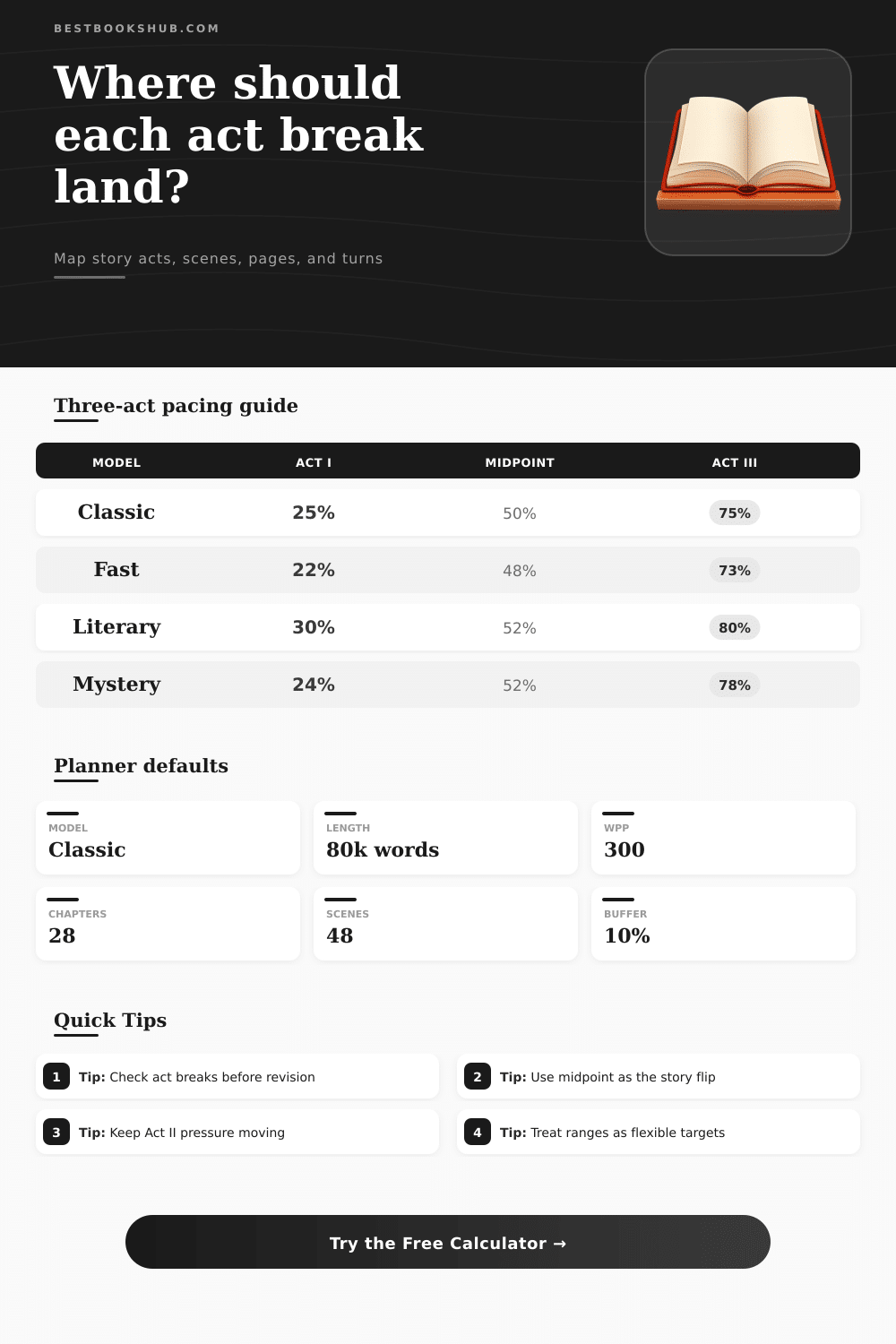
| Pacing model | Act I break | Midpoint | Act III start | Best fit |
|---|---|---|---|---|
| Classic novel | 25% | 50% | 75% | Balanced commercial, book club fiction, mainstream nonfiction. |
| Fast commercial | 22% | 48% | 73% | Thrillers, adventure, high-concept stories, and tighter genre pacing. |
| Mystery reveal | 24% | 52% | 78% | Investigation plots where clues build pressure later in the middle. |
| Romance arc | 23% | 50% | 76% | Relationship-forward stories with emotional reversal at the midpoint. |
| Literary slow-burn | 30% | 52% | 80% | Character-led novels, layered memoir, and reflective structures. |
| Epic expansion | 27% | 50% | 78% | Large casts, worldbuilding, quests, and wide-canvas series openers. |
| Draft length | Typical pages | Common chapters | Scene count | Structure note |
|---|---|---|---|---|
| Novella | 90 to 150 pages | 10 to 18 | 18 to 30 | Act breaks arrive quickly, so keep setup lean. |
| Short novel | 180 to 240 pages | 18 to 24 | 30 to 42 | Each turn needs visible consequence within a few chapters. |
| Standard novel | 250 to 340 pages | 24 to 34 | 42 to 60 | Classic three-act proportions usually feel natural. |
| Long novel | 350 to 500 pages | 32 to 48 | 60 to 90 | Act II often needs internal rises to avoid a flat middle. |
| Epic manuscript | 500+ pages | 40+ | 80+ | Use subplots and sequence turns to support the main act map. |
| Checkpoint | Story function | Common signal | If it lands early | If it lands late |
|---|---|---|---|---|
| Act I break | Commitment to the central problem | The protagonist cannot return to normal. | Build setup consequences. | Compress opening material. |
| Midpoint | Major reversal or revelation | The story changes direction or meaning. | Give the first half more escalation. | Trim repeated middle beats. |
| Act III start | Final plan or last confrontation | The ending engine starts clearly. | Expand the squeeze before the finale. | Move decisive action sooner. |
| Climax | Central conflict resolved | The main story question receives an answer. | Allow aftermath space. | Shorten final explanations. |
Then there’s that moment at three thousand pages into your novel, where this little helper calculates structure for you. When do you know if you’re in middle act? Or is it even the beginning of the book? Are you in the dark night of soul yet? These questions trouble us, make our writing seem flat, the stakes low.
Our chaos needs a container: we need some structure to let the reader enjoy the ride. Plug in your scene estimates, plug in your word count, and the tool do all the math. It saves you from guessing about where those pillars of structure will appear.
How the Tool Fixes Your Story Structure
No one begins with an exact sense of pacing. They only have a general sense of length, such as knowing you has eighty thousand words. You don’t know what percentage should be setup and what percentage will be conflict. This is where stories goes slack.
Enter your estimated number of chapters into the tool, along with size of your book, and it will plot the rhythm of narrative. Numbers are divided up, yes, but they’re also plotted onto a reference chart on the page. This chart shows why a literary slow-burn have different pacing than a commercial romance. It also shows why a mystery drops clues later in the middle, which often moves its midpoint a little to the right.
Knowing these patterns will tell you if your story’s dragging, or if your genre require a longer pause. So what does it tell you? A lot! Why? Because it forces you to consider rhythm prior to writing the next scene.
How many inputs? More important than number of outputs. While output formats seem trivial (words per page), it shift where the act breaks will appear on actual page. And that also makes your manuscript look more visual.
But then there’s chapter count, which is even more important. An eighty-thousand word novel with twenty-eight chapters means each chapter are about three thousand words. That’s a lot of space to keep readers interested without scene break.
The calculator takes that and translates it into pages and scenes. It says your Act I break would ideally occurs around the seventh or eighth chapter. Now if you find it falls within chapter twelve, something is slowing down your start. No need to rewrite from scratch. Just add speed to the inciting incident, or cut some fat.
A story changes direction at its midpoint. It happens not merely halfway, but with a reversal. The tool points out that spot well. If you miss it, your second half will feel like a repeat of the first half instead of building tension.
You set the tolerance (tight/loose). Tight is disciplining. Loose is organic-drift. Most drafts needs some balance. It lets you breathe while keeping engine running.
And revision buffers? We don’t pay attention to those till after we’re already screwed. And then we’re stuck with this eighteen-thousand-word draft that’s supposed to be eighty thousand. You’ll see on the meter where you’re at structurally, ahead of schedule, or woefully behind. Stop thinking that just a few thousand words separate you from home plate. In reality, you’ve missed three whole chapters worth of plot building.
Use it to audit the middle (in halves if necessary). If it’s dragging, split it up into two audits: one for the first half and one for the second. See if it was a problem in both. Then perhaps the midpoint wasn’t tough enough.
The tool doesn’t care about the quality of your prose. It cares about the pace. Structure isn’t a cage, it’s a map. As long as you know your destination, you’re free to deviate. Think of these calculated ranges as targets. Not chains. If the cause-and-effect rhythm still holds true, shifting a few pages in either direction can be a turning point.
Make major cuts, then recalculate: Delete a subplot and all of those subsequent milestones shifts with it. Yes, the numbers changes. But the story logic doesn’t. When an act break hits, make sure it doesn’t feel arbitrary, make sure it feels earned.
This is how you turn a sprawling draft into a novel that actualy ends. And this is how you stop worrying about where you are and start worrying about where the characters need to go next.