📖 Story structure lab
POV Chapter Balance Calculator
Measure how evenly viewpoint chapters, word count, openings, closings, and chapter gaps are distributed across a multi-POV manuscript.
Load a common narrative setup, then adjust the chapter sequence, weights, and manuscript length to match your draft.
DISCLOSURE: This post may contain affiliate links, meaning when you click the links and make a purchase, I receive a commission. As an Amazon Associate I earn from qualifying purchases.
The table compares actual chapter share, estimated word share, target share, openings, closings, and gap risk for each viewpoint.
| POV | Chapters | Chapter share | Estimated words | Target share | Open / close | Max gap | Status |
|---|---|---|---|---|---|---|---|
| Run the calculator to compare POV shares. | |||||||
Use the rotation view to spot repeated blocks, missing viewpoints, and chapters where a dormant arc returns.
| Chapter | POV | Estimated words | Act zone | Since last POV | Rotation note |
|---|---|---|---|---|---|
| Run the calculator to build a rotation schedule. | |||||
| Structure | Typical share | Good signal | Watch point |
|---|---|---|---|
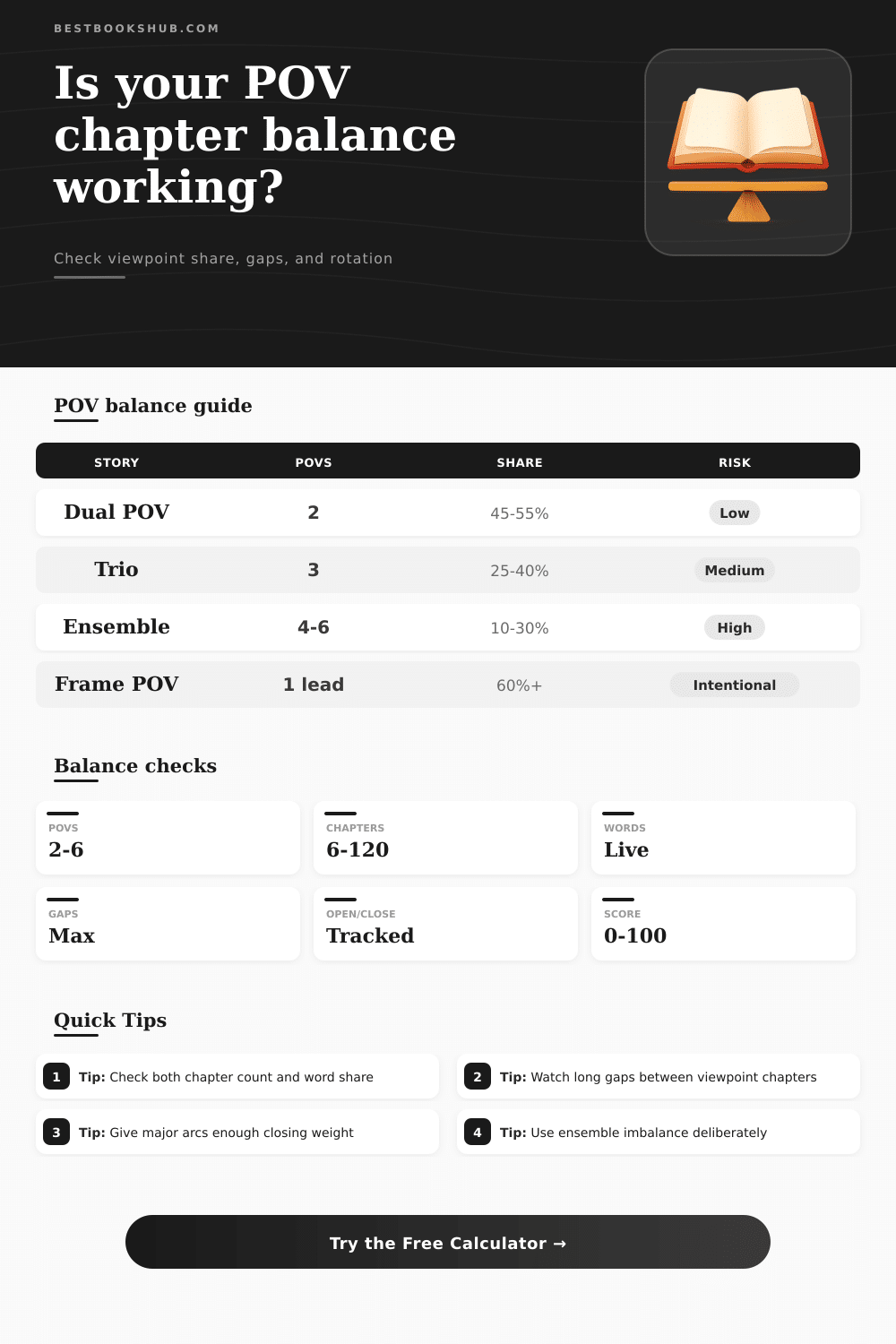
| Dual POV | 45-55% each | Both arcs open and close major turns. | One voice quietly becoming the real main character. |
| Lead with supports | 45-65% lead | Support POVs reveal pressure the lead cannot see. | Support chapters that repeat known information. |
| Three POV ensemble | 25-40% each | Each thread has a clear story job. | One POV vanishing for a long middle stretch. |
| Large ensemble | 10-30% each | Viewpoint changes mark location, stakes, or strategy. | Readers losing emotional priority. |
| Gap length | Reader effect | Best use | Revision cue |
|---|---|---|---|
| 1-2 chapters | Fresh continuity | Romance, thriller, and tight dual POV. | Check for overly mechanical alternation. |
| 3-5 chapters | Manageable absence | Trio casts and separate plot threads. | Re-enter with a strong objective. |
| 6-8 chapters | Thread may cool | Intentional mystery, travel, or delayed reveal. | Add reminders or move a chapter earlier. |
| 9+ chapters | High reorientation cost | Frame devices and rare interludes. | Make the return chapter unmistakably necessary. |
| Opening / closing role | Why it matters | Common pattern | Risk |
|---|---|---|---|
| Opening lead | Teaches readers whose want begins the book. | Main POV appears in chapter 1 or 2. | False promise if the book shifts away. |
| Midpoint owner | Controls the story's pressure turn. | Lead or antagonist-adjacent POV lands the reversal. | Important turn seen by a low-stakes observer. |
| Finale owner | Determines emotional payoff. | Primary arc holds the last decisive chapter. | Closing from a POV with too little setup. |
| Interlude POV | Adds scale, irony, or outside knowledge. | Short, sparse chapters with clear function. | Interesting but nonessential detours. |
Viewpoint rotation becomes a choreography problem for most writers. You’ve got dancers on stage and you want them to move in time, never tripping each other up. This means they naturaly gravitate towards mathematical perfection. If I’ve got three protagonist, I’ll give them each a third of the space. Feels fair. Looks nice on the spreadsheet.
But stories aren’t spreadsheets. They are an emotional experience. To feel alive, they need to feel intentional, with imbalance, rhythm and tension.
Why Equal Parts Make for Weak Stories
Once you know what chapters come when, the calculator do all the heavy lifting for you. It converts those vague concerns about pacing into something you can see as data points and fix. This brings me to the biggest pitfall: thinking only about how many words is being written, but not when they’re written. Maybe you have fifty thousand words from one character. And maybe your other character has fifty thousand words too. Sounds even-steven, right? Except that you write about one character up to chapter five, then don’t come back to them till chapter forty. Now what happen to their thread? What about their arc? Because by this time the reader has forgotten both.
Six to eight chapters is typically where mainstream readers will turn off. By now, something about the stakes have changed. Or the protagonist has changed. Enough so that returning to the book at this juncture takes a lot of narrative glue that doesn’t pay out. So rather than think about overall word counts, it’s better to think about maximum gaps.
Readers remember certain parts more than others… Like openers and closers. It becomes clear in those first few pages who is driving the engine of the story. Could you risk misleading your readers about who to care about if it takes until halfway through for the lead to appear? Or do you build up a second POV only to have them land the last emotional beat, making everything feel coincidental and unearned at the end?
This tool focuses on those areas so that your structural decisions is intentional rather than just accidental. Does the end land hard enough from the right vantage point?
Then there’s the challenge of ensemble casts. With four or more voices involved, it’s impossible (and generally undesirable) to treat everyone equally. Some will be there for scale, offering irony or outside context unavailable to central protagonists. Others will carry through subplots that barely intersect with the main conflict at all. In my experience, attempting to divide things evenly among members of an ensemble usually produces a diluted narrative in which nothing feel urgent. Don’t strive for symmetry; instead, seek function. Does this viewpoint provide information unavailable to any of the others? Is this character’s portion just retreading ground covered by the lead? If so, that character are taking up precious space while failing to add anything to the tension. You can adjust the weight to create the imbalances necessary for actual story.
To write a dual romance, maybe it should of been weighted almost evenly so there’s still plenty of conflict and longing on both sides. Perhaps you could write a thriller from an antagonist’s POV, where we mostly see events from hero’s perspective but use the villain’s point of view only here and there to increase tension through dramatic irony. Set those goals, then use them as markers to know when your draft starts wandering off course.
Hey, the secondary plot (the mystery thread) got out of hand. Now it’s overshadowing the primary storyline. The data will tell you that’s happening before you finish final draft. Common structures are shown in table form as a kind of sanity check against what you expect from the genre. Tight alternation with dual point of view stories frequently swap chapters, using quick pacing to build tension. Trios benefits from a little more breathing room so that all three characters gets their own arc and voice without rushing things along. Big groups depend on good scene objectives and labels to keep readers grounded. Knowing where your story fits on this spectrum helps you decide if an imbalance is actualy a structural strength instead of a weakness.
And this. Ultimately… Is what balance isn’t: Fairness. Balance is making sure that all those threads stay engaged through the end so the final resolution has that right mix of certainty and surprise. That each viewpoint feels not just there, but needed. If the tool says there’s some weak spot, take a look at who it’s from, did they bring a different perspective or pressure? And if not … chop their chapters. Did they bring something valuable? Make them fit more closely in the main conflict.
The math tells you where to go; it doesn’t steer the car. That requires your storytelling instinct. Respect the gaps and keep the rhythm tight. Trust that things written in perfect equality can read worse than things written with intentional imbalance.