Subplot Word Allocation Calculator
Plan how many words belong to your main plot, each subplot, chapters, acts, and revision buffer before the draft starts drifting.
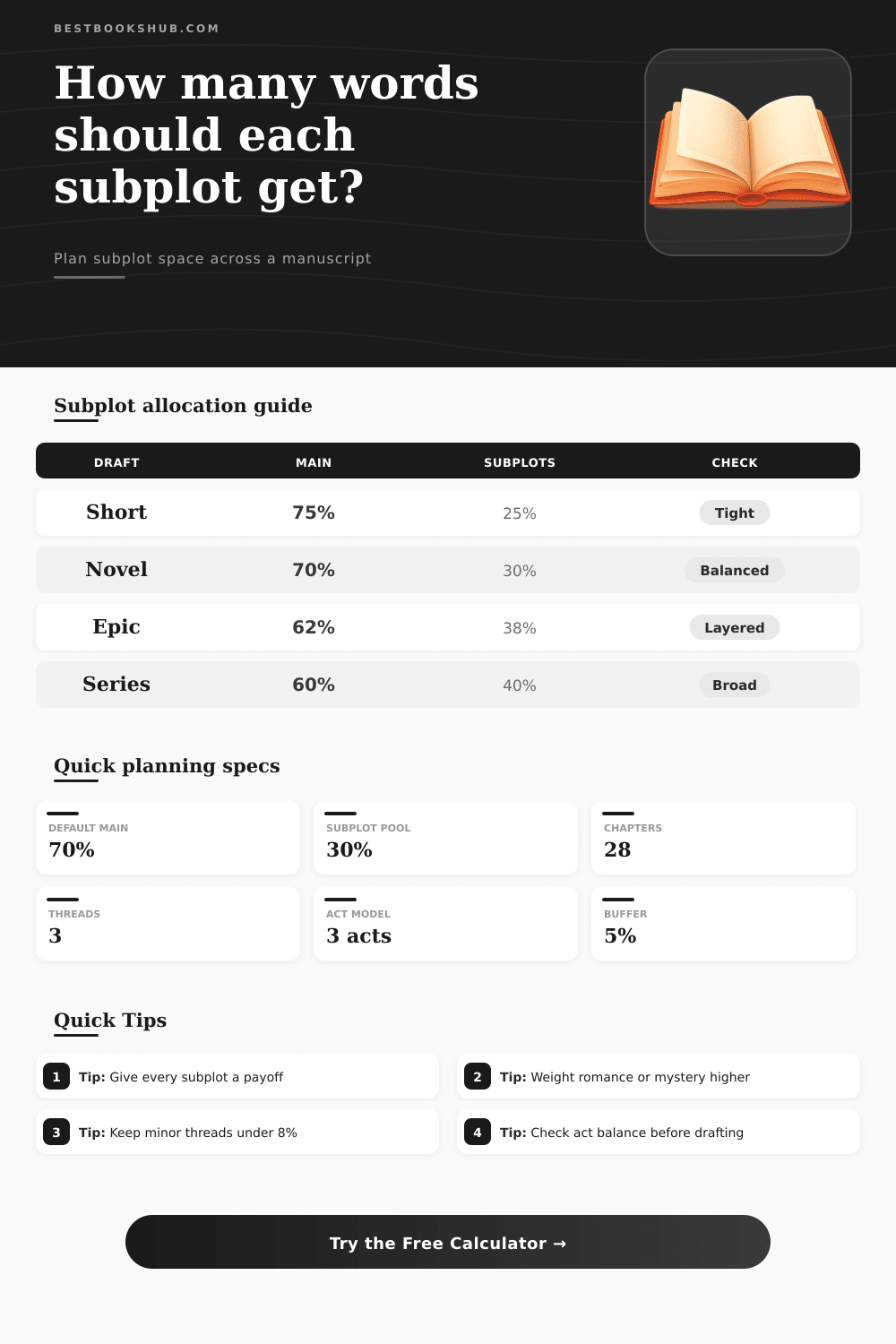
Allocation breakdown
| Manuscript type | Main plot share | Subplot pool | Common thread count | Best use |
|---|---|---|---|---|
| Novella or short genre draft | 78-85% | 15-22% | 1-2 | One emotional counterpoint or clue thread. |
| Lean commercial novel | 70-78% | 22-30% | 2-3 | Fast pacing with controlled relationship or mystery arcs. |
| Balanced trade novel | 62-72% | 28-38% | 3-5 | Multiple character arcs that still serve the main question. |
| Epic, saga, or ensemble | 55-65% | 35-45% | 5-8 | World, politics, family, and secondary POV movement. |
| Thread weight | Approximate share | Beat spacing | Scene count | Drafting check |
|---|---|---|---|---|
| Major subplot | 9-14% | Every 2-4 chapters | 8-14 scenes | Needs a turn, crisis, and payoff. |
| Medium subplot | 5-9% | Every 4-6 chapters | 5-9 scenes | Works as pressure on the protagonist. |
| Minor subplot | 2-5% | Every 6-10 chapters | 3-5 scenes | Should resolve cleanly or merge upward. |
| Motif thread | Under 2% | Brief repeats | 2-4 touches | Track as recurring detail, not full plot. |
Mystery
Keep clues in the main plot, then allocate subplot space to suspects, relationships, and false pressure.
Romance
The love arc may be the main plot; use subplot words for family, work, identity, or friendship arcs.
Fantasy
DISCLOSURE: This post may contain affiliate links, meaning when you click the links and make a purchase, I receive a commission. As an Amazon Associate I earn from qualifying purchases.
World and politics can sprawl, so reserve a clear pool for lore-bearing secondary threads.
Thriller
Subplots usually need shorter beats that increase stakes rather than slowing the central threat.
| Structure model | Opening load | Middle load | Ending load | Subplot note |
|---|---|---|---|---|
| Three act | 25% | 50% | 25% | Introduce most threads by the first major turn. |
| Four part | 25% | 50% | 25% | Place the densest weaving in parts two and three. |
| Five act | 20% | 60% | 20% | Useful for rotating POV and ensemble pressure. |
| Compressed | 30% | 45% | 25% | Best when a subplot launches early and resolves fast. |
| Chapter count | 80k draft | 90k draft | 110k draft | Use case |
|---|---|---|---|---|
| 24 chapters | 3,333 words | 3,750 words | 4,583 words | Broader chapters with multiple subplot beats. |
| 30 chapters | 2,667 words | 3,000 words | 3,667 words | Balanced pacing for most trade novels. |
| 36 chapters | 2,222 words | 2,500 words | 3,056 words | Shorter chapters with cleaner beat rotation. |
| 45 chapters | 1,778 words | 2,000 words | 2,444 words | Fast genre pacing or alternating POV. |
Eventually, there’s going to be a moment in your novel-writing process where you slam into the invisible wall. Perhaps you envisioned the overall plot when you began, but now by Chapter Six youve got a side character asking questions you never intended for her to ask. Or maybe romance has flared between two characters who havent been getting along, or suddenly there’s a political conspiracy that needs explaining. So now your book expands by thirty thousand words, and the main plot seem sluggish.
This isn’t because you’re bursting at the seams with ideas. It’s because they don’t fit in your budget. Word allocation forces you to think of a novel different than before, which shapes your outline differently. Instead of wondering whether something’s interesting, you wonder: Can I afford this subplot? Narrative real estate is precious; interest is not.
How to Plan Your Subplots with a Word Count Budget
If you set aside a percentage of your entire draft for supporting threads, then you’re making concrete structural decisions about what serves the story and what’s just noise. It makes abstract creative instincts feel like tangible structure. Once you input your number of subplots and desired word count, the calculator do the math. No more guesstimating how many thread will fit under big story without smothering it.
But here’s the rub: Knowing what those numbers imply is where the labor comes into play. Say you’re aiming for a typical 90k-word novel. You allot 70% of those words to the meat of the book, which is the central problem. This gives you 30k words for all other aspect. Sounds like plenty? But then you remember you have two POV characters and three subplots fighting for that territory. So now you’re looking at ten thousand words per side-story. Ten thousand! That’s hardly enough for an arc to develop, let alone get wrapped up in a satisfying way.
The limitations arent a flaw; they’re a feature. The other aspect is genre expectations. Genre conventions matters a great deal. For example, a cozy mystery fan wants quick pacing and little meandering: that means keeping the pool of subplots small. Red herrings? Sure. Suspect dynamics? Go ahead. But if it doesn’t advance the investigation, it could drag the pacing. On the flip side, an epic fantasy fan knows they’re going to get some politics, some world-building, and a lot of maneuvering. If you attempt to shoehorn in a long-running story with the same restricted budget as a thriller, then youll end up with flat, under-developed secondary characters. Leave ‘em enough breathing room!
As you can see from the reference table on the page, commercial novels tend to have about twenty-five percent of their plot devoted to subplots; epics creep closer to forty-percent before it feel like too much. Also keep in mind which threads are spread out over which acts. In most three-acts, the middle half of the book is spent in rising action and complication. Subplots tends to grow here. So if you throw in a secret identity or a rival relationship during act one, that has to have enough gas in its tank to carry it through the middle stretch, the longest part of the book. A subplot that shows up too soon but never pays off will be felt as abandoned. One that shows up at the last minute will feel like an afterthought.
The key is mostly in what exactly the act breaks measure. It is not about word count alone, but attention span. Weighting your subplots matters just as much as the total count. Just because there are 10 doesn’t mean they all needs equal billing. The main one, the one that is at least half the reason readers want to know what happens next, such as a mystery clue or a romance, might be eight to twelve percent. Lesser ones should be fewer than five percent each. These help provide some texture but don’t form the backbone of the story. You’ll end up with a flat, fragmented-feeling narrative if you allot the same amount of time to every character. It’s about hierarchy, which generates a sense of rhythm.
Lastly, there is room for tweaking. There’s going to be stuff in the first draft that doesn’t work. Some scenes might overlap and some characters might blend together naturaly. When you have 5% wiggle room to trim fat, you’re able to cut out extra fluff without panicking over falling short on word counts. It allows for exploration within a structured framework; it allows for permission.
You should of used this before. Plotting isn’t just about big ideas. Plotting’s about making decisions: Which of those ideas gets to stick around for dinner? And which one has to go home early? When you think of your word count as something finite (rather than an infinite well), each sentence begin to do its fair share. You’ve cut out the dead wood, leaving the path clear for the main plot to shine through.