📖 Fiction pacing lab
Scene-sequel ratio calculator
Measure how much of a draft is driven by action scenes, reflective sequels, and hybrid beats, then compare the balance against genre and revision targets.
| Story lane | Scene share | Sequel share | Use when |
|---|---|---|---|
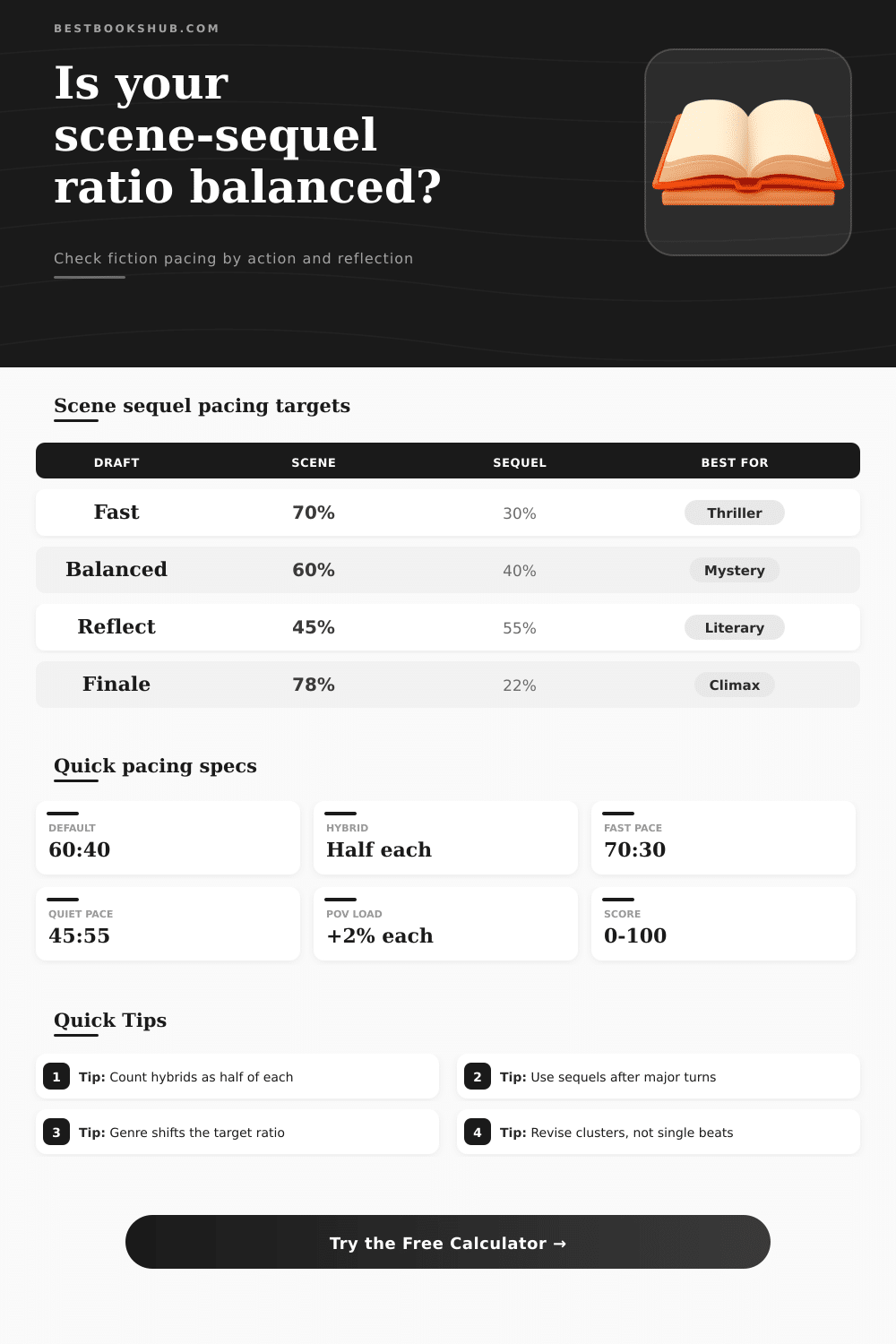
| Thriller or suspense | 68% to 78% | 22% to 32% | Threat, pursuit, reveals, and reversals carry the reading drive. |
| Mystery or crime | 58% to 68% | 32% to 42% | Clues need action, but interpretation scenes must reset suspicion. |
| Romance | 52% to 62% | 38% to 48% | External turns and emotional processing both need visible space. |
| Fantasy adventure | 58% to 70% | 30% to 42% | World events move fast while travel, politics, and magic need digestion. |
| Literary fiction | 40% to 55% | 45% to 60% | Meaning, voice, consequence, and interior change carry the draft. |
| Memoir or narrative nonfiction | 38% to 55% | 45% to 62% | Experience and reflection are paired to create insight. |
| Unit type | Typical length | Scene use | Sequel use |
|---|---|---|---|
| Micro beat | 250 to 700 words | Exchange, discovery, quick obstacle. | Flash reaction or a one-choice pivot. |
| Short scene | 700 to 1,500 words | Focused conflict with one visible turn. | Processing a loss, clue, kiss, or mistake. |
| Standard scene | 1,500 to 2,800 words | Full goal, resistance, escalation, and outcome. | Emotional settling plus a deliberate next plan. |
| Long chapter scene | 2,800 to 5,000 words | Set piece, confrontation, journey leg, or battle. | Large moral dilemma or multi-person fallout. |
| Signal | Likely ratio issue | First check | Revision move |
|---|---|---|---|
| Readers feel rushed | Too many scenes in a row | Count post-turn reactions. | Add a sequel after the largest consequence. |
| Readers feel stalled | Too many sequels in a row | Mark the next external pressure point. | Convert one reflection into a choice under pressure. |
| Motives feel unclear | Missing sequel logic | Track dilemma-to-decision links. | Insert a short choice beat before the next action. |
| Plot feels mechanical | Scene chain lacks fallout | Check emotional residue after turns. | Blend a hybrid beat into the next scene opening. |
| Ending feels thin | Finale has no processing | Find the last earned decision. | Add a compact sequel after the decisive event. |
| Draft slice | Modeled units | Balanced target | Fast target |
|---|---|---|---|
| Single chapter | 3 to 6 beats | 2 to 4 scene beats | 3 to 5 scene beats |
| Three-chapter opening | 9 to 16 beats | 5 to 10 scene beats | 6 to 12 scene beats |
| Act one | 18 to 32 beats | 11 to 19 scene beats | 12 to 23 scene beats |
| Full novel pass | 45 to 90 beats | 27 to 54 scene beats | 31 to 65 scene beats |
| Final act pass | 12 to 28 beats | 7 to 17 scene beats | 9 to 21 scene beats |
A hybrid scene can satisfy both movement and processing. Count it by purpose first, then decide whether the draft truly needs another full sequel.
DISCLOSURE: This post may contain affiliate links, meaning when you click the links and make a purchase, I receive a commission. As an Amazon Associate I earn from qualifying purchases.
Scene-sequel rhythm is felt across runs of beats. Check the three to five units around a turning point before moving a single chapter.
The plot is not boring; this is why most manuscripts stalls out. The pacing are broken. Your draft is either too fast and shallow or stuck in internal monologues that lead nowhere. This happens even when you has a great idea for a breakup or heist.
What happened? In short, it means that somewhere along the way, the writer lost sight of how to maintain the rhythm of action and reaction. Readers respond different to external events vs. Readers notice how characters react to them, and this makes the distinction more important then most realize. Too many action beats stack one after another without giving character breathing room. Because of this, the stakes evaporates into noise. Linger too long on reflection and narrative momentum dies.
How to Fix Pacing in Your Story
Look at your manuscript as a series of weighted units instead of just pages to find sweet spot. To take guesswork out of structural editing, just enter your counts into calculator above and let it do the math.
Begin with your action scenes: those moments with a clear goal, escalating conflict, and a definite outcome that shifts situation. Next come your sequels: the beats spent on reaction, emotional processing, and dilemma that sets up another decision. Because hybrid sections quickly complicate this equation, the trick is knowing exactly what’s getting measured here.
When a character fights off an attacker only to realize his/her spouse was behind it all, they’re blending action with reflection. Weight those hybrids halfway between both categories, or tip toward whichever function dominates page. This leeway allows you to account for nuances of writing that don’t fit in rigid boxes, so your data represents actual reading experience, not a forced categorization.
How do we define a balanced pace? That’s where genre comes into play in a huge way. Suspense requires scenes that makes up a greater percentage of the story, so the sense of impending threat never fades. Romance requires time to let emotional ties grow. Memoir and literary fiction might prefer more sequel to give interior shifts, consequences, and voices space to change. Genre puts a force on the tool, which then tweaks its base targets accordingly: a mystery needs room for interpretation; a romance needs room for emotional connection.
Defy those norms and your otherwise-polished draft may sound off key. Readers who came for adrenaline won’t know what to do with long reflective chapters in a fast-paced thriller. Likewise, nonstop action in a slow-burn drama will jar making it seem too superficial to be satisfying.
Seeing the numbers makes the revision strategy shift in a big way. Does output indicate your draft has stalled? Maybe it’s not that your writing is bad, maybe it’s that there are too many reactions with no follow-up pushback. In that case, shifting one of those reflection moments into a decision taken under outside pressure could of relighted the spark of the story.
On the flip side, do readers say they feel as though things happen too fast, and/or your characters’ motivations lack clarity? Then you probably have too many action beats piled up on top of each other without enough sequels between them to connect the dots. Motivation problems typically resolve immediately when we add a brief processing moment following a big pivot. That’s because the “why” of this character’s next step becomes clear. We know what they’ve seen, felt, and thought. Now we get to watch them take the next step based off all that.
This is also where having a sense of your ideal targets helps: the calculator will tell you whether your current division align with those goals, and score how close you are. Small deviation? Likely just textural details for now. Big mismatch? Structural thing to address before you dive into the line edits.
Keep in mind that it’s not just in individual scenes but over runs of beats where we feel the rhythm. Look at groups of three to five units near significant plot turns, and consider whether flow aligns with the story’s intention. Changing the ratio is not so much about hitting a perfect percentage as it is about making sure every action earns its emotional payoff and every reflection earns the next conflict.
Finding that balance between motion and meaning is how you produce a draft that doesn’t merely pass the time, but carries reader forward with purpose. Always make them turn the page, but also make them care about what’s coming on the other side.