📚 Book description lab
Description density calculator
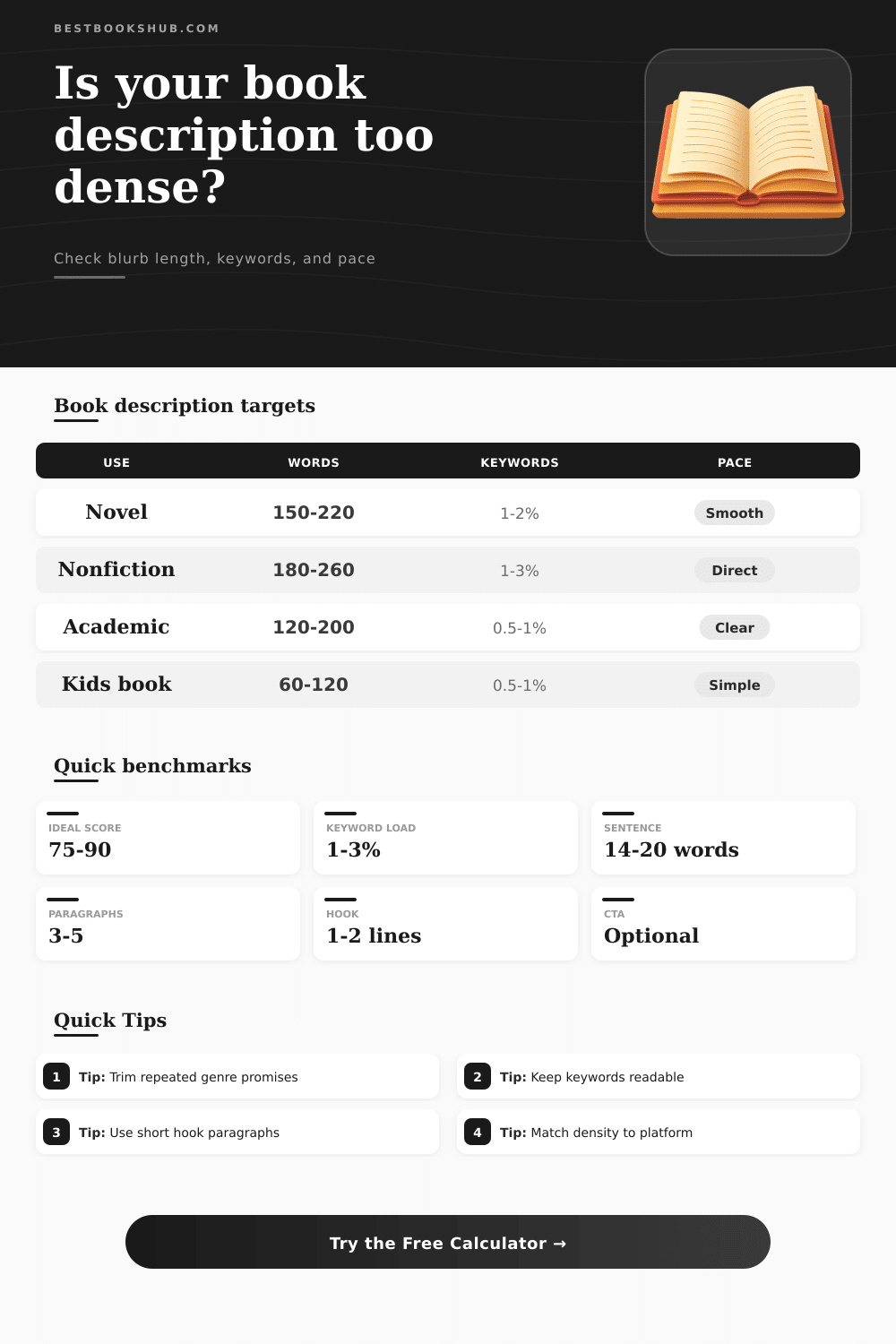
Measure whether a book description has enough useful detail without becoming crowded, repetitive, or keyword-heavy.
| Density band | Score range | Reader effect | Typical fix |
|---|---|---|---|
| Thin | 0 to 49 | Feels vague, short, or under-positioned. | Add stakes, audience promise, and one concrete detail. |
| Light | 50 to 69 | Readable but may miss useful search or genre signals. | Add a clearer hook, benefit, trope, method, or subject cue. |
| Balanced | 70 to 90 | Enough information while still easy to scan. | Keep wording natural and trim only repeated phrasing. |
| Crowded | 91 to 100 | May feel overloaded, keyword-stuffed, or slow. | Shorten long sentences and remove duplicated claims. |
| Platform use | Best word range | Paragraph target | Density priority |
|---|---|---|---|
| Amazon or KDP product page | 150 to 230 words | 3 to 5 paragraphs | Hook, genre signals, and reader promise. |
| Apple Books listing | 120 to 220 words | 2 to 4 paragraphs | Clean scan, emotional promise, concise proof. |
| Kobo or retailer listing | 140 to 240 words | 3 to 5 paragraphs | Search phrases without repeated wording. |
| Library catalog summary | 80 to 160 words | 1 to 3 paragraphs | Subject, audience, form, and scope. |
| Back cover copy | 120 to 200 words | 2 to 4 paragraphs | Voice, hook, stakes, and memorable close. |
| Publisher website page | 180 to 350 words | 4 to 6 paragraphs | Positioning, credentials, themes, and discovery terms. |
| Signal type | What it measures | Useful range | When to adjust |
|---|---|---|---|
| Hook density | Opening sentences that create curiosity or a problem. | 1 to 2 strong lines | Add one clear premise if the opening feels flat. |
| Keyword density | Search phrases matched against total word count. | 1 to 3 percent | Rewrite repeated phrases into natural synonyms. |
| Detail cue rate | Concrete words about character, method, subject, or outcome. | 4 to 10 cues per 100 words | Add specifics if the description could fit any book. |
| Pace load | Average words per sentence plus paragraph length. | 14 to 20 words | Split long sentences if the score feels crowded. |
| Pattern | Typical structure | Best for | Density watchout |
|---|---|---|---|
| Hook, stakes, promise | Premise, conflict, reader payoff, soft close. | Fiction and memoir | Do not retell the whole plot. |
| Problem, method, result | Pain point, approach, outcomes, fit. | Nonfiction and workbook | Avoid listing every chapter feature. |
| Scope, field, contribution | Subject area, argument, evidence, audience. | Academic titles | Replace repeated jargon with plain context. |
| Age, theme, experience | Reader age, story moment, lesson, tone. | Children's books | Keep adult explanation short and concrete. |
DISCLOSURE: This post may contain affiliate links, meaning when you click the links and make a purchase, I receive a commission. As an Amazon Associate I earn from qualifying purchases.
Maybe you’ve seen a book’s blurb and thought it was trying too hard. There is a lot of adjectives, and a little too much description for the premise. You’re left unsure what genre it even is. It is more than you might imagine.
Weeks go into copy from authors. They bury their hook behind jargon or repetitive stakes. In most cases, it’s not a lack of good ideas; it’s an excess of effort without measurement.
What Is Description Density?
What is this? How do you give enough info to satisfy curiosity while keeping the reading pace fast enough to scan on a mobile device in ten seconds? That is description density. Plug in your draft, and let the calculator do the math.
That way you can avoid second-guessing how to fix your paragraph. Did it sound long? Was it bloated, or was it just very detailed? If you’re like most writers, you’ll have a sense of when something’s off, but not exactly what about it. Maybe it’s the number of times you repeat keywords. Maybe it’s the length of the sentences. Maybe hook came too far into the piece.
When you break the writing into measurable elements, it stops being “a feeling” and becomes something you can edit with precision.
It turns out your guidebook doesn’t read like a guide book at all; it reads like a novel. Your mystery blurb buries its plot behind abstract statements. The root of most density problems is keywords. Certain words are search engine gold, while others make us humans cringe at their overuse. You mentioned the word cozy mystery four times in 200 words. That’s not helping your reader; that’s optimizing for a machine.
The tool measures density and alerts you if you have moved from being useful to sounding robotic. A good number of keywords feels non-existent. They’re integrated as smoothly into the promise of the story as a thread running through the fabric. They are not slapped-on labels. Readers don’t come to remember how well you’ve written your SEO plan: they come to remember the story itself.
Beyond word choice, the speed at which you write each sentence also affects the result. Winding, lengthy sentences can suggest complexity or luxurius, appropriate for an academic book or work of literary fiction. They signal that there’s room to meander through nuances. But when you’re selling something like a children’s picture book or a fast-paced thriller, those same long sentences will get in your way. They’ll slow readers down and make them less inclined to buy.
Your Pace score reflects how many words-per-sentence you use and whether it fits with what people expect from your chosen genre. Does yours reflect a faster pace? It might be time to cut some phrases in half.
What is considered balanced density? It depends on context. For a scholarly book, a thin description may suffice since readers will expect rigor and brevity. But that thin description would kill on an Amazon product page where people scan visually. What makes it sellable there? Everything is about the platform you’re addressing. On an Apple Books listing, where the screen constrains how much can be seen immediately, things must be clear at first glance; back cover copy can indulge in moody language.
Avoid trying to apply a one-size-fits-all rule to your marketing materials. Knowing those environments will help.
So what goes wrong? Common mistakes include stacking benefits in nonfiction or retelling the entire plot in fiction. The problem is both examples are full of information from the actual book that shouldn’t be in the sell-sizzle at all. You don’t want to walk through the door, you want to open the door.
And where do you think the cluttered score comes from? It’s not because they cut random words. Read them closely and look for redundant benefit claims. “The hero is brave” (line 1). “And he demonstrated his courage when…” (line 4) Don’t make the reader do your thinking for you.
In short, a good description is more about subtracting than adding. Make your point with just enough signal to rise above the noise, but not so much noise that you drown out the point. It’s a tiny thing, but man does it matter when it comes to conversion rates.
A good-blurby-blurb honors the reader’s time and makes its case clearly. Keep the hooks sharp, the keywords naturaly, and the sentences on-point. It should of not be too long or too short. It does not fill up space, but it fills up interest. Get that right and description no longer feels like work; it feels like an invitation.