📖 Narrative balance lab
Backstory ratio calculator
Estimate how many words, pages, scenes, and chapter beats should carry past events so your draft keeps the present story moving.
| Genre or form | Lean draft | Balanced draft | Rich draft | Use when |
|---|---|---|---|---|
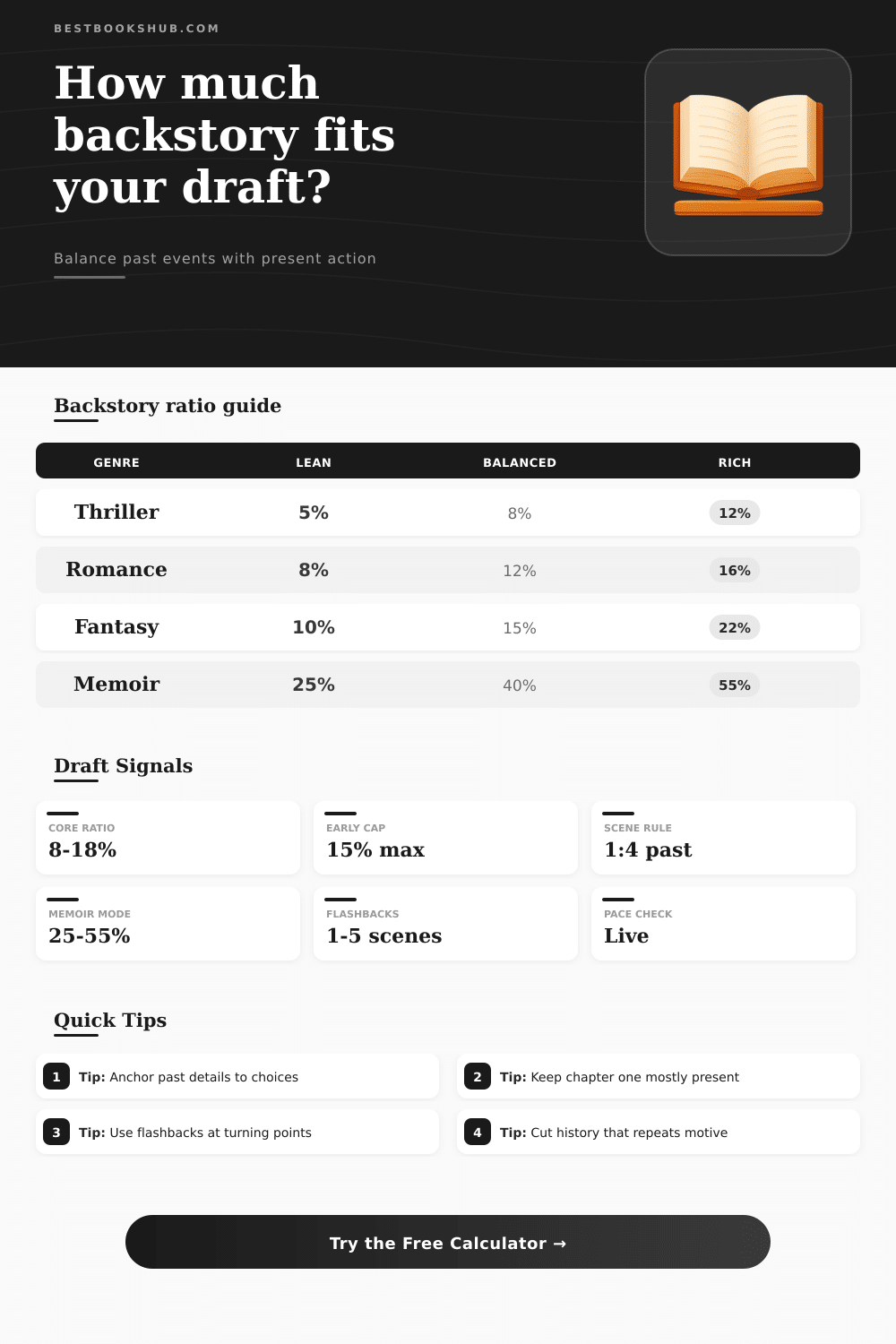
| Thriller / suspense | 4-7% | 8-10% | 11-14% | The past is motive, clue, or pressure on the chase. |
| Mystery | 6-9% | 10-13% | 14-18% | Old relationships and hidden timelines shape the reveal. |
| Romance | 7-10% | 11-15% | 16-20% | Backstory explains wounds, reluctance, and trust repair. |
| Literary fiction | 9-13% | 14-20% | 21-28% | Memory and interiority are core parts of the plot engine. |
| Fantasy / science fiction | 9-13% | 14-19% | 20-26% | World history, origin events, or systems need context. |
| Memoir hybrid | 25-32% | 33-45% | 46-55% | Past events are the story material, not just explanation. |
| Manuscript zone | Safe share | Watch point | Best delivery | Revision check |
|---|---|---|---|---|
| Opening 10% | 0-8% | Too much setup before desire is clear | One charged image or line | Can the scene work if cut in half? |
| First quarter | 8-15% | Early chapters stall under explanation | Need-to-know fragments | Does every past detail alter a choice? |
| Middle build | 15-45% | Repeated motive beats | Revelation after conflict | Are flashbacks changing the present? |
| Late turn | 20-35% | Reveal arrives too late to matter | Secret, confession, or missing link | Can readers reframe earlier scenes? |
| Final act | 0-12% | Resolution pauses for history | Brief confirmation | Does the ending stay in motion? |
| Device | Typical length | Backstory weight | Best use | Risk |
|---|---|---|---|---|
| Memory beat | 20-120 words | Light | Shows trigger, wound, or association | Can become repetitive seasoning |
| Expository aside | 100-400 words | Medium | Clarifies a necessary relationship | May explain what scene already implies |
| Full flashback | 900-2500 words | Heavy | Dramatizes a turning point from the past | Can interrupt momentum if unearned |
| Document / letter | 250-1200 words | Medium | Delivers evidence, voice, or confession | Can feel inserted for convenience |
| Dual timeline chapter | 1500-4000 words | Heavy | Past and present carry equal suspense | Needs its own forward motion |
| Draft size | 8% backstory | 14% backstory | 20% backstory | At 250 words/page |
|---|---|---|---|---|
| 50,000 words | 4,000 words | 7,000 words | 10,000 words | 16 / 28 / 40 pages |
| 70,000 words | 5,600 words | 9,800 words | 14,000 words | 22 / 39 / 56 pages |
| 90,000 words | 7,200 words | 12,600 words | 18,000 words | 29 / 50 / 72 pages |
| 120,000 words | 9,600 words | 16,800 words | 24,000 words | 38 / 67 / 96 pages |
Past as clue trail
Works best for thrillers and mysteries where each past detail answers a specific question while raising a sharper one.
Past as emotional cause
DISCLOSURE: This post may contain affiliate links, meaning when you click the links and make a purchase, I receive a commission. As an Amazon Associate I earn from qualifying purchases.
Useful for romance, YA, and literary drafts where backstory explains fear, desire, shame, or a repeated choice.
Past as setting logic
Common in fantasy, science fiction, and historical fiction when readers need origin events, systems, or cultural memory.
Past as parallel plot
Best when the earlier timeline has its own stakes, reversals, and payoff rather than serving as background explanation.
If chapter one needs backstory, attach it to a visible decision, conflict, or sensory trigger so the present scene still has priority.
When several memories explain the same fear or desire, keep the strongest scene and convert the rest into brief reminders.
For fiction writers, the backstory ratio calculator also estimates how much backstory they have in their draft and what kind: pages, scenes, chapters, or pacing signals. In other words, it converts vague worries over exposition to concrete things that can be managed throughout revision.
Often you discover that half your draft is there because main character is sad. The backstory ratio calculator help you manage that. Readers love the depth of backstory. That’s not bad. What makes it problematic is when it impedes the present action. Backstory should be lean: typically no more than an eighth to one sixth of your book (eighteen percent is probably max). That’s what works for most commercially successful fiction.
How to Use Backstory Wisely
Why? Thrillers in particular live off momentum they create, momentum IS their value. Memoirs and literary fiction can afford more backstory: as much as half. In those genres, the past IS the story.
The tool will also show you the words you’ve budgeted to spend on an active scene vs. Explanation. If your story is a 90k word fantasy book, then perhaps you get 16k words to tell the history of things/where things came from. And that sounds like a lot, but now you has to divide them up over thirtyish chapters with no one chapter dragging down the whole thing.
Scroll down to see the reference table on the page; it breaks out by genre what’s going to work. What will fly in a crime thriller won’t work in a romance novel. One of the most difficult inputs is placement distribution. One common mistake by novices is to shove sixty percent of their backstory into the first chapter to establish motive quickly. That almost never works, because human beings has limited attention spans. Readers will tune out if you’re explaining too much during those opening pages. You also need to throw them into some sort of conflict with the hero.
The “early share” is the number the tool will spit back to illustrate that skew. You ideally want very little (a tiny percentage) of your backstory allotment to be delivered within the first quarter of the book. The rest has got to come as a revelation that shifts our perspective on what’s happening now.
How you get there is also key. A momentary reminder hidden within current action will evoke emotions with maximum punch for minimal sacrifice (it doesn’t affect your ratio much). However, a complete flashback scene stop the current story cold, which is an extremely costly investment of your limited budget. Think of it as a precious ingredient, use it sparingly. Use this tool to enter how many flashbacks you plan to use, and it will tell you if they is using up too much of your storytelling potential.
It also considers character complexity, which is another factor. If you have a small cast and only one wounded character, they can be motivated without much background explanation. But if you’ve got an ensemble with complex intertwined histories, then the reader will need some kind of explanatory glue to understand how characters relates to each other. For this reason, the tool includes multipliers: it accounts for both the number of characters and how dense your world building is. (A sci fi universe would require more contextual explanation different than a moddern drama about people in their everyday office lives.)
Think of it as an exercise in trusting your readers to fill in gaps. If they don’t see everything spelled out at the start, they will connect the dots themselves. Leaving room for them to do this makes their brains feel like they’re doing the work. Backstory isn’t minimized; it’s timed to the current story. Each bit of backstory have a reason and serves a function right now: It adds something to the tension, gives the reader more insight into motive, etc. If a memory beat doesn’t accomplish any of that, its merely noise.
First, figure out what’s absolutely essential to the back story. Figure out how many pages that realy needs to be, with the calculator as your guide. And then write in those beats, making them tighter. Set firm limits, and watch how sharp your writing becomes. Once you do, you won’t be summarizing any more, you’ll be dramatizing instead. The past is still a powerful engine for your story, but now it doesn’t weigh down the vehicle. Move the present along, and allow the shadows to fall where they may.