📖 Serialized fiction lab
Serial episode length calculator
Plan readable installment lengths from story words, cadence, reader minutes, recap space, hook pressure, and launch buffer.
| Episode | Story words | Release words | Reader minutes | Hook job | Length signal |
|---|---|---|---|---|---|
| Run the calculator to generate episode rows. | |||||
| Arc segment | Episodes | Story words | Release weeks | Purpose |
|---|---|---|---|---|
| Run the calculator to generate arc rows. | ||||
| Serial format | Episode words | Typical cadence | Reader promise | Watch point |
|---|---|---|---|---|
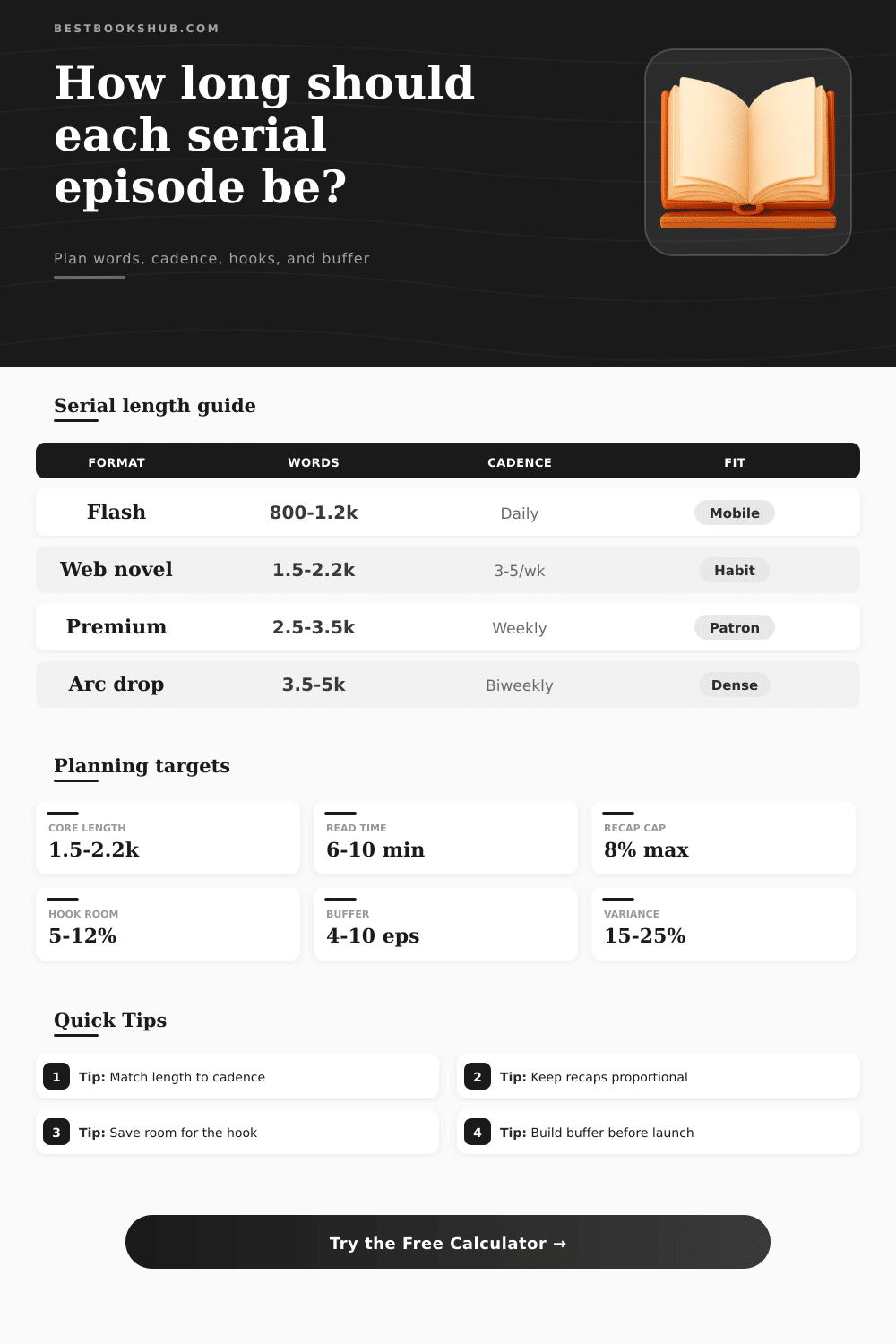
| Daily flash serial | 800-1,200 | 5-7 per week | Quick mobile habit | Recaps can crowd the actual scene. |
| Standard web novel | 1,500-2,200 | 2-5 per week | Reliable bite-size progress | Repeated false cliffhangers weaken trust. |
| Mobile app serial | 1,200-1,800 | 3-7 per week | Fast scroll episodes | Keep scene goal visible early. |
| Newsletter serial | 1,800-2,800 | Weekly or twice weekly | Inbox-friendly installment | Longer gaps need cleaner reminders. |
| Premium weekly drop | 2,500-3,500 | Weekly | Substantial paid episode | Use internal turns, not one ending beat. |
| Dense arc episode | 3,500-5,000 | Weekly or biweekly | Chapter-like depth | Readers need strong orientation. |
| Cadence | Episodes per month | Good buffer | Recap range | Planning signal |
|---|---|---|---|---|
| Daily | 28-30 | 14+ episodes | 0-80 words | High habit value, high production risk. |
| Five per week | 20-22 | 10-14 episodes | 25-100 words | Strong app rhythm with little recovery time. |
| Three per week | 12-13 | 6-10 episodes | 50-150 words | Common web-novel cadence with manageable spacing. |
| Twice weekly | 8-9 | 5-8 episodes | 75-180 words | Good for deeper scenes and newsletter readers. |
| Weekly | 4-5 | 4-6 episodes | 100-250 words | Needs stronger memory cues and payoff. |
| Biweekly | 2-3 | 3-5 episodes | 150-350 words | Best paired with longer, denser installments. |
| Genre pressure | Length nudge | Hook spacing | Best episode shape | Risk if wrong |
|---|---|---|---|---|
| Quiet literary or slice of life | Longer by 5% | Every 3-5 episodes | Scene turn plus emotional residue | Too-short drops may feel slight. |
| Romance or relationship arc | Near target | Every 2-4 episodes | Choice, misread, reveal, or intimacy shift | Hooks without emotion feel mechanical. |
| Mystery or case fiction | Near target | Every 2-3 episodes | Clue, suspect pressure, or theory change | Too much recap can solve the puzzle early. |
| Thriller or suspense | Shorter by 8% | Every 1-2 episodes | Reversal, threat, chase, or decision | Long episodes can drain urgency. |
| Fantasy or progression | Longer by 8% | Every 2-4 episodes | Quest step, power gain, cost, or reveal | Worldbuilding can bury the installment promise. |
| Young adult serial | Shorter by 4% | Every 2-3 episodes | Social pressure, goal turn, or identity beat | Large variance may disrupt school-day reading. |
A serial episode can be short, but it still needs a clear movement: new information, a sharper decision, a changed relationship, or a pressure increase.
DISCLOSURE: This post may contain affiliate links, meaning when you click the links and make a purchase, I receive a commission. As an Amazon Associate I earn from qualifying purchases.
If reminders rise above about eight percent of a short episode, fold memory cues into action and dialogue instead of opening with a separate recap block.
Short episodes work best near cliff tags, reveals, and aftermath cuts. Longer episodes work best when they carry multiple scene turns or an arc payoff.
A strong launch buffer is part of the length decision. A perfect 2,000-word plan fails if the cadence demands more weekly words than you can sustain.
If you’re facing the panic of realizing that your serial is going to run dry three weeks prior to launch, here’s what you’re up against: you’ve got the draft in hand, but the release math doesn’t add up. The episodes is either too long (you’ll never draft them fast enough for months) or they’re too short (your readers will be disappointed). At this stage, planning starts to shift from creative to logistical. This is where the tool on this page help.
Tell it your total word count. Include your buffer needs, your cadence, and your hook space requirements. It figures out the number per episode you realisticly need, instead of hoping vaguely for it. That’s why we begin with genre instinct: Most people who write fantasy has an urge to get going with densely plotted, five-thousand-word installments full of lore. People who read romance tend to think, I’d love something tighter that fits into my lunch break, tighter emotional beats.
How to Plan Your Serial Story
But instinct doesn’t recognize attention span. That’s where the tool lays out standard ranges for various format lengths. A flash daily serial should be small enough to read during your commute, but meaty enough to feel like forward motion. A premium weekly drop can packs more heft because the reader knows they’re investing time to wait for it.
Cadence matching length isn’t optional. Daily? Your installments must be brief. Biweekly? They’ll require depth. By setting a target, then revealing how much pressure it puts on your calendar, the calculator align these factors.
Recaps are another stealth enemy to serial momentum. How seductive it is to begin each chapter with a paragraph of reminder about last week’s events! Trouble is, if recaps takes up more than eight percent of an episode, they gobble up precious time for new scene work. Readers don’t want to reread. They want to know what happens next. The calculator gives you a way to measure this tradeoff.
Input the number of words you intend to devote to reminders, and see where it cuts into your story space. It will tell you, in black and white, if you’re cutting back on plot in favor of convenience. If things appear tight, here’s the advice: incorporate memory cues into dialogue rather than writing standalone summary blocks.
You also have to consider hooks. You want something every episode for people to click “next.” This can be a character decision, a reveal, a cliff hanger, whatever. But it take up space. If you budget five to twelve percent of your word count for this type of content, then you won’t run out of space at the end of each installment and feel frustrated by having to let your plot meander all the way up to the cutoff line before arriving at a satisfactory place to stop. You can tweak this slider as needed according to demands of the genre. Slice-of-life tales need fewer hooks and they need them less often. Thrillers requires bigger, bolder hooks more often. Tweak those sliders and you’ve got a whole new structural map.
Perhaps most critically, you need to have some buffer episode lined up. Because if you launch without any completed episodes? That’s a recipe for burn out. Life will get in the way. Motivation will come and go. Your editor will request tweaks. If you’ve got six to 10 episodes produced by the time you launch, you’ve got some runway when shit goes wrong.
With your desired cadence, how many weeks of episodes does that buy you? That’s what the calculator tells you: it takes the abstract concept of safety and turns it into concrete time. One missed week shatters the habit that you’re trying to establish with your audience.
Last, think about how much you can draft. Do you have the ability to crank out seven thousand words per week? Or do you only manage five? Your plan might call for ten. Unavoidably, those numbers won’t match. The tool takes into account what you can produce in a week and matches it against your planned releases. Are you too ambitious? Is your plan unsustainable? Does this tell you when your writing plan is doable and when it’s doomed by grandiosity? Tweak those numbers until they align and you’ll have a roadmap that honors the writer and the story.
Delivery isn’t just an afterthought of good serial fiction. Reliable delivery allows creativity to shine.