📖 Web fiction pacing lab
Webnovel Chapter Length Calculator
Estimate webnovel chapter words, reader minutes, release span, weekly production load, recap pressure, hook space, and backlog runway.
Load a common publishing rhythm, then tune arc words, target minutes, platform style, genre, hook size, recap size, and backlog.
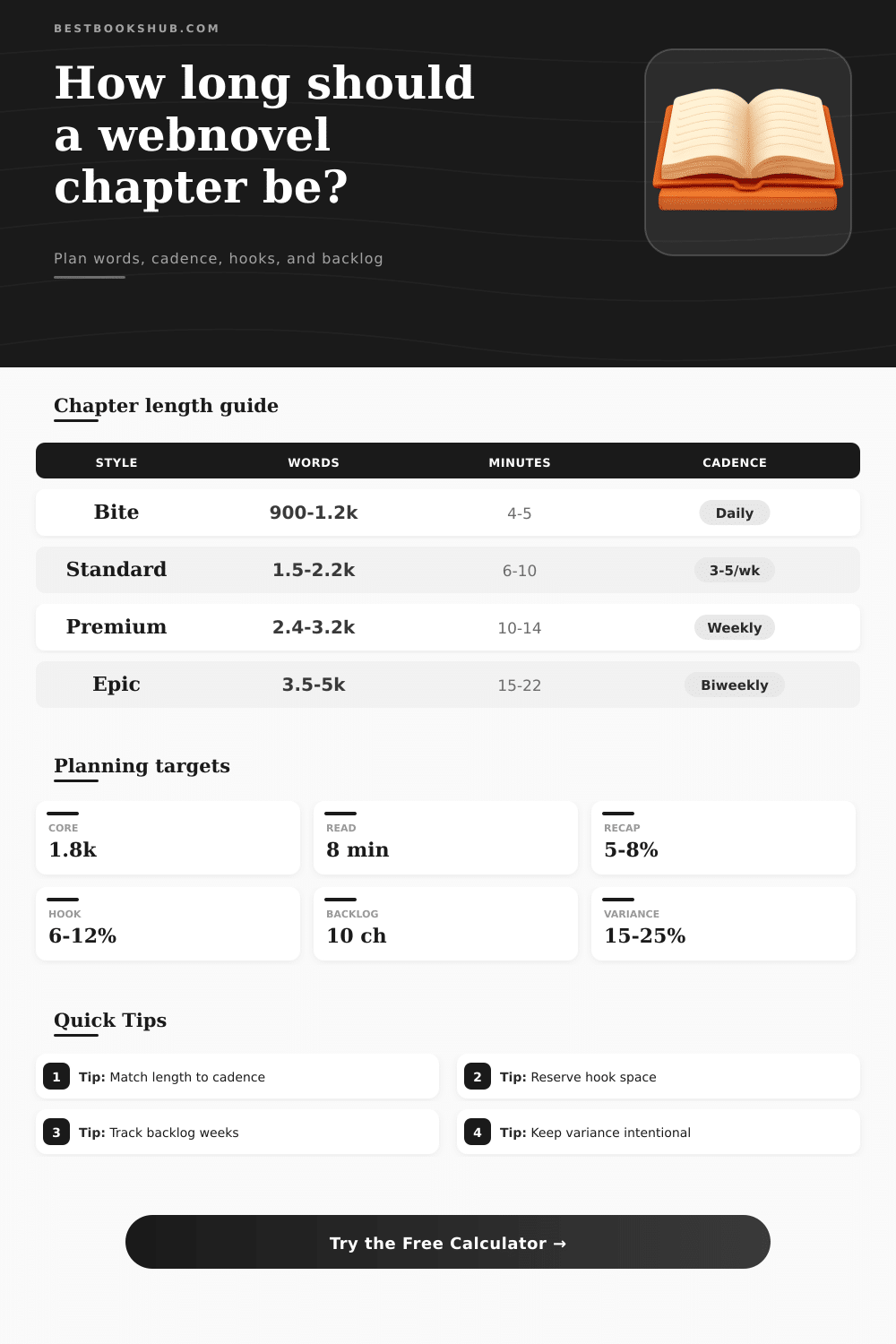
| Platform style | Core chapter words | Reader minutes | Best cadence | Planning note |
|---|---|---|---|---|
| Bite-size daily | 900-1,200 | 4-6 | Daily or five per week | Works when each chapter has one clean beat. |
| Mobile app chapter | 1,200-1,700 | 5-8 | Three to seven per week | Good for scroll sessions and coin unlock pacing. |
| Standard webnovel | 1,500-2,200 | 6-10 | Three to five per week | Flexible for most online genre fiction. |
| Community serial | 2,000-2,800 | 8-13 | Twice weekly or weekly | Enough room for discussion-worthy turns. |
| Premium weekly | 2,400-3,400 | 10-15 | Weekly | Feels substantial for supporters or paid unlocks. |
| Epic long chapter | 3,500-5,000 | 15-22 | Weekly or biweekly | Best when each release carries several scene turns. |
| Genre | Length nudge | Hook interval | Good chapter engine | Watch for |
|---|---|---|---|---|
| Progression fantasy | Near target | Every 2-3 chapters | Goal, obstacle, gain, cost | Training chapters without changed stakes. |
| LitRPG | Longer by 6% | Every 2-3 chapters | Quest step plus system consequence | Stat blocks crowding scene movement. |
| Romance | Near target | Every 3-4 chapters | Emotional turn, misread, choice | Hooks that ignore relationship movement. |
| Thriller | Shorter by 10% | Every 1-2 chapters | Threat, pursuit, reversal, deadline | Long setup that drains urgency. |
| Mystery | Near target | Every 2-3 chapters | Clue, suspect pressure, theory shift | Recap revealing too much too early. |
| Slice of life | Longer by 8% | Every 4-5 chapters | Small change with emotional residue | Chapters that feel like loose diary entries. |
| Cadence | Monthly chapters | Useful backlog | Weekly words at 1.8k | Signal |
|---|---|---|---|---|
| Daily | 28-31 | 18+ chapters | 12,600 | Habit is strong, production risk is high. |
| Five per week | 20-22 | 12-16 chapters | 9,000 | Common webnovel rhythm with little slack. |
| Three per week | 12-13 | 8-12 chapters | 5,400 | Good balance for editing and reader memory. |
| Twice weekly | 8-9 | 6-8 chapters | 3,600 | Supports longer chapters and deeper comments. |
| Weekly | 4-5 | 4-6 chapters | 1,800 | Needs stronger payoff or stronger memory cues. |
| Biweekly | 2-3 | 3-5 chapters | 900 | Best for dense chapters or planned hiatus gaps. |
DISCLOSURE: This post may contain affiliate links, meaning when you click the links and make a purchase, I receive a commission. As an Amazon Associate I earn from qualifying purchases.
Write less; read more.
Before worrying about the volume of what you’re going to write, decide how long each chapter will be. Most serial writers chooses a haphazard number of words and then get derailed by real life. When life throws you off track, having a structural limit (i.e., “I’ll publish X chapters per week”) help you stay on target. It forces you to think about how many words your readers has time to read instead of how many word you can write. You can plug in some numbers and the calculator will tell you what is realistic for your schedule.
Plan Your Chapter Length
Pacing is a measure of how dense your text is in word counts, not necessarily how hard it was to write. Are you writing daily progression fantasy? Your readers are going to expect to see stats increase quick, so your chapters will be short. A single clear beat in a chapter of nine hundred words is fine. But stretching it out to three thousand words dilute the reward cycle. There’s a difference in the rhythms between genres too and the tool accounts for those pressures. Readers of romance novels can go with longer emotional arcs; readers of thrillers get through their setups fast. Bloating chapters without accounting for the details here feel like filler.
Structural Overhead: Every chapter require structural overhead. You require a recap in many cases (and even more so if your releases is spaced out). You need a hook at the conclusion. All this takes space. This space do not move the scene forward. If you allocate 10% of your word count to this kind of glue, that means there is less room for plot. The inputs allows you to reserve this space explicitely. You should of do this to make sure you don’t write a whole chapter and then suddenly have no words left for the cliffhanger. This means you cut the climax short. You didn’t plan for ending. There is no substitute for a safety net.
A writer who doesn’t have a backlog has nothing between her and disaster if she get sick or her computer crashes. She’s risking her consistency. The calculator shows you how many weeks of runway you have in your backlog. It shows more than just number of chapters. How fast can you draft sustainablly? And how much are people demanding on a weekly basis? If the pressure meter reaches max, it’s probably going to lead to burnout within months. Reduce frequency or brace yourself for a drop-off in quality once fatigue set in.
Readers have different expectations depending off the interface. Platform style counts, too. Readers of mobile apps want bite sized content to read during their commutes, something they know they’ll be able to complete in one go. Readers who come from communities following a serial may expect longer updates, enough to make them feel like it was worth there time waiting for new material. Aligning your content to the natural pace of your platform cut down on friction. When the bus ride ends or the battery drains so does the chapter. Not only does it provide a margin of error; it’s a weapon we can use to our advantage.
For example, shorter chapters is good when you need urgent pacing. Use them when you want a character to have a quick emotional punch, or when something dangerous happens suddenly. The longer ones gives you time to transition from one scene to another and to resolve things. Even with an overall consistent average chapter length, we can keep things interesting by varying this purposefully. It makes some weeks go by faster. Other times, they will be deeper.
But what you’re actualy doing is managing a supply chain of attention. Before it breaks your streak, look at the numbers. They’ll show you where the bottlenecks is forming. It might be daily updates; maybe it’s weekly epics. Either way: Deliver value, don’t burn out. Plan the length. Plan the stamina.
When you’ve got a clear view of that runway, the blinking cursor won’t feel like a judge. It’ll feel like the starting line.