📖 Reading time estimator
Time remaining in book calculator
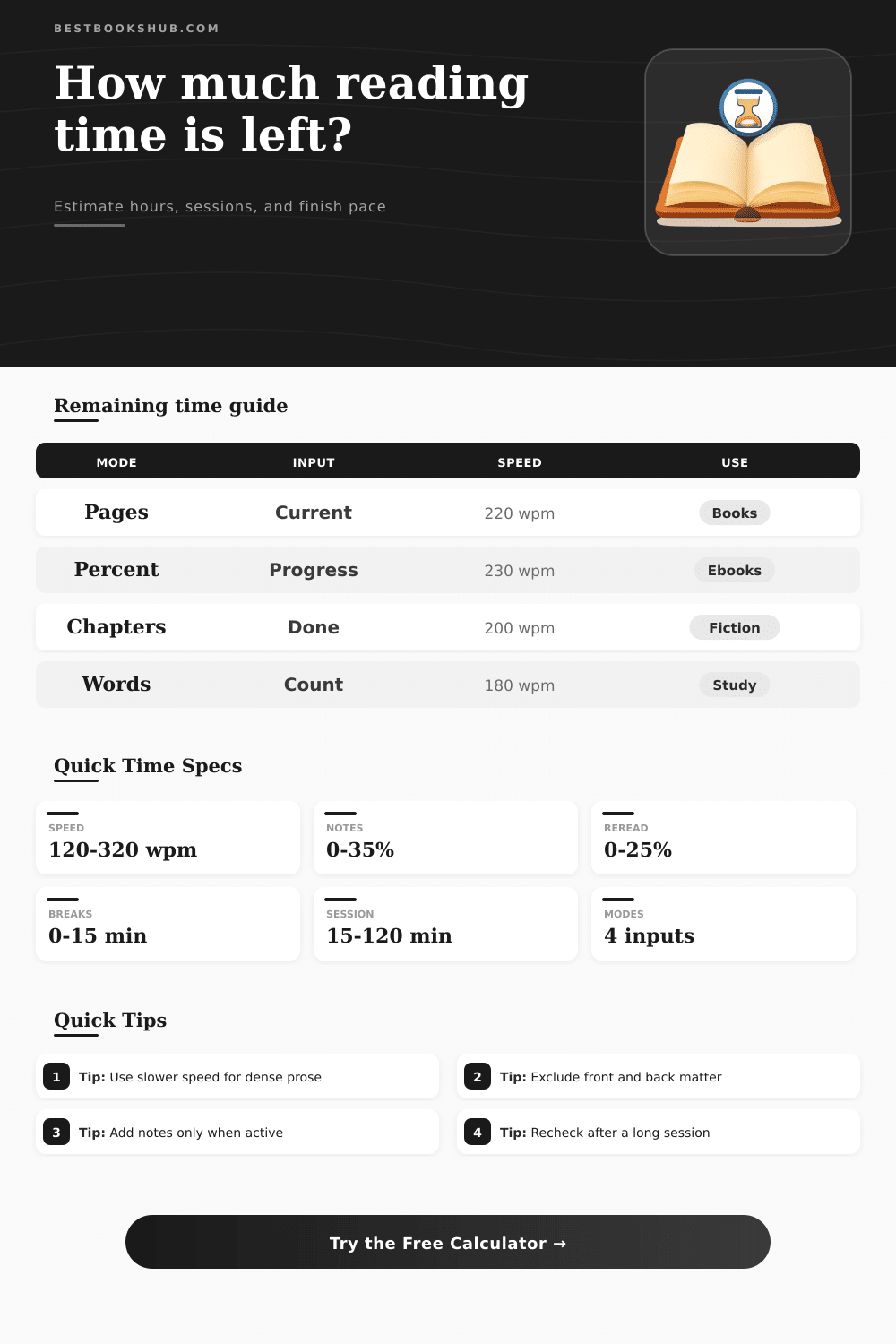
Estimate how much reading time is left from pages, ebook percent, chapters, or word count, then convert the result into sessions, daily pace, and deadline readiness.
| Book type | Typical words per page | Suggested WPM | Time adjustment |
|---|---|---|---|
| Mass-market paperback | 250-300 words | 230-280 wpm | Light to standard |
| Trade fiction or memoir | 280-340 words | 210-260 wpm | Standard baseline |
| Literary classic | 300-380 words | 170-230 wpm | Add reread buffer |
| Dense nonfiction | 320-430 words | 150-210 wpm | Add notes and lookups |
| Academic textbook | 400-650 words | 110-170 wpm | Use study mode |
| Progress method | Best source | Common pitfall | Best use |
|---|---|---|---|
| Pages | Print book or PDF page count | Counting appendices as main pages | Physical books and PDFs |
| Percent | Ereader progress display | Percent includes samples or end matter | Kindle, Kobo, serial apps |
| Chapters | Chapter list or table of contents | Uneven chapter lengths | Fiction with similar chapters |
| Words | Manuscript, article, or document count | Forgetting already-read words | Drafts, study packets, web text |
| Session length | Best fit | Break suggestion | Planning note |
|---|---|---|---|
| 15-20 minutes | Hard books or commute reading | 3-5 minutes | Good for dense or interrupted days |
| 25-30 minutes | Study reading and notes | 5 minutes | Fits focused active reading blocks |
| 45-60 minutes | General books and book clubs | 5-10 minutes | Balances momentum with fatigue |
| 90-120 minutes | Weekend or deadline sessions | 10-15 minutes | Use only when the text stays manageable |
DISCLOSURE: This post may contain affiliate links, meaning when you click the links and make a purchase, I receive a commission. As an Amazon Associate I earn from qualifying purchases.
So you set off on a good note. You read enthusiastically. You whiz through those initial 100 pages, because they’re fresh and you’re paying attention.
Then it’s the middle section. It’s here that most reading plans goes down in flames: you look at pile of unread pages left on the table (or Kindle) and know that “soon” isn’t going to cut it when it comes to preparing for a test or finishing a book.
Why Most Reading Plans Fail
This exercise has nothing to do with showy numbers; it has everything to do with knowing actualy how much time you have and managing your life to match. The raw number of pages gives most people a sense of how long they have left to go. Because everyone thinks it’ll take them half an hour per book (without considering all the other stuff they’re doing while they read).
If you’re skimming a thriller, your reading speed might be faster then when you’re dissecting a philosophy text. But if you’re sitting down with a philosophy book, then you’re going to dig in, and each page may takes you longer.
When you put your current progress into the calculator, the calculator crunches numbers for you. So you don’t need to guess at conversions or coefficients. Instead, it makes you realize that there’s a distinction between reading speed and actual effective reading time: Base speed is just how fast your eyes move. Effective time includes all extra steps you take (notes, re-reads, pausing and skipping back, thinking about what you read), so you can’t accurately estimate without taking those into account.
Drift is the time you spend rereading the same paragraph three times because you drifted off to think about what you’ll have for dinner. To account for this, a savvy estimator add a bit of a buffer, perhaps 15-20 percent to your baseline time (or even more if you’re reading something dense like nonfiction). That way, if you do lose focus for a few minutes here and there the added time accounts for the lapse.
It’s better to overestimate just a little bit than to convince yourself that you’ll be able to knock out that textbook in two days when it obviously needs four. Because light fiction usually takes less time then literary classics, you can adjust this buffer depending on how difficult the text is. Does it have a lot of big words? Is the plot action-packed or does it move slowly? Tailor your schedule to its needs.
The other important factor people gloss over is session length: Reading for three hours at a stretch typically means diminishing returns after first hour. Breaking up your reading into shorter focused blocks followed by brief pause helps maintain understanding as your brain continues processing new material instead of just recognizing shapes on the page. Setting your session length to 45 mins with a 5 min break give a more realistic estimate of total time including rests.
This is especially important for planning. Knowing exactly how many pages that buys you prevents frustration at falling short of your daily goal (and vice versa, if all you have time for is 30 mins in the morning before work).
And then there’s how you measure progress, which also depends off the format of your book. On an e-reader, it shows a percentage, though most of the time that percentage is counting endnotes and sample chapters that aren’t even part of the narrative. And if you’re going old school with a physical copy, anything in the front matter (blurbs, introductions) will skew your page count unless you factor those out.
Removing those non-essential pages gets rid of distractions from the equation, giving you a cleaner view of what’s actualy left ahead. It doesn’t seem like much but when you’re working towards hitting a certain milestone by Friday, it matters.
So really the answer lies somewhere between scheduling properly and sheer force of will. It doesn’t matter how much motivation you have; if your schedule assumes you’ll read too fast or too slow, you’re going to get off track and end up behind.
The reading rate charts on the page tells you what normal rates are for various types of books. A romance novel doesn’t move the same way a technical manual does; understanding this helps you create a schedule based off your brain’s reality, not fighting it. Once you understand that you only have X number of sessions left, the problem seems more doable because now it’s broken into achievable chunks instead of one large daunting thing.
Now you crack the cover of book because you know exactly where you should of been when you close it tomorrow.