✈ Airborne reading planner
Finish on flight calculator
Estimate whether your remaining pages, ebook locations, or audiobook minutes fit into available gate-to-gate reading time after taxi, meals, sleep, layovers, and attention breaks.
| Flight type | Block time | Typical usable reading | Best book target |
|---|---|---|---|
| Short domestic hop | 60 to 120 minutes | 25 to 75 minutes after taxi and boarding pauses | Essays, novella finish, light chapters |
| Medium domestic leg | 2 to 4 hours | 90 to 180 minutes after service and breaks | 100 to 180 remaining pages |
| Cross-country flight | 4 to 6 hours | 180 to 300 minutes if awake and focused | Most novels with a mid-book start |
| Long-haul flight | 7 to 12 hours | 240 to 540 minutes depending on sleep | Long novel, nonfiction, or audiobook |
| Book profile | WPM multiplier | Flight risk | Planning note |
|---|---|---|---|
| Light fiction or reread | 1.14x | Low | Good for fragmented travel reading |
| Standard novel or memoir | 1.00x | Medium | Use normal pace plus a 10% buffer |
| Dense nonfiction | 0.78x | Medium high | Subtract more time for rereading |
| Academic or technical | 0.62x | High | Split into smaller leg goals |
| Annotation-heavy reading | 0.55x | High | Include margin notes and citations |
| Cabin condition | Pace multiplier | Common losses | Use when |
|---|---|---|---|
| Quiet seat | 1.03x | Minor announcements | Window seat, noise control, rested |
| Typical cabin | 0.92x | Service, lights, movement | Most daytime flights |
| Busy seat | 0.78x | Aisle traffic and companions | Family travel or tight layovers |
| Tired red-eye | 0.64x | Sleepiness and rereading | Late night departures |
DISCLOSURE: This post may contain affiliate links, meaning when you click the links and make a purchase, I receive a commission. As an Amazon Associate I earn from qualifying purchases.
You have two hundred pages left in a thick history book and you have a three-hour flight. According to the airline app, you’ll land on time. Your gut say otherwise. It takes forever to board. Meal service cuts into your flow. Every time you pause, it add up fast. Here, planning is better then hoping.
When most people plan their flights, they only consider the overall gate-to-gate duration and think they can reading throughout each minute. They never pull it off. By accurately accounting for friction, you can tell the difference between reading a novel with time to burn or being forced to watch a movie that you don’t want to see.
How to Plan Reading for Your Flight
After entering your flight information and number of remaining pages, the calculator do the work for you (above). You don’t need to do any more conversions or coefficients. What are you reading? A light book goes faster than a textbook with footnotes. That’s why it asks the question: What are you reading? It has options for book density, from heavy academic text to leisure fiction.
Why is this important? When writing gets tricky, the cognitive load decreases. On the patio, maybe you can fly through three-hundred words-per-minute. At high-altitude, with tired eyes taking in complex argument, you may find yourself at half-speed. The tool account for this by applying multipliers to your base speed.
After that, it gets into environment: How much attention are you paying to the cabin? Is seat in front of you occupied by a fidgety kid? You pick busy/tired/focused/typical; the less attention you pay to your surroundings, the larger penalty applied to help you set realistic expectations. When you see flight broken up into segments and it removes takeoff/landing/taxi time where you’re required to store your screen, those half-hour-long legs don’t look like much, but on a four-leg international trip they vanish entirely from your usable reading window. People is just as skeptical about that layover time. It’s only going to ask you how many minutes you’ll be able to sit still enough to read during that period.
What’s simple to forget is sleep and eating, both of which can wreck things on you in a hurry. It does this by providing an explicit field for “time off”, i.e., time set aside for sleep (or movies), with the remainder assumed to be dedicated to reading in focus mode. There’s also what’s called a ‘buffer’, again, typically ten percent by default, that represents the cushion we want to provide ourselves to account for engaging chapters or any other kind of trouble we can’t foresee. This is the difference between a plan that can recover from setbacks and one that cannot.
Afterward, you see the answer: not merely did I do it? But also, how fast do I actualy need to go versus how fast I think I am going? If the answer is No, the fit check provide exactly the speed at which we’d need to push through to make it fly. At this point, the question becomes: Is it really worth it?
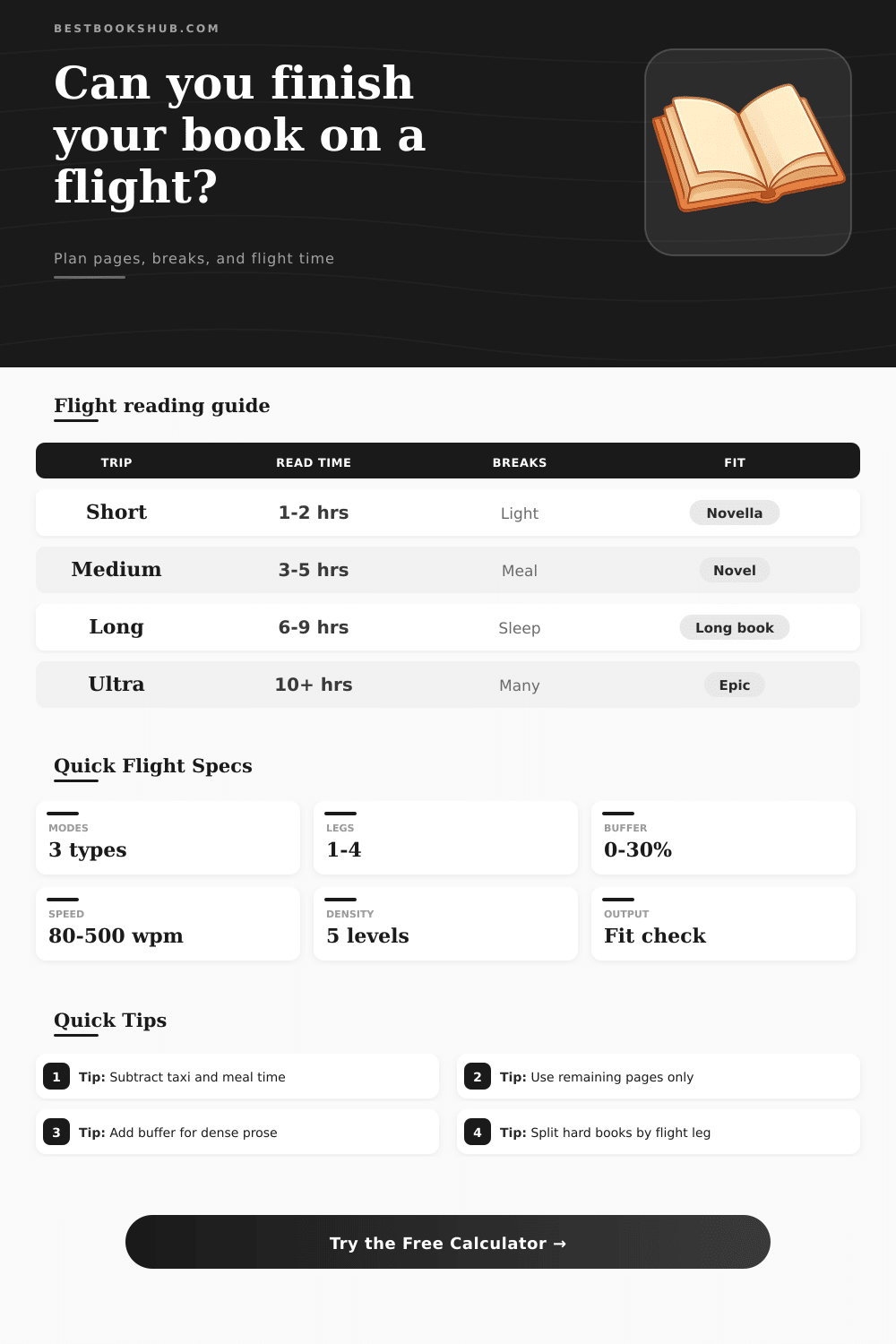
The page includes reference tables that show roughly how long you can expect to read based off different flight lengths. Forty-five minutes of focused reading might be all you get following post-boarding chaos on that quick domestic trip. Which is fine if it’s an essay, not so great if it’s a whole chapter of technical detail. On a long haul, you’ll have more time, but also fatigue will become a significant factor. The trick here is aligning the book with your true capacity, not what you wish you could of done.
If you are regularly coming up short, consider breaking up a fat book over several legs, or even converting to audiobook form, where someone else sets the pace and not your fidgeting fingers. Finishing on a plane isn’t so much about time as it is about subtraction. Subtraction of distractions, of people bothering me, of meals served to me, and of travel fatigue. Until all you have left is reading time.
Look at what’s in front of you and either be OK with not finishing or high-five yourself for having done it. Either way, you’re no longer fighting the clock, now you’re playing nice with it. The next three-hour plane ride you take will go just as fast; now you just know how many pages you’ll get through during it.