✈ Air travel reading planner
Flight reading time calculator
Estimate how much reading you can finish across airport waits, onboard time, layovers, no-reading phases, breaks, cabin friction, notes, and travel fatigue.
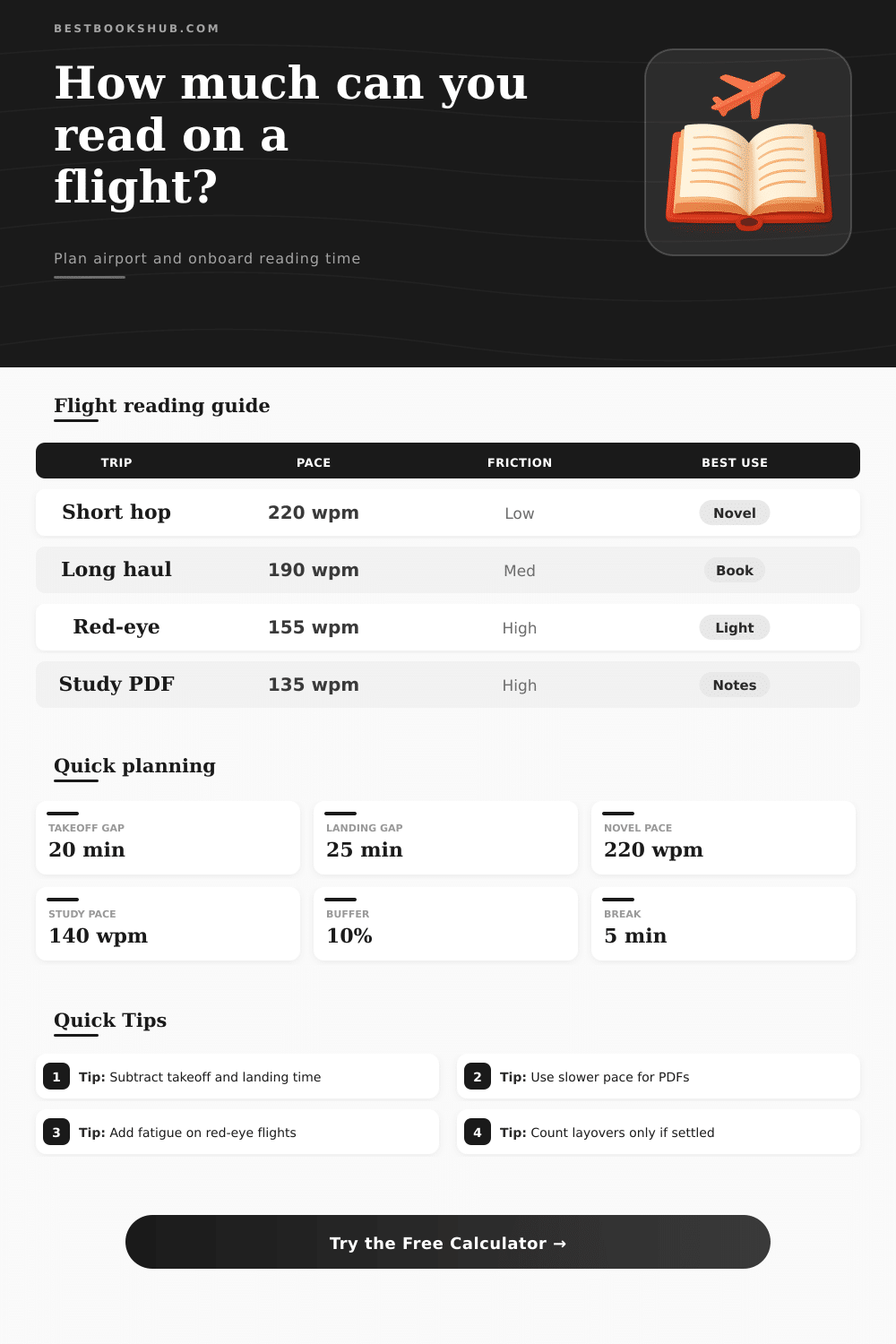
| Travel phase | Typical readable share | Default minutes | Planning note |
|---|---|---|---|
| Gate wait after settling | 50% to 80% | User entered | Count only the portion after boarding tasks, food, and restroom breaks. |
| Taxi, takeoff, climb | Low | 15 to 25 min | Announcements, device handling, and tray rules often interrupt focus. |
| Cruise | Highest | Flight minus gaps | This is the strongest reading window if lighting and seat comfort cooperate. |
| Meal or cabin service | Low to medium | 10 to 30 min | Use a larger no-reading gap for long-haul meal service. |
| Descent and landing | Low | 20 to 30 min | Pack-up time and repeated announcements reduce sustained reading. |
| Reading material | Base pace range | Multiplier | Why it changes in flight |
|---|---|---|---|
| Light fiction or memoir | 230 to 280 wpm | 0.92x | Simple continuity survives small cabin interruptions well. |
| Standard novel | 200 to 240 wpm | 1.00x | Most leisure books fit a steady cruise reading plan. |
| Narrative nonfiction | 170 to 210 wpm | 1.12x | Names, dates, and argument structure usually slow the pace. |
| Dense nonfiction | 145 to 185 wpm | 1.28x | Definitions and idea tracking need more rereading in the cabin. |
| Academic or legal PDF | 110 to 155 wpm | 1.55x | Citations, figures, layout, and notes make air reading slower. |
| Trip type | Flight time | Likely reading window | Good target |
|---|---|---|---|
| Short domestic hop | 1 h 20 min | 35 to 50 min | A chapter, article, or light review packet. |
| Medium domestic flight | 3 h 15 min | 120 to 150 min | Half a short novel or several nonfiction chapters. |
| Cross-country route | 5 h 40 min | 240 to 290 min | A full novella or a serious chunk of a longer book. |
| Overnight long haul | 8 h 30 min | 180 to 300 min | Lower target if sleep is part of the plan. |
| One-stop itinerary | 6 h total | 260 to 360 min | Works best when the layover has a settled reading spot. |
DISCLOSURE: This post may contain affiliate links, meaning when you click the links and make a purchase, I receive a commission. As an Amazon Associate I earn from qualifying purchases.
You should expect one kind of panic: you are on a long plane ride (say, four hours), sitting in an aisle seat, and all you have in your bag is a thick academic PDF. On the one hand, you’ve got four hours of clock time; but as you look at your screen, you realize that doesn’t equal four hours of reading time. What do you see? It is a bad place to focus for a long time. Physical discomfort breaks your focus. Meal service disrupts it. Crying infant distract you. Turbulence derails you. Most of us underestimate how much friction comes from travel. We don’t factor the friction in our plans.
We think “Well, this book is two hundred thousand words long” and we know we read at two-hundred words per minute. So we figure, just over fifty minutes. That’s where most people go wrong. They does the math of reading but not the math of flying. Because you’re planning, you must separate your actual reading window from scheduled flight time. The calculator does that for you, adjusting for dead zones that always arise.
How to Read Better on a Plane
Take-off and landing are non-negotiable. You cannot read during the safety demo. Probably no reading as you ram your laptop bag beneath a tiny seat, and certainly not during service when the crew wheels up with dinner. On any moderately long flight, I’d say there’s at least forty minutes of gap-time built into operations, which is to say that you can’t count on uninterrupted reading. Plus, you need some time to get settled, find your spot in text, et cetera. Before you reach page one, your usable window has shrunk considerabley. Not pessimism, just math.
Your reading speed, however, isn’t as important than the kind of thing you’re reading. Cabin interruptions don’t kill light fiction; the narrative thread is easily picked back up upon return. Miss a sentence? Just read what’s around it. Seconds later and you’re back in the flow. Study packets or dense non-fiction doesn’t forgive interruptions. Interrupted while studying a technical manual or legal document? Your brain must reorient itself to entire argument all over again.
To account for this difference, the tool assigns multipliers based off the text type. A standard novel gets baseline efficiency. Study packets or academic PDFs may slow your effective pace by 50% or more because it takes more mental effort to understand their complex structure on a small screen. Bring the novel to the plane; leave the textbook for the hotel room.
Another reason why you read less: fatigue. Your eyelids are heavy; your eyeballs is dry, and there’s barely any light around as everyone tries to catch some Zs. If you choose a timing that involves sleeping during part of the trip, the calculator takes that into account and lowers what it thinks you’re capable of doing. It makes you admit that you won’t be at your best mentally. Yes, you may feel like rushing through a chapter, but truthfully, you will skim paragraphs and fail to take in anything you are reading.
I’d recommend adding 10-15 percent to your calculations. It’s smart insurance against overestimating yourself. It factors in all those times you’ll want to sit and stare out the window while watching the clouds drift overhead. You deserve it, and it helps keep your sanity on long-haul flights. But so too are breaks.
Diminishing returns set in when you spend three hours sitting in a crowded seat reading. Your eyes starts straining. By breaking up the reading into focused blocks with short resets, you stay fresh and your focus doesn’t wander. That’s where the tool comes in, helping you plan out exactly how many of those kinds of sessions you can squeeze into your trip (with airport waits and connection times factored in).
A long layover? Perfect reading time; as long as you can snag a quiet corner far from departure gates. But a tight connection? Rushing through terminal and transit security eats up all that time. Don’t include it unless you’re certain you’ll have enough time to sit down with your book. After all, the point of flight reading isn’t to read as many pages as possible; it’s to manage expectations.
Your plan becomes strong, taking into account personal fatigue, material density, and of course, cabin friction. When you pick up your book, you have confidence: you’ve already planned how far you’re going to get before you burn out at row twelve. You shouldn’t of strive to read every single page you bring onboard. Instead, you simply enjoy the reading you will get done, without feeling guilty about what you couldn’t fit in. That balance between reality and ambition is where the best travel reading occur.