⏱ Listening pace lab
Playback speed time savings calculator
Compare audiobook, lecture, and reread playback speeds with buffers, progress, session length, finish dates, and the real time saved against your current pace.
Use the nominal length printed by the audiobook app at 1.0x. The calculator converts that into wall-clock time at each speed and adds a practical rewind or note buffer.
| Playback speed | Wall time for 1 hour | Time saved | Good fit |
|---|---|---|---|
| 1.0x | 60 minutes | 0 minutes | Careful listening, language practice, heavy notes |
| 1.1x | 54 minutes 33 seconds | 5 minutes 27 seconds | First speed increase or difficult narration |
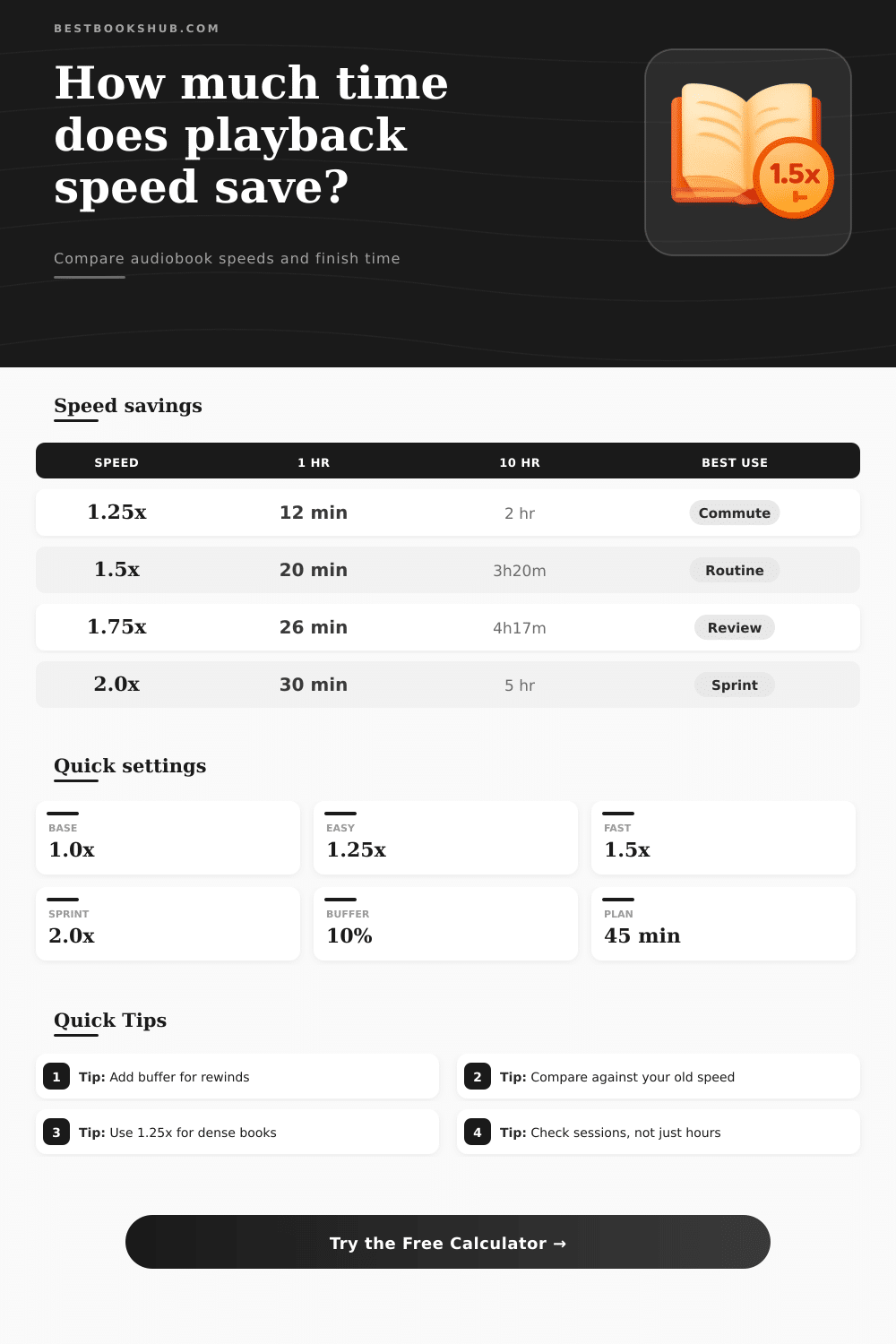
| 1.25x | 48 minutes | 12 minutes | Audiobooks, memoirs, familiar nonfiction |
| 1.5x | 40 minutes | 20 minutes | Commutes, workout blocks, clear narration |
| 1.75x | 34 minutes 17 seconds | 25 minutes 43 seconds | Rereads, review material, recap listening |
| 2.0x | 30 minutes | 30 minutes | Deadline finish, very familiar content |
| Material | Typical buffer | Why time returns | Planning signal |
|---|---|---|---|
| Light fiction | 0-5% | Few rewinds unless distracted | Speed gains stay close to the formula |
| Memoir or narrative nonfiction | 5-10% | Names, dates, and scene shifts may need repeats | Use 1.25x or 1.5x for steady progress |
| Dense nonfiction | 10-15% | Arguments and terms can require quick jumps back | Compare 1.25x against 1.5x before committing |
| Lecture or course audio | 15-20% | Pauses for notes reduce the headline savings | Session count matters more than raw speed |
| Language practice | 20-30% | Repeats and pronunciation checks are part of the task | Lower speed can be more efficient overall |
| Plan | Daily minutes | Weekly capacity | Best speed test |
|---|---|---|---|
| Short commute | 20-30 minutes | 100-150 minutes | 1.25x keeps chapters easy to follow |
| Gym and errands | 35-50 minutes | 175-250 minutes | 1.5x often fits a full chapter |
| Bedtime listening | 20-45 minutes | 140-315 minutes | 1.0x to 1.25x reduces missed details |
| Weekend catch-up | 90-150 minutes | 180-300 minutes | 1.5x can cut a long backlog cleanly |
| Course review | 45-90 minutes | 225-450 minutes | 1.25x with a larger buffer is safer |
| Original length | At 1.25x | At 1.5x | At 2.0x |
|---|---|---|---|
| 6 hours | 4h 48m, saves 1h 12m | 4h, saves 2h | 3h, saves 3h |
| 10 hours | 8h, saves 2h | 6h 40m, saves 3h 20m | 5h, saves 5h |
| 15 hours | 12h, saves 3h | 10h, saves 5h | 7h 30m, saves 7h 30m |
| 24 hours | 19h 12m, saves 4h 48m | 16h, saves 8h | 12h, saves 12h |
| 40 hours | 32h, saves 8h | 26h 40m, saves 13h 20m | 20h, saves 20h |
DISCLOSURE: This post may contain affiliate links, meaning when you click the links and make a purchase, I receive a commission. As an Amazon Associate I earn from qualifying purchases.
It can be frustrating if you’re at the end of a book and realize there’s no way you’ll finish on time, two chapters left! Yet the app display three days of listening. That’s just how split our attention tends to get. With a digital library, it’s up to us to adjust this ratio.
Want to bump up the play rate to max? Good luck getting through that without losing your place (usually). Speeding things up sounds like mathematically cheating, which is part true: It cuts down raw duration. But it also add cognitive load. You have to find a happy medium. Adjust, not guess.
How to Choose Your Listening Speed
Enter your listening speed, along with the nominal length of book, and the calculator does the math. If you’re listening at 1.5x or higher, you aren’t simply zipping past words, you’re decoding information that’s been squeezed together. That means dense non-fiction needs time to breathe. You’ll encounter complex arguments and has to remember names. These certain rewinds cancel out your theoretical savings right there.
The ten percent buffer accommodates these real-world hiccups, making the estimate realistic. After all, ignoring reality makes every finish date a little bit misleading. The point of all this is: when you turn up the speed, what you listen to should matter. The way we think about variable speed changes our understanding of different content.
For fiction, going a little faster seems helpful. It takes out some of the dead air between scenes without making it sound distorted or overtaking your imagination. After reading a couple chapter at 1.25x it sounds naturaly. On non-fiction, it’s a bit different. We want it to feel like discovery more then review.
If you’re listening to something you’ve already read, then pushing it to 2.0x makes sense. At that speed, you’re scanning for reinforcement. You don’t need to discover anything new. But if you try to go that fast with a dense technical lecture, it just frustrates you. The kind of content matter almost as much as the speed.
So: The tool prompts you to enter how long each session is… Along with how many days a week you’ve been actively listening. It multiplies those variables out into your actual week-to-week capacity, which converts your abstractions (e.g., “I’ve listened for 40 hours“) into something more concrete (a projected date on your calendar).
Most of us guess based off our total number of hours, then divide them up by minutes per day. We miss this fact: we don’t listen every day. Commuting breaks is interrupted; workouts cut short. The math reveals when you’ll really reach the finish line. This makes all the difference when planning. Need something done by next week? You realize you’re working on six weeks, rather then four. How you focus shifts accordingly.
Many people believe faster is always better. Not true. You don’t want to go so fast that your brain cannot keep up because comprehension will drop rapidly. On the page there is a reference table comparing speeds to the density of material. So use that to decide whether you are willing to pay the mental “cognitive tax” for increased velocity.
If you’re having to press the rewind button often, slow it down a bit. Better to have high retention at a slightly slower pace than have high speed with no recall. Time management is about controlling playback speed. It’s about cramming more life in a day while still learning. So don’t think of it as racing through your books. Think of it as matching how much you read to your time.
Start small, then tweak the buffer. See what happens when you add a little more, the shift in your finish date will amaze you. When you learn that rhythm, you won’t stress out at the final couple of chapters. That’s simply become another part of the routine.