🎧 Narration pace lab
Narrator words per minute calculator
Estimate spoken words per minute, finished audio length, target pace, pickup allowance, studio time, and recording days for audiobooks, podcasts, lessons, and voiceover scripts.
Load a realistic narration job, then adjust words, pacing style, pauses, pickups, and recording schedule.
| Narration format | Typical finished WPM | Pause behavior | Planning note |
|---|---|---|---|
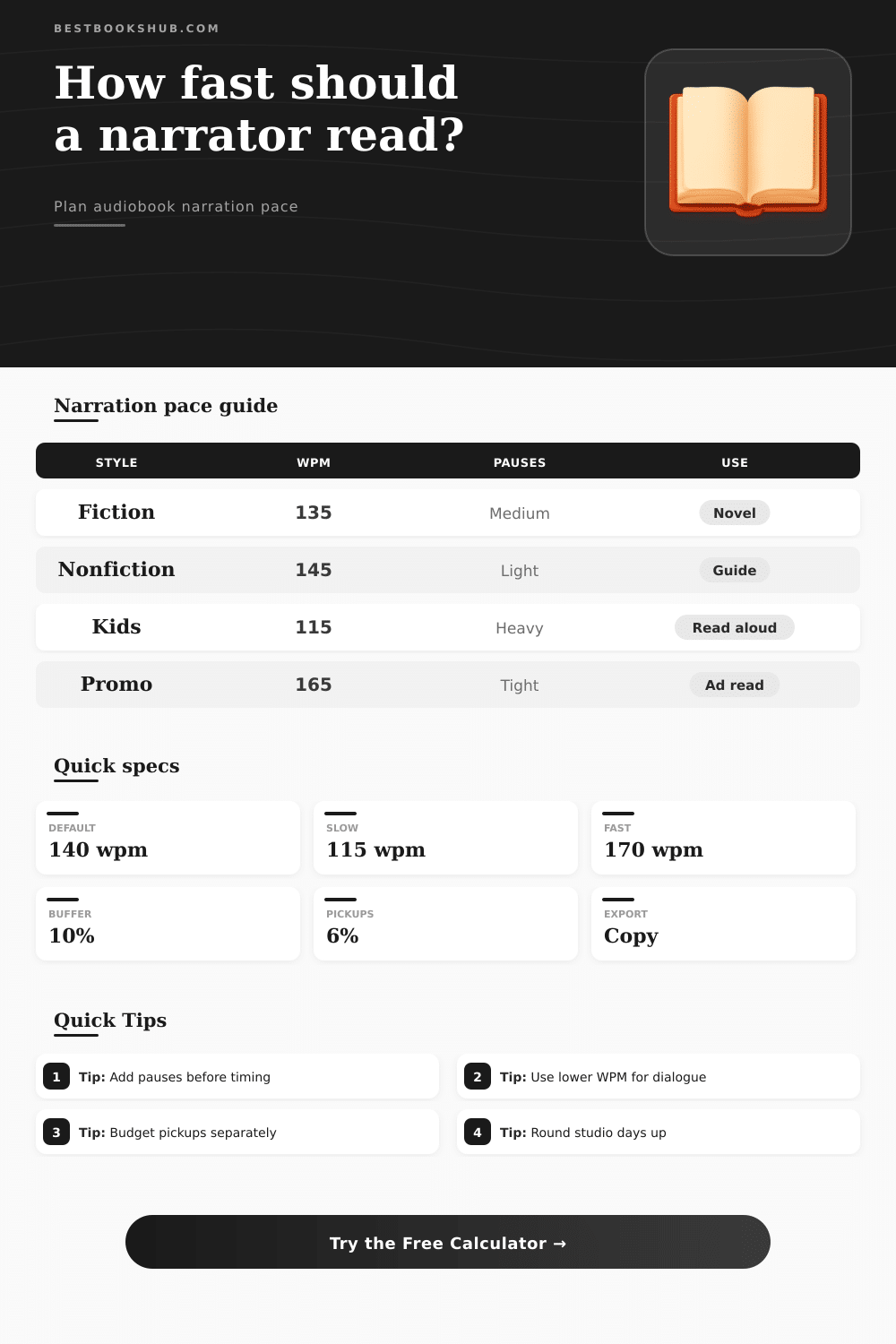
| Literary fiction | 115 to 140 WPM | Longer paragraph and emotional pauses | Good for reflective prose, interiority, and atmosphere. |
| Commercial fiction | 130 to 155 WPM | Moderate pauses with character beats | Works for most novels, memoirs, and narrative nonfiction. |
| Clear nonfiction | 140 to 165 WPM | Shorter pauses, strong sentence clarity | Use for business, self-help, history, and guide-style prose. |
| Children's read aloud | 90 to 125 WPM | Heavy pauses and expressive emphasis | Leave space for comprehension, reactions, and page turns. |
| Podcast script | 135 to 170 WPM | Varies by host rhythm | Conversational scripts can run fast but still need breath marks. |
| Promo read | 160 to 190 WPM | Tight pauses | Useful for short ad reads where every second matters. |
| Word count | At 120 WPM | At 140 WPM | At 160 WPM | Best use |
|---|---|---|---|---|
| 750 words | 6.3 min | 5.4 min | 4.7 min | Short article or intro |
| 1,500 words | 12.5 min | 10.7 min | 9.4 min | Podcast segment |
| 3,000 words | 25.0 min | 21.4 min | 18.8 min | Typical book chapter |
| 8,000 words | 66.7 min | 57.1 min | 50.0 min | Long chapter or lesson |
| 50,000 words | 6.9 hr | 6.0 hr | 5.2 hr | Short audiobook |
| 80,000 words | 11.1 hr | 9.5 hr | 8.3 hr | Full-length novel |
| Script signal | Adjustment | What it changes | When to raise it |
|---|---|---|---|
| Dialogue density | +2% to +8% time | Character turns, attributions, emotional beats | Many short quoted lines or rapid speaker changes. |
| Comma-heavy prose | +3% to +10% time | Breath marks and clause clarity | Long sentences with serial phrases or academic cadence. |
| Scene breaks | +2 to +6 sec each | Listener orientation | Multiple shifts in viewpoint, date, or location. |
| Hard names | +4% to +14% load | Practice, retakes, and proofing | Fantasy names, citations, foreign terms, or acronyms. |
| Pickups | +3% to +12% load | Extra recording and correction time | New narrators, noisy rooms, or complex dialogue. |
| Production ratio | Meaning | Good fit | Watch item |
|---|---|---|---|
| 1.4x | Lean live-read workflow | Clean narrator, simple script, light edits | Leaves little room for proofing surprises. |
| 1.8x | Experienced audiobook pass | Prepared narrator and stable recording space | Still budget pickups separately. |
| 2.4x | Normal home-studio workflow | Most independent narration projects | Editing time can spike with noise or mouth clicks. |
| 3.2x | Careful proof and polish | Technical, dialogue-heavy, or release-ready audio | Requires realistic session spacing. |
| 4.0x | New narrator safety plan | Learning workflow or difficult material | Fatigue can reduce clean take quality. |
DISCLOSURE: This post may contain affiliate links, meaning when you click the links and make a purchase, I receive a commission. As an Amazon Associate I earn from qualifying purchases.
Measure finished WPM from a one-page test read before recording a long manuscript. A personal sample beats any generic range.
Keep listener runtime separate from studio load. Pauses affect both, while pickups and QC usually affect only production time.
Speed of speech is typically thought of as something innate, like eye color, or height: it can’t be changed. It can.
It’s variable, depending not just on number of hard-to-pronounce names in book, but also how they’re punctuated and what voice you’re giving them. When you think of your manuscript as a fixed chunk of words the time clock will cheat you. Plug in how many words you want spoken at what pace, and calculator does the rest. You won’t have to guess if you’ll read your chapter in twenty minutes or forty-five. Because when you’re billing-by-the-hour, or you need a specific run-time for an audiobook release that difference makes all the difference.
How to Calculate Audiobook Timing
Begin with the base pace. Most fiction float down around one hundred thirty words a minute. This is because silence is a part of storytelling. Non-fiction is typically a bit quicker at about one hundred forty words a minute for adult. For children’s books, go even lower. They require that you emphasize more and give them time to breathe as they follows along with the tale.
With this tool you can set the bands up by genre so you’re not relying on how quickly YOU read last night. Most projects are tripped up by the density of pauses. You can count words easily. But you can’t count the silence. Commas mean time, paragraph breaks mean more time. Scenes with lots of dialogue need separate pauses after each speaker or else listener will get lost. To deal with all of this, calculator allows you to choose a pause mode, adding those silent seconds back into overall runtime.
This is important, as listeners judge not only by clarity, but also by pacing. If it sound rushed, they think it was a cheap read. If it sounds measured, they feel like it was done professionaly.
And then there are the pickups. That’s the secret tax of narration. And yes, you’ll miss a word. Yes, you’ll stumble over a proper noun. Yes, you’ll laugh at your own line reading and blow the take. Give yourself a buffer for retakes: typically about six percent of total load per project. Otherwise, what should of be a final edit turns into a scramble. That’s why the tool helps separate studio load from finished runtime, a useful distinction to make. One number represents how long you sit in chair. The other is how long listener sits down.
Your production speed also greatly depends on how experienced you are. One-hour of finished audio could take a pro just two hours in the studio. Meanwhile, a newcomer may spend four hours trying to deal with mic technique and background noise. That’s why calculator allows for a production efficiency factor. This makes you be real with yourself about your work flow. Go with a higher ratio if you’re still getting the hang of it. Your ears will appreciate you later… especially when you burn out at chapter three.
The industry offers general reference tables that do not consider texture of your particular script. Technical manuals with pronunciation checks slows everything down. Complex sentence structures speed up the mind but slow down mouth in literary fiction. Look at your actual pages. Scan them for long lists, comma clusters and foreign terms. They’re speed bumps. With calculator you can adjust for difficulty and add time back into schedule before you’ve recorded a single word. Hope is not a plan.
Narrators often underestimate the editing process. They assume recording is difficult task, when in fact leveling volume and cleaning up mouth clicks takes time. Quality control gets its own 10% buffer. These are the little things that keep listeners from getting tired. In one chapter you won’t hear it, but across fifty hours of audio those minutes are days worth of difference.
In the end, it’s all about wpm: It’s where you start. What matters most? You need to know when to dial back. Are you reading from a textbook, or a thriller novel? It doesn’t matter. Your job is for people to understand what you say. If they need to hit “back,” you went too quick. Let the words tell you how to proceed; use this as a tool to establish your standard. It will inform your plans, and it’ll keep them listening if the performance does.