Writing goal planner
Words remaining to goal calculator
Calculate the true gap between your current draft and your word-count goal, then turn it into daily targets, session loads, finish timing, and a realistic buffer.
| Project type | Typical goal | Good daily range | Planning note |
|---|---|---|---|
| Short article or newsletter | 800-2,500 words | 250-800 words | Use a light buffer if most research is already done. |
| Book proposal chapter | 5,000-12,000 words | 500-1,200 words | Model cuts because proposal language often gets tightened. |
| Novella draft | 20,000-40,000 words | 800-1,500 words | Session targets matter more than calendar averages. |
| Novel draft | 70,000-100,000 words | 750-2,000 words | Reserve missed days so the middle of the book does not collapse the schedule. |
| Thesis or dissertation chapter | 8,000-20,000 words | 300-1,000 words | Use academic mode and a higher cut rate for revision passes. |
| Words per session | 50-minute pace | Best for | Watch for |
|---|---|---|---|
| 250-400 | 300-480 words/hour | Dense research, academic paragraphs, careful revision | Too low for deadline-heavy drafting unless many sessions are available. |
| 500-750 | 600-900 words/hour | Steady fiction scenes, essays, memoir sections | Works best with a clear outline or next-scene note. |
| 900-1,200 | 1,080-1,440 words/hour | Prepared drafting, sprints, familiar material | May need a higher cut buffer after fast sessions. |
| 1,500+ | 1,800+ words/hour | Timed challenges, dictation, very loose drafts | Quality control should happen in a separate revision pass. |
| Setting | When to use | Effect | Example |
|---|---|---|---|
| 0-5% buffer | Clean expansion, fixed assignment, final gap | Keeps target close to the exact goal | 2,000 words left may become 2,100. |
| 10% buffer | Normal drafting with mild trimming expected | Protects against small cuts and deleted sections | 20,000 words left becomes 22,000 before cut modeling. |
| 15-20% buffer | Revision-heavy or uncertain middle sections | Creates room for rewritten passages | A 35,000-word gap may need 40,000+ drafted words. |
| 25% buffer | Exploratory drafts, discovery writing, major restructure | Assumes much of the draft will be reshaped | Useful when the outline is still moving. |
| Signal | Low pressure | Moderate pressure | High pressure |
|---|---|---|---|
| Daily calendar target | Under 700 words | 700-1,500 words | Over 1,500 words |
| Session load | Under 600 words | 600-1,000 words | Over 1,000 words |
| Writing days per week | 5-7 days | 3-4 days | 1-2 days |
| Cut modeling | 0-5% | 10-15% | 20% or more |
DISCLOSURE: This post may contain affiliate links, meaning when you click the links and make a purchase, I receive a commission. As an Amazon Associate I earn from qualifying purchases.
Or: You’re halfway through your 80,000-word novel, having written exactly 42,000 words. Cold dislike glares back at you from the blinking cursor. On one hand, you’re proud; on the other, you’re petrified: Forty-eight thousand more words remain before the deadline arrives. Which means you’ll need to type them all right now, right? You might do this if only to get back on schedule.
And if there’s anything that scares most people away from writing, it’s this very thought. It’s panic. Panic usually ends with giving up altogether.
How to Use the Writing Calculator
But what if you could swap that fear for some good old-fashioned math, a way to turn a shapeless mountain into a doable staircase? The calculator above do just that.
So start here: be honest about where you’re starting from. Enter the actual number of words you’ve got, the ones on the page, the ones you know for certain are written down and not up there in your head or on your notes. Including today’s progress matter because it shrinks the gap immediately, even if the amount seem small. And that’s a good thing.
The tool gives you the option to include or exclude today’s work in your running total, and this is less of a math decision than a psychology decision. If you want to include it, you get to see the smaller number and that feels great. If you don’t, you get to declare victory on that day but preserve the longer-term strategy. It’ll adjust the math either way so you know how far you still has to go.
The other thing that distinguishes a daydream from a plan is the buffer setting. Novices will skip over this, but seasoned writers understands that first drafts are sloppy beasts. Scenes gets cut out. Chapters get rewritten. What was a beloved character in Chapter 3 turns out not to work by Chapter 10.
If you intend for your book to be precisely eight-oh thousand words, and fail to account for all the things you’ll lose along the way, you will probably end up too low. The calculator has settings where you can build in a buffer of between zero and twenty-five percent. A standard draft will often be fine with just adding in ten percent. Use twenty-five percent if you’re learning about the story while writing it down. Remember: This buffer isn’t padding; it’s insurance against your own creativity evolving.
But then there’s the matter of scheduling. How frequently do you write? How many days do you have left? Is it five days a week, or seven? Seven sounds great, but five is very different than. That affects what the tool tells you: how much you can expect to do each day, given those limits.
Depending on what it says (e.g., fifteen hundred words a day, if all you get is an hour), maybe it’s not your typing speed that is the issue. Maybe it’s your schedule. Perhaps you should of consider shortening your buffer, stretching your deadline, or facing up to the fact that the book will turn out shorter than expected.
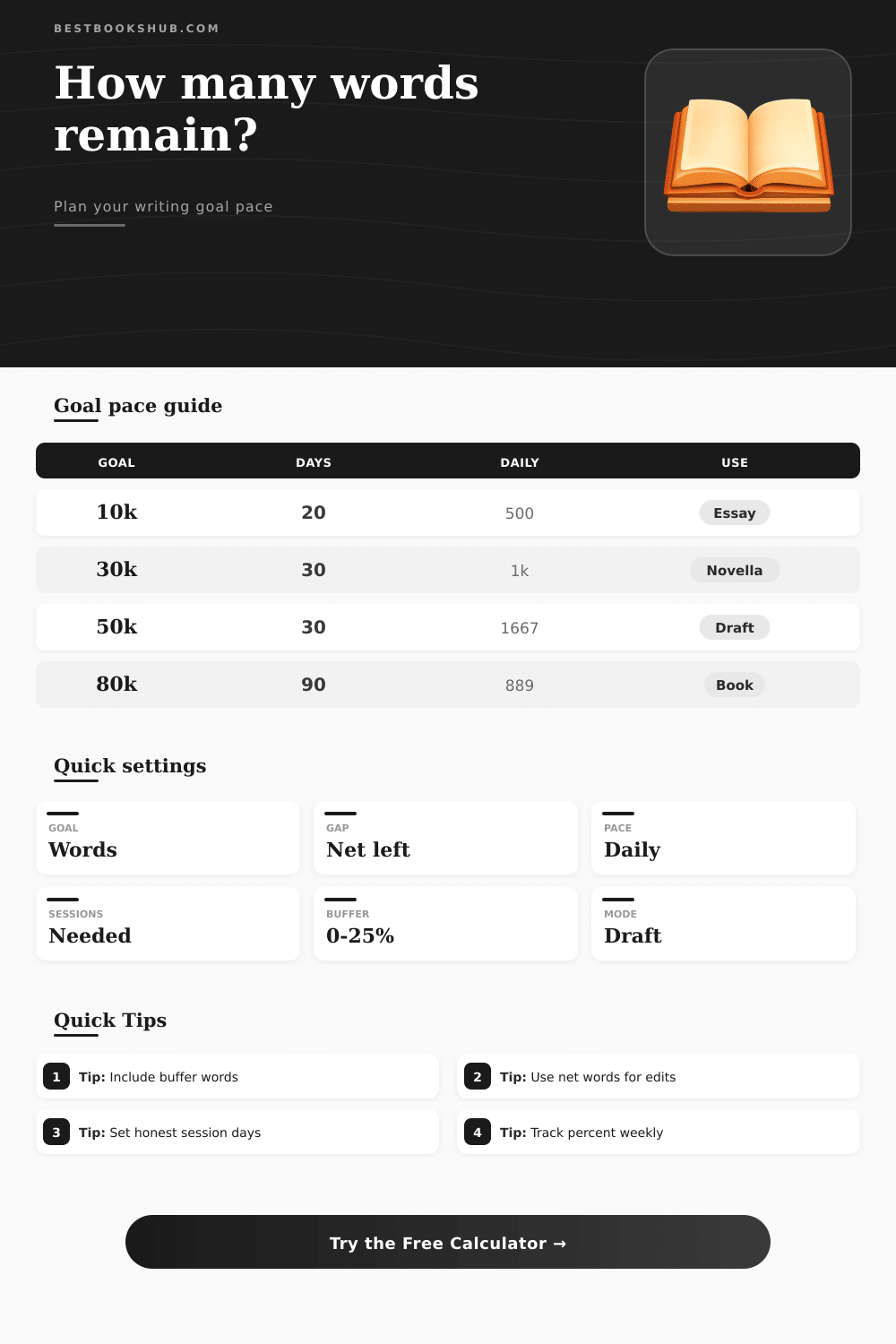
The page contains a reference table that helps with this. It outlines common goals and their reasonable daily pace so you can compare your situation to what is standard in the industry.
Finally, there’s the idea that you must write fast. A lot of new writers assume if they can’t get their goals down on paper by typing quickly, it doesn’t count. That’s not true. It’s better to be consistent than fast. For example, getting used to showing up and writing five-hundred words a day for a couple months will get you further along. This is better then blasting through ten-thousand words in a weekend and taking a break from writing for three weeks.
The calculator asks about average session length and sessions per day, which makes you think about specific blocks of time instead of fuzzy good intentions. Often, a concentrated half-hour writing session tend to yield better results than an hour of sporadic tapping around.
Last, think about word count. Did you know you can edit out words? (You do know this, right?) When you’re not creating from scratch but cleaning up existing content, you’ll want to include those missing words in the calculation. Expecting major cuts down the road? Just tell the tool, and it’ll bump your target accordingly so that your finished product will meet the mark, polished and cut.
Taking these factors into consideration helps eliminate guessing. It goes from, “can I make it?” to “I KNOW how much I need to produce every day.”
Sure, there’s still a mountain standing before you. But now there’s also a map of how to conquer it.