📖 Reading pace lab
Pages per hour calculator
Estimate adjusted pages per hour from words per page, reading mode, notes, rereads, pauses, and fatigue so book deadlines feel measurable.
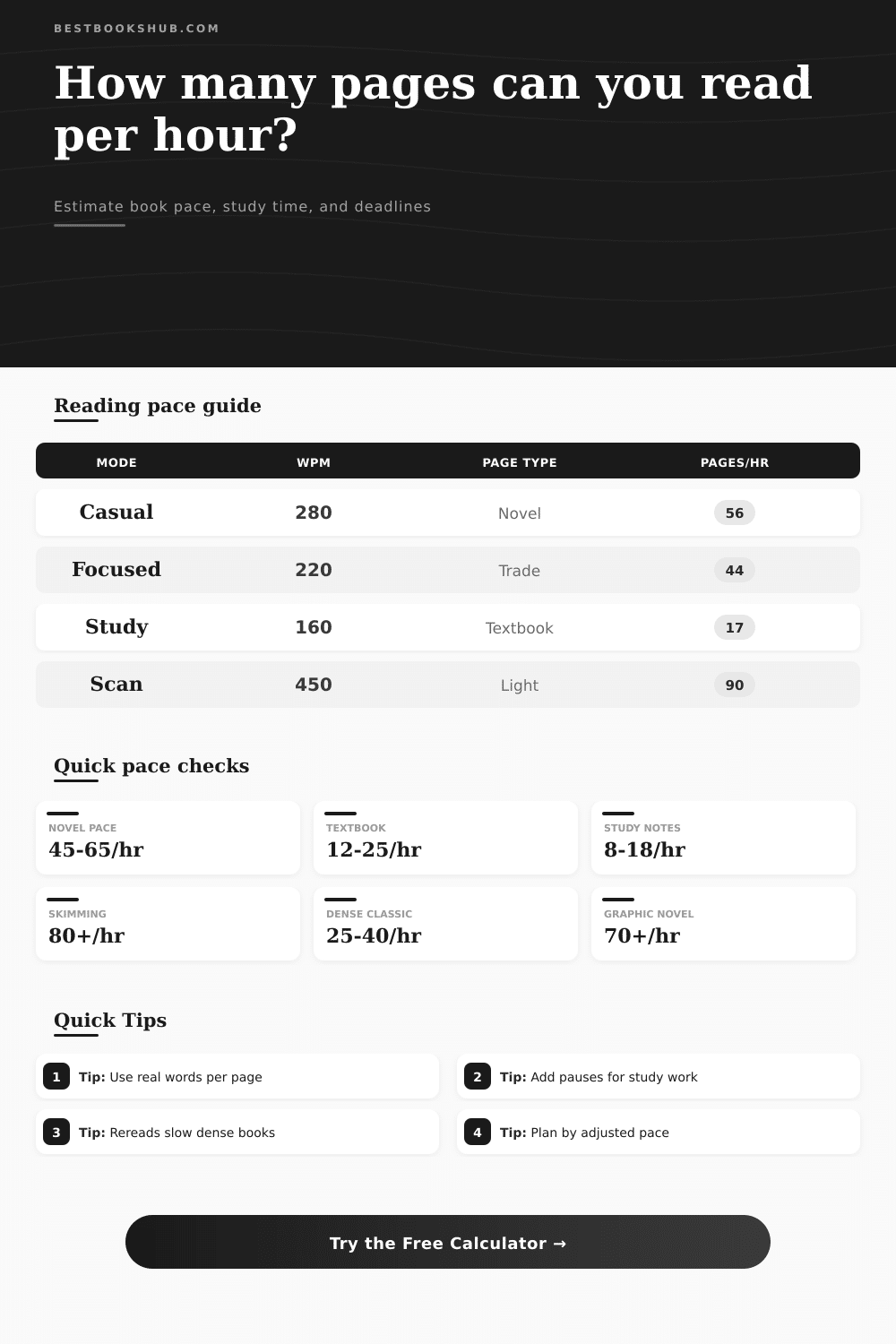
| Mode | Typical wpm | Best for | Adjustment to time |
|---|---|---|---|
| Skim or scan | 400-600 | Finding headings, terms, or a basic overview | Fast, but retention may be shallow |
| Casual reading | 240-320 | Novels, memoirs, light nonfiction | Good default for page-per-hour planning |
| Focused reading | 180-240 | Serious nonfiction, classics, complex arguments | Adds time for attention and mental pauses |
| Study reading | 120-180 | Textbooks, exams, marked-up readings | Often doubles total elapsed time with notes |
| Proofread/edit | 90-150 | Manuscripts, theses, line edits | Slowest because the eye checks every sentence |
| Page type | Words per page | What changes pace | Common use |
|---|---|---|---|
| Mass market paperback | 250-300 | Small trim size but compact type | Genre fiction and portable paperbacks |
| Trade fiction | 280-330 | Moderate margins and readable line length | Most modern novels and memoirs |
| Dense classic | 330-420 | Long sentences and compact layouts | Classics, literary fiction, older editions |
| Academic monograph | 375-475 | Footnotes, citations, and argument density | Research books and graduate reading |
| Textbook | 450-650 | Figures, problems, captions, and review stops | Courses, exams, and technical study |
| Graphic novel | 50-140 | Image scanning and panel density | Comics, manga, and visual narratives |
| Goal | Pages | Adjusted pace | Daily minutes needed |
|---|---|---|---|
| Book club novel in 7 days | 320 | 50 pages/hour | 55 minutes/day |
| Textbook chapter in 3 days | 75 | 18 pages/hour | 83 minutes/day |
| Research packet in 5 days | 140 | 24 pages/hour | 70 minutes/day |
| Classic novel in 14 days | 480 | 34 pages/hour | 61 minutes/day |
| Proofread thesis in 10 days | 210 | 14 pages/hour | 90 minutes/day |
| Scenario | Pages | Page density | Expected pace |
|---|---|---|---|
| Paperback Novel | 320 | 275 words/page | 55-70 pages/hour |
| Dense Classic | 420 | 360 words/page | 28-42 pages/hour |
| University Textbook | 95 | 550 words/page | 12-22 pages/hour |
| Research Chapter | 38 | 425 words/page | 18-30 pages/hour |
| Graphic Novel | 180 | 90 words/page | 80-160 pages/hour |
A 40-page textbook chapter can take longer than 100 pages of a fast novel because each page carries more words, concepts, and stops.
DISCLOSURE: This post may contain affiliate links, meaning when you click the links and make a purchase, I receive a commission. As an Amazon Associate I earn from qualifying purchases.
If notes matter, add minutes per page instead of lowering words per minute. It keeps your base reading speed honest.
When you attempt to read quickly, there’s a practical limit on how fast you can go. It has nothing to do with your finger or turning the page. It’s about your brains speed at processing information and moving eyes across sentences. People tend to estimate how fast they read by assuming that each page take up an even amount of time. They don’t account for varying degrees of difficulty between chapters (a complicated one will take longer to process then a light story). Pages-per-hour is important because it takes this into account.
After setting your reading environment, let the calculator do the math. First consider page density. We all tend to ignore this variable. Total word count gets our attention instead of how concentrated that count are on each page. A textbook might have more words per page than a paperback, yet it also breaks your flow with diagrams and footnotes. Rereading and note-taking for study time adjusts the grand total. Your goal isn’t reading, it’s absorbing information so tack on a few seconds per page for notes and then realize that those thirty seconds multiplied by fifty pages equals…
How to Plan Your Reading Time
When you spend an hour intensely working, you’re spending two hours in calendar time. The next step is: The comprehension goals will set your speed based off how much you need and can handle. If retention isn’t necessary (skimming), then you can go fast. But if it’s study reading (you must remember the material) then you’ll be forced to slow your eyes down and let your brain process what it see. That’s why the tool use multipliers based on real world attention spans. It takes into account fatigue as well.
Most people hits a bit of a wall around 2 hours when it comes to processing power. Don’t ignore this and think you can get just as much done on a Saturday afternoon. Plan ahead for the slowdown and avoid the frustration of running headfirst into a wall half way through a chapter. Measuring exposure time (e.g., “I’m a fast reader”) rather than comprehension time makes people overestimate their reading speed. Fast page flipping doesn’t imply stored information. Reading deeply, not merely rapidly (separates studying from casual reading).
Set the system to university textbook, and it will reduce expected words-per-minute. Why? It adjusts for density of complex sentences and technical vocabulary. It is about realism, not a penalty. Academia demands more eye movements and more mental pauses as we work through an argument. Trying to read academic text at novel speed lead to wasted time and shallow understanding.
The other invisible variable of reading efficiency are breaks. Sure, it might seem like you’re being more efficient by sitting down and reading for an hour without pause but what happens after you shatter your concentration? How do you sustain that same level of understanding over time? Shorter breaks prevent brain tiredness from hurting your understanding. You can plug them into the hourly rate to find out how many pages you’re really getting through.
When planning a reading marathon, or when deciding how long to schedule study session, this modified rate becomes relevant. The changed pace lets you plan for it. You don’t have to guess when you’ll be done, anymore. Keep in mind that fifteen pages of detailed content take an hour when you include note-taking and breaks. Now you know just how many study sessions it would of required to get through a text. It takes away the guessing game and makes anxiety into math.
The tables on the page shows the average benchmark so that you can test your own guesses against a standard. How does what you get compare to these benchmarks? Are you too cautious? Or are you over-optimistic? Yes, reading is something you get better at over time. But there are limits, biological ones. There’s no point in pushing yourself beyond your ability. You’re not going to read any faster than your brain can think.
Understanding these limits lets you plan accordingly and also not feel stressed out about it. Once you know where your weak spots are, you’ll stop trying to fight your own body and learn to work with it instead. Ripping through the text isn’t the point. The point is to spend your time reading well and engaging with the material. Pacing yourself accuratley turns reading from a stressful experience into a manageable chunk of your day. You know what you’ve read, you’ve finished on-time, and you don’t have that sinking feeling at all.