📚 Reading deadline planner
Book finish countdown calculator
Turn a total page count, current page, reading speed, available days, and target date into a realistic page-by-page countdown.
Use the page number printed in your copy. If the edition has notes, introductions, or appendixes you do not plan to read, set the total pages to the last page you need.
| Remaining pages | 14-day plan | 30-day plan | 60-day plan | Best use |
|---|---|---|---|---|
| 150 pages | 11 pages/day | 5 pages/day | 3 pages/day | Short classic, novella, or assigned excerpt |
| 300 pages | 22 pages/day | 10 pages/day | 5 pages/day | Standard novel or moderate nonfiction section |
| 500 pages | 36 pages/day | 17 pages/day | 9 pages/day | Long novel, collected essays, or course reading |
| 800 pages | 58 pages/day | 27 pages/day | 14 pages/day | Large edition or multi-part reading project |
| 1,200 pages | 86 pages/day | 40 pages/day | 20 pages/day | Very long classic or complete volume deadline |
| Pace type | Pages/hour | Pages in 30 min | Pages in 60 min | When it fits |
|---|---|---|---|---|
| Careful annotation | 15-25 | 8-13 | 15-25 | Close reading, margin notes, or difficult passages |
| Dense fiction | 25-35 | 13-18 | 25-35 | Older prose, complex structure, or frequent references |
| Comfortable novel | 35-45 | 18-23 | 35-45 | Most sustained reading sessions without heavy notes |
| Fast light reading | 50-70 | 25-35 | 50-70 | Clear style, rereads, or high-familiarity subjects |
| Skim review | 80+ | 40+ | 80+ | Review pass, not a first complete reading |
| Preset | Page count used | Sample progress | Planning load | Calculator note |
|---|---|---|---|---|
| War and Peace | 1,225 pages | Page 150 | Large | Uses a high buffer and slower dense-text pace. |
| Moby-Dick | 635 pages | Page 90 | High | Balances long chapters with steady reading days. |
| Dune | 688 pages | Page 180 | High | Good for a five-week finish plan. |
| The Hobbit | 310 pages | Page 60 | Medium | Works well with shorter daily sessions. |
| The Great Gatsby | 180 pages | Page 30 | Light | Shows how small books can still need a buffer. |
| Daily time | At 30 pages/hour | At 40 pages/hour | At 60 pages/hour | Best deadline style |
|---|---|---|---|---|
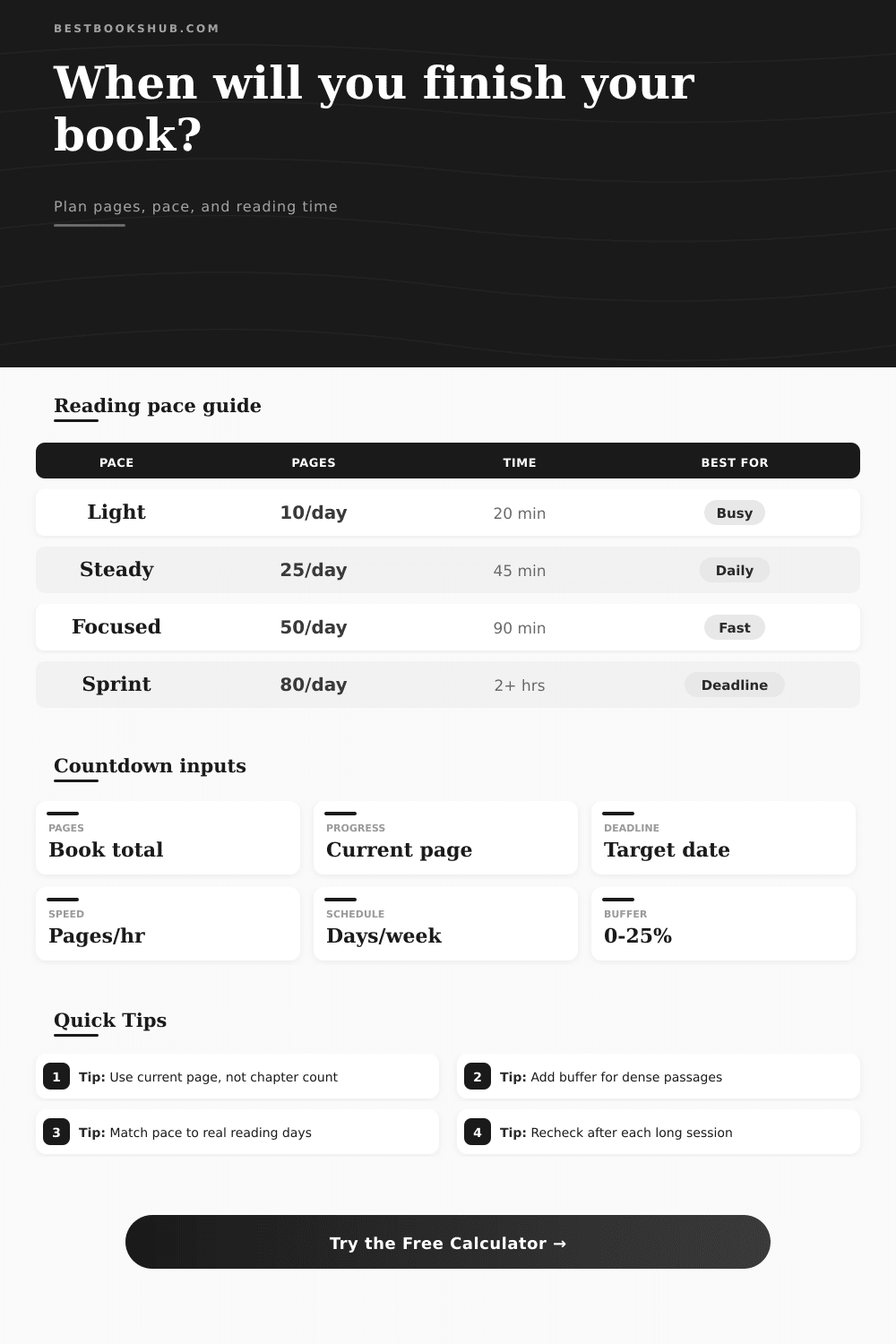
| 20 minutes | 10 pages/day | 13 pages/day | 20 pages/day | Light steady habit |
| 45 minutes | 23 pages/day | 30 pages/day | 45 pages/day | Most book-club plans |
| 60 minutes | 30 pages/day | 40 pages/day | 60 pages/day | Course or deadline reading |
| 90 minutes | 45 pages/day | 60 pages/day | 90 pages/day | Focused finish push |
| 120 minutes | 60 pages/day | 80 pages/day | 120 pages/day | Short-term reading sprint |
DISCLOSURE: This post may contain affiliate links, meaning when you click the links and make a purchase, I receive a commission. As an Amazon Associate I earn from qualifying purchases.
There’s nothing wrong with buying books. The provided source does not mention learning about yourself or the world through buying books. But here’s the problem: we get our hopes up when we purchase a book. We think we’ll plow through it. We imagine reading it on our commutes, during our lunch hours. Then, before you know it, three weeks have gone by and you’re only on chapter three. Why? Because you lost your rhythm. Your momentum for the story are gone. It’s not because you don’t have willpower, it’s because you didn’t have a plan.
Reading shouldn’t be something that you do when mood strikes; it should be part of your schedule, a project. Until real life gets in the way, it’s easy math. How fast do you actualy read when you are not trying? How long does that take? And then there’s the question: How far along are you? Enter your starting point (page number) and your goal ending date (deadline), and the calculator do the rest of calculations for you. You don’t have to wonder anymore whether or not you’ll make it; instead, it spits out a very clear plan for what need to be accomplished every single day to get you to where you want to go.
How to Make a Plan to Finish Your Book
You might be underestimating how fast you read (and I think most of us do). Skimming and comprehension are two different skill. When we read difficult books (whether it’s complex fiction or dense nonfiction), our brain can’t keep up with our eyes’ rapid motion. To do this, use the tool to measure how difficult the text is. For light texts, add a ten percent buffer. For heavier academic texts, go for thirty five percent. This will protect against crash of overestimating your daily intake. Underestimate your pace rather than drop the book altogether after you find chapter four to be more difficult then anticipated.
In addition to pages, there’s another variable: how many days you’ll be able to read. Six day feels like a lot. Then, you find yourself unable to read even once and suddenly feel like all of those plans went out the window. To make things more realistic, you can specify how often you’re going to read and the calculator will adjust accordingly. Want to read on weekdays but take weekends off? The app will lower your daily requirement while ensuring you still meet your end-of-week deadline on Friday night. No weekend cram sessions! That way, it doesn’t feel like work; it’s always fun.
The key for good readers is buffer time. You’ll get tired. Life will happen. You’ll have social event. Schedules with zero percent buffer are fragile; they shatter at any hint of difficulty. When you add a cushion (ten to fifteen percent), missed days no longer turns into emergencies. They simply become little deviations. Things you can absorb without panicking. Flexibility prevents giving up and keeps you on track. Consistency, not perfection, is what we’re aiming for.
Finally, the classic novel settings can give you a useful reality check. You approach The Great Gatsby different than War and Peace. The former is one that lends itself better to shorter, more concentrated bursts, whereas the latter need to be tackled in smaller amounts over weeks with greater stamina. Knowing what you’re taking on gives you an opportunity to select an appropriate speed at the beginning. If you try to run through a thousand page book, you’ll find yourself out of steam long before the halfway mark. Conversely, if you take a slow stroll through a short story collection, you may think you’re wasting precious time that could of been spent crossing things off the list.
In the end, though, it’s all about enjoying the ride, not forcing it. And one way a good plan eliminates friction is that you don’t have to ask yourself “how many pages should I read today?” It’s already chosen for you! Just flip open the book and get lost in it. Let the story take you where it needs to go. Finish on time. Understand what you’ve read. Feel like you got something done. Instead of feeling depleted by the experience. That’s why it moves from good intention to fulfilled goal: when the structure works for you and helps support the enjoyment. Have realistic expectations and let the numbers do their thing.