🎧 listening pace lab
Audiobook Hours to Pages Calculator
Estimate equivalent print pages, word count, listening time, and page pace from an audiobook length, narration speed, playback speed, and page density.
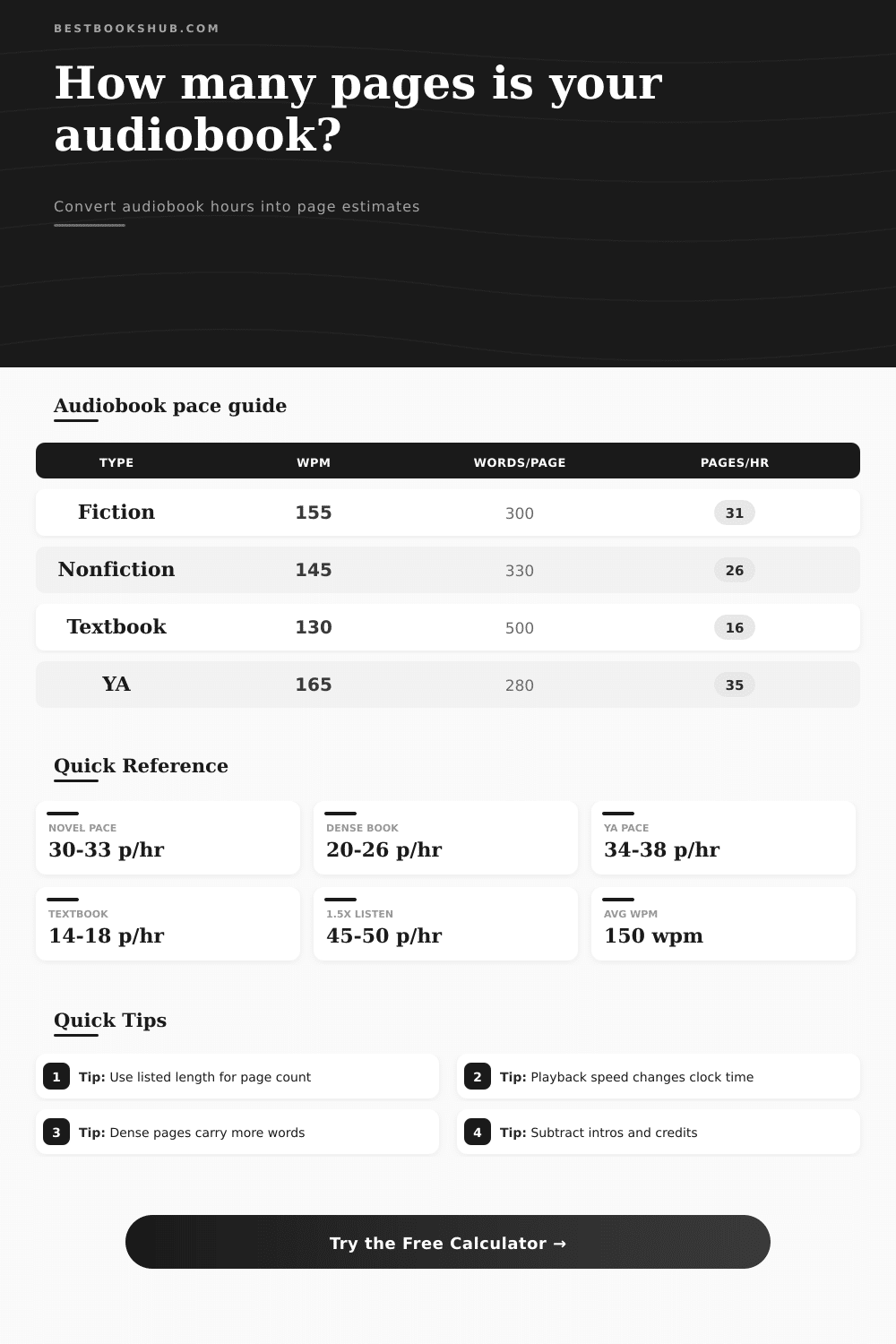
| Narration type | Working WPM | Best use | Pages per listed hour at 300 wpp |
|---|---|---|---|
| Slow literary performance | 130 to 140 wpm | Classics, poetry, dramatic pauses, complex prose | 26 to 28 pages per hour |
| Measured nonfiction | 140 to 150 wpm | Memoir, business, history, and idea-driven books | 28 to 30 pages per hour |
| Standard audiobook narration | 150 to 160 wpm | Most contemporary fiction and narrative nonfiction | 30 to 32 pages per hour |
| Brisk commercial narration | 160 to 170 wpm | Dialogue-heavy fiction, thrillers, lighter prose | 32 to 34 pages per hour |
| Fast dialogue-heavy audio | 170 to 180 wpm | Short chapters, comedy, ensemble dialogue | 34 to 36 pages per hour |
| Print format | Words per page | What changes the estimate | Audio hours for 300 pages |
|---|---|---|---|
| Mass market paperback | 250 to 300 | Small trim, compact type, narrow margins | 8.3 to 10.0 hours at 150 wpm |
| Trade paperback novel | 280 to 330 | Common fiction page density and readable line length | 9.3 to 11.0 hours at 150 wpm |
| Hardcover nonfiction | 300 to 360 | Notes, headings, lists, and wider pages | 10.0 to 12.0 hours at 150 wpm |
| Academic book page | 375 to 475 | Citations, longer paragraphs, smaller type | 12.5 to 15.8 hours at 150 wpm |
| Textbook page | 450 to 600 | Figures and captions can distort pure word count | 15.0 to 20.0 hours at 150 wpm |
| Listed audiobook length | At 1.00x | At 1.25x | At 1.50x |
|---|---|---|---|
| 6 hours | 6h 00m listening | 4h 48m listening | 4h 00m listening |
| 8 hours | 8h 00m listening | 6h 24m listening | 5h 20m listening |
| 10 hours | 10h 00m listening | 8h 00m listening | 6h 40m listening |
| 12 hours | 12h 00m listening | 9h 36m listening | 8h 00m listening |
| 16 hours | 16h 00m listening | 12h 48m listening | 10h 40m listening |
| Scenario | Listed length | Assumptions | Estimated pages |
|---|---|---|---|
| Short novella audio | 3h 30m | 155 wpm, 275 words/page | About 118 pages |
| Average trade novel | 10h 30m | 155 wpm, 300 words/page | About 326 pages |
| Long fantasy novel | 22h 00m | 160 wpm, 325 words/page | About 650 pages |
| Measured nonfiction book | 8h 15m | 145 wpm, 330 words/page | About 217 pages |
| Academic audio course text | 14h 00m | 130 wpm, 500 words/page | About 218 pages |
Audiobook page estimates come from the recorded 1.0x runtime. Listening at 1.5x shortens the clock time, but the book still contains the same words.
DISCLOSURE: This post may contain affiliate links, meaning when you click the links and make a purchase, I receive a commission. As an Amazon Associate I earn from qualifying purchases.
The same audiobook can look shorter as a dense hardcover and longer as a roomy paperback because words per page changes the page conversion.
The progress bar hovers well above middle; you’ve got ten hours logged with the app so far. You’d like to share your current location with a friend, but explaining “ten hours” doesn’t mean much to them. Especially since they’re holding physical copy of the book. If you can read a novel in ten hours, does that mean 100 pages? Or 300?
There’s no clear link between runtime of an audiobook and its printed length in today’s reading culture. Because we thinks of audiobooks as having an inherent page count. Which they don’t. Audiobooks has duration alone. Only by knowing how dense the text is can you convert that duration into something concrete.
How to Change Audiobook Hours Into Pages
If you know how fast you like to be read aloud (and what you want done in an hour), this site will crunch numbers for you. Just plug your own parameters into the calculator up top. You won’t even have to guess how fat a novella or how skinny a doorstop that is going to make it.
But before you believe the figure, you ought of to know how it got there. The same six hours of audiobook listening could be equal to massive mountain of pages or a modest pile of paperbacks. This happen because of two variables everyone forgets about: page density and narration speed.
Depending on the genre, the amount of dialogue vs. Depending on the genre, the amount of dialogue versus explanation, the style, and sentence length, a professionally recorded book can range anywhere from one hundred twenty-five words a minute to one hundred seventy or faster. And that single adjustment mean everything: it radically alters the number of words contained within those hours. Not just in style but substance.
And then there’s the question of what counts as a page in the first place. When people say “a book has this many hours,” they’re assuming a page is some sort of standard unit of measurement… Which it isn’t! Some books cram two hundred seventy-five words onto tiny sheets of paper printed with slim margins (think: mass-market paperback), while others manage to fit three hundred words onto a slightly bigger sheet of paper (easier on the eyes) (think: trade hardcover). Or hey, imagine an academic textbook. It can stuffs five hundred words on one page, and each page is packed with paragraphs and footnotes.
If we assume that an audiobook hour = thirty pages, well, we’re placing a bet about original print format; and often losing. The reference table show how word density affects the final estimate by genre.
At least for me, listening to something at one-point-five times speed makes my clock time shrink, which distorts my perception of progress… Most people underestimates this distortion. Listening at that speed mean taking a twelve hour book and making it feel like an eight hour commitment, while page count and the words themselves stays completely unchanged. This is where the tool comes into play. It separates out how much material you’ve gone through from how long you’ve been doing it. You may be finishing books quicker, but that doesn’t mean you’re reading fewer pages. Maintaining those two different metrics will help you better track amount of reading you’re actualy doing versus how long it takes to get through things.
For example, if you’re listening to an audio version of a memoir with long author interviews/introductions, context is everything. Yes, those minutes accumulate, but they don’t align with the narrative arc of the story itself. For accuracys sake, it’s always a good idea to skip past the promo material and credits at the beginning. Subtract those minutes from your estimate so the number matches only the actual text. This prevents an inflated page count from making you think the book is longer then it actualy is. This also comes in handy when considering how the book (or rather its audiobook) might compare to a physical copy on your bookshelf, or to its ebook counterpart.
But all told, translating hours into pages isn’t so much an act of science as it is translation: two distinct mediums governed by their own sets of rules. It’s not meant to be precise… To within a single digit. It’s meant to give you some perspective: Is there enough time in my day to listen to this audiobook? Does this one compare to the brick-thick novel that I’ve left on my nightstand?
If we can get these translations correct, then the medium becomes less abstract, and the hours become chapters and the minutes becomes milestones. And the time no longer exists. There is only progress.