📝 BestBooksHub writing planner
Writing days to deadline calculator
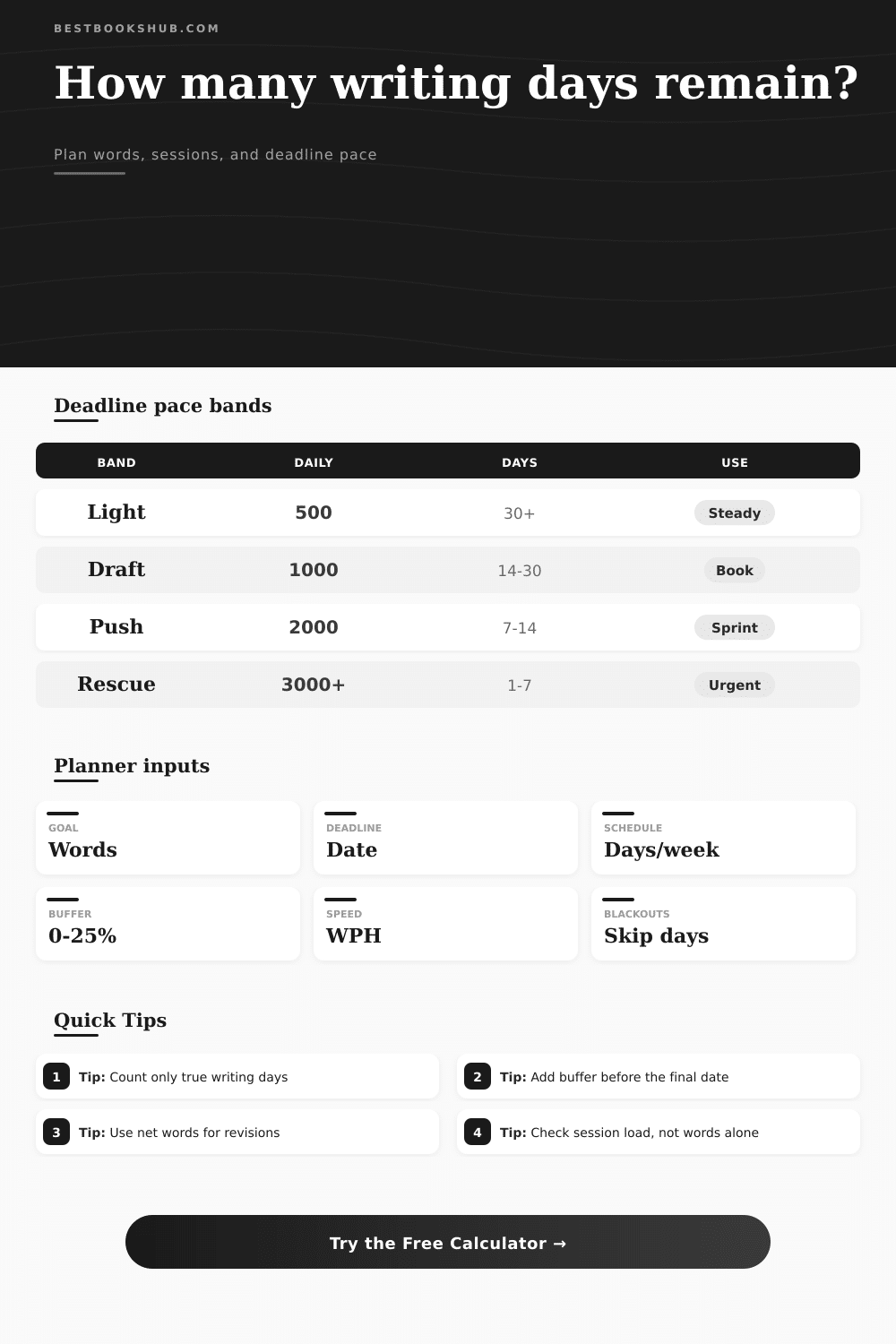
Count the real writing days between a start date and a deadline, then convert the remaining work into daily words, sessions, hours, and catch-up pressure.
| Project type | Typical speed factor | Why it changes pace | Planning note |
|---|---|---|---|
| Drafting new prose | 1.00x | Fresh words are measurable and easy to count. | Use a buffer if scenes are not fully outlined. |
| Fiction scene work | 0.90x | Dialogue, continuity, and scene beats slow pure output. | Protect lower-output days after hard scenes. |
| Revision or rewrite | 0.65x | Net word count can hide line edits and structural fixes. | Plan by usable net words, not hours alone. |
| Academic writing | 0.60x | Citations, evidence, and argument structure add friction. | Leave a proofing buffer before submission. |
| Proposal or pitch | 0.75x | Shorter copy often requires tighter decision-making. | Use smaller sessions and review checkpoints. |
| Script or screenplay | 0.85x | Page count and dialogue shape do not map perfectly to words. | Treat word targets as workload estimates. |
| Deadline distance | Planning behavior | Recommended buffer | Watch point |
|---|---|---|---|
| 1 to 3 writing days | Rescue sprint | 0% to 5% | Daily target may be the whole project. |
| 4 to 10 writing days | Short push | 5% to 10% | One skipped day can sharply raise the target. |
| 11 to 30 writing days | Managed draft | 10% to 15% | Weekly review keeps the plan realistic. |
| 31 to 90 writing days | Habit plan | 10% to 20% | Schedule drift matters more than one bad day. |
| 90+ writing days | Long project track | 15% to 25% | Reforecast after major outline or life changes. |
| Words per hour | 50 minute session | Two sessions | Best match |
|---|---|---|---|
| 350 WPH | 292 words | 583 words | Research-heavy, academic, or revision work. |
| 500 WPH | 417 words | 833 words | Careful nonfiction or mixed drafting. |
| 700 WPH | 583 words | 1167 words | Steady outlined writing sessions. |
| 1000 WPH | 833 words | 1667 words | Fast drafting with a prepared outline. |
| 1400 WPH | 1167 words | 2333 words | Dictation, sprint drafting, or very clean planning. |
DISCLOSURE: This post may contain affiliate links, meaning when you click the links and make a purchase, I receive a commission. As an Amazon Associate I earn from qualifying purchases.
And then there’s panic mode, you look at your calendar, and you see that your deadline is nearer than your word count. So you pull up a chair with high hopes: you’ve got a big number written on a sheet of paper; you feel vaguely anxious; you mean business. But then you open Word and stare at a blinking cursor, and the calendar keeps ticking.
What’s the problem? Why can’t you get it done? Is it time? Is it talent? Actualy, no. It’s arithmetic, and you’re almost certainly doing your math wrong.
Do the Math Right for Your Writing Schedule
The thing about a project timeline is that most of us consider our schedule a continuous stream of days, all ready and waiting to be filled up in sequence with words. That’s the day you’ll get started! That’s the day you finish Chapter 2! That’s the day you write 1,000 word! Here’s the truth: Life. Energy. Sometimes you don’t even get a day. Before you begin to count on the days you are likely not to recieve, you better make sure you know which ones they are.
After you enter your target number of words and start date, the calculator (above) do the math for you so you don’t waste time trying to guess how many words you’ll produce amidst a random schedule. It does this by removing the illusion of continuity. Rather than give you a daily average assuming there are 30 calendar days in every month, it identifies the days you’re actually working.
Choose which weekday(s) you plan to write; tick off the days when you need a blackout (sick day, vacation), then tell it how fast you realisticly expect to crank out the words. Separating calendar time from production time matters. For example: When you’ve been given a ten-day deadline encompassing two weekend days and a holiday, you may really only have five usable writing days. Divide your word count by ten rather than dividing it by five and you’re already set up to fail. The tool makes you face reality about how much you can get done vs. You have very little time to do it.
Another factor which seems obvious, but needs thoughtful adjustment, is writing speed. Many people overestimates how fast they type, as if that were the same thing as how quickly they draft, in hours. This shows up in the example chart on the page. Each kind of writing slows down pure word count, sometimes dramatically.
For example, academic argumentation and citations will really hurt your velocity, unlike something like a free-flow first-draft of fiction. Within fiction alone, creating is faster than revising, since you’re no longer creating problems so much as fixing them. Your net speed takes all these factors into consideration, which means it’s going to be lower than your raw words-per-hour when you plug it into the planner. You want to use the difficult figure, not your ideal case.
The difference between hopeful amateur writers and experienced ones is in the buffers. Ten to fifteen percent added words over what you think you’ll need isn’t being pessimistic, it’s adding insurance for the inevitable time-sucking bad scenes. That dialogue exchange that hits a wall needs to be rewritten. That chapter has to be completely changed when the motivation behind a character come out flat. Those happen, and they’re impossible to schedule.
But if you’ve given yourself some buffer in your word counts, then those wasted days aren’t reflected everywhere else on your schedule. They become nothing more than a small tweak. Without the buffer, one wasted day ripples forward in time, making you write even faster (and therefore poorer-quality) work as you scramble to keep pace. With the buffer, that missed day becomes… Just a minor adjustment. A little less margin, sure, but no falling down.
Also, pay attention to the length of each session. A common mistake I’ve seen is writing for a single two-hour chunk rather than splitting it into two 45-minute sessions. This is because we lose concentration and becomes tired after an hour. This can be modeled based off the calculator: how many sessions/day would you like? And would this mean going beyond what seems reasonable with your attention span? It’ll tell you whether your goal is achievable… If it’s aggressive but possible, or if it’s truly unattainable within your limitations.
Finally: What’s at stake here isn’t simply an appointment on a calendar. A deadline is a binding agreement between you, the present-day you, and you, the exhausted, distracted, crisis-plagued you who must actually complete this book. When you plan for that future state, then it’s doable.
This isn’t word-counting; this is building a bridge strong enough to support those words once the heat comes down. Should of made the good-faith math first. Shield your productive days. Let the rest happen naturaly from there.