📖 Reading session lab
Per-session page target calculator
Turn a book deadline into a clear pages-per-session target with pace, session length, buffer, missed-session risk, and catch-up math included.
Enter the pages still to read, then choose whether your plan is driven by a calendar deadline, a fixed number of sessions, or a weekly rhythm.
| Reading type | Pages/hour | 30-minute target | Best use |
|---|---|---|---|
| Study reading | 10-20 | 5-10 pages | Textbooks, citations, notes, and rereading. |
| Dense prose | 20-30 | 10-15 pages | Classics, theory, literary nonfiction, and careful reading. |
| Comfortable novel | 35-50 | 18-25 pages | Most fiction and narrative nonfiction with normal focus. |
| Light fiction | 50-70 | 25-35 pages | Fast genre reading, familiar authors, and rereads. |
| Audiobook equivalent | 70-110 | 35-55 pages | Listening plans converted to page progress. |
| Scenario | Pages left | Sessions | Target with 10% buffer |
|---|---|---|---|
| Short book over two weeks | 180 | 8 | 25 pages/session |
| Book club novel in three weeks | 315 | 14 | 25 pages/session |
| Course packet in ten days | 220 | 6 | 41 pages/session |
| Classic novel over six weeks | 620 | 24 | 29 pages/session |
| Vacation reading stack | 750 | 12 | 69 pages/session |
| Sessions/week | 30 days | 60 days | What changes the target |
|---|---|---|---|
| 3 sessions | 12-13 sessions | 25-26 sessions | Missed sessions hurt quickly, so keep targets smaller. |
| 4 sessions | 17 sessions | 34 sessions | Good for moderate book goals with one catch-up slot. |
| 5 sessions | 21-22 sessions | 42-43 sessions | Strong default for steady weekday reading. |
| 6 sessions | 25-26 sessions | 51 sessions | Useful for course reading if sessions stay short. |
| 7 sessions | 30 sessions | 60 sessions | Best for daily habits, but buffer still matters. |
| Preset | Workload | Session pattern | Pressure point |
|---|---|---|---|
| Weeknight Novel | 275 pages left | 5 sessions/week | Balanced if each session reaches about 25 pages. |
| Class Chapters | 210 pages left | 4 sessions/week | Notes can double the practical load. |
| Classic Slow Read | 520 pages left | 4 sessions/week | Target stays realistic only with a longer horizon. |
| Weekend Stack | 430 pages left | 2 long sessions/week | Each miss creates a large catch-up target. |
| Slump Restart | 140 pages left | 4 short sessions/week | Keep the page target deliberately easy. |
DISCLOSURE: This post may contain affiliate links, meaning when you click the links and make a purchase, I receive a commission. As an Amazon Associate I earn from qualifying purchases.
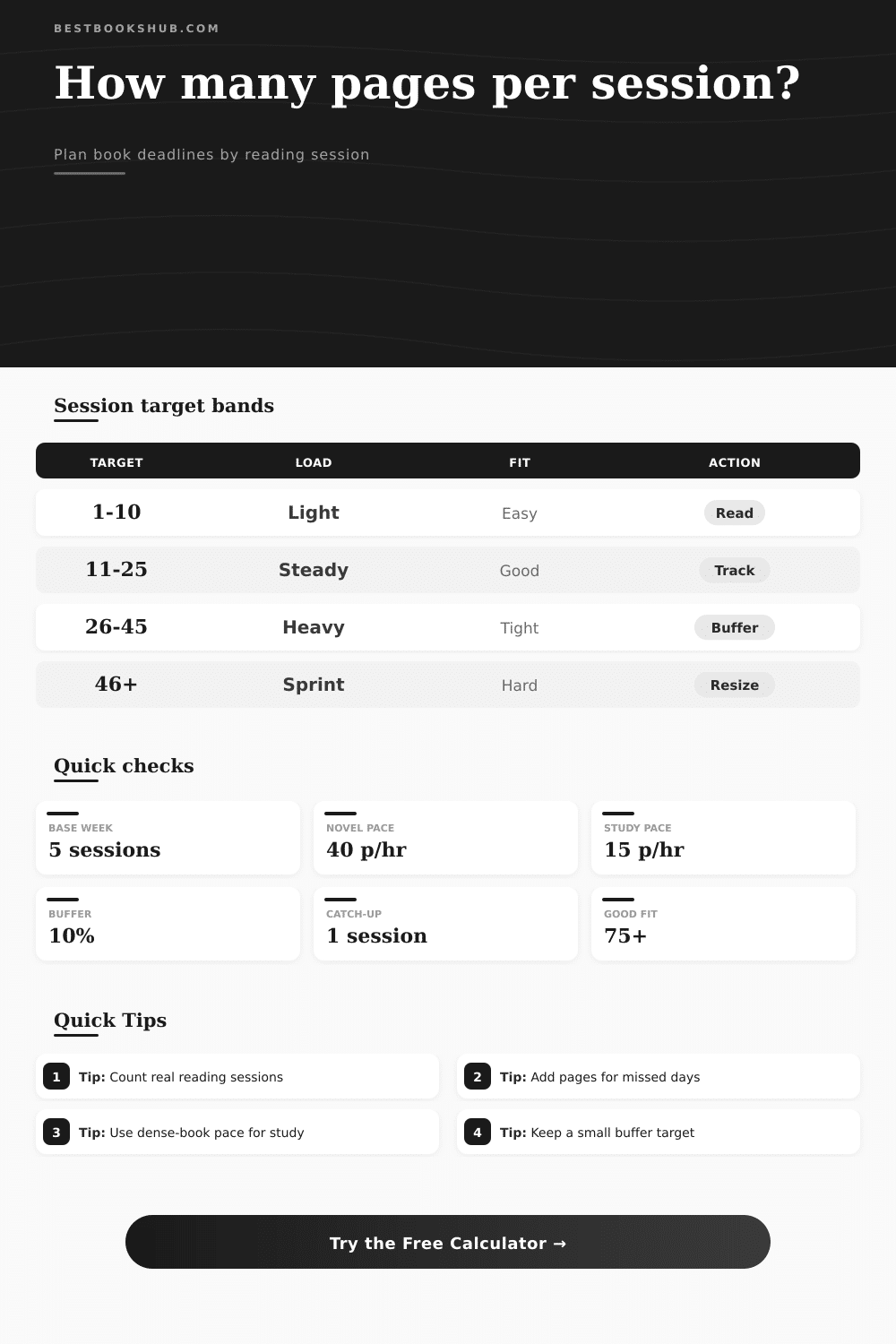
A page target is more useful when it divides by the reading blocks you can actually protect, not by every calendar day before the deadline.
One missed session can add several pages to every remaining session, so this calculator shows both planned and risk-adjusted targets.
There are three hundred pages to go. The deadline is in two weeks! Panic sets in.”
The problem isn’t that there’s 300 pages left; it’s that surviving is a matter of math. Common wisdom says: take the number of pages left, then divide by the number of days til deadline. Seems reasonable enough, right? Except it rarely work. Life intervenes. You get sleepy one day. You miss a day here or there. That blindfolded division has no margin for error, so you race through last hundred pages in a panicked mess.
Plan Your Reading with Realistic Goals
What if you approach reading as a target per session? Change the geometry. Focus on how much you can steadily complete during separate block of time, rather than daily duties. After plugging in your constraints, the calculator does the math; it spares you from guessing if you’ll be able to read thirty pages on a tired Tuesday night.
It’s up to you to honestly assess yourself: How many reading session will you actualy have? Will you read five times per week, knowing fatigue will knock out one session? Be sure to factor that hole into your plans beforehand, or else you won’t get very far when you realize midway through that your expectations was too high. That’s why the missing-session input is more important then the page count itself. Subtracting this possible loss at the beginning prevents you from being shocked when you realize halfway through that your schedule were too optimistic. It encourages you to spread workload over fewer, sturdier containers instead of stretching it thin across weak hopes.
The other factor that kills almost all plans (because everyone overestimates how fast they’ll be able to go when fired up) is pace. Speeds vary greatly by subject. You skim a mystery novel but read a thick textbook slowly, forty pages an hour. Your eyes cross the page, but your brain has to understand it differentally. This app will let you adjust pace by subject matter… Recognizing that reading something light like a fiction book takes less mental effort than something heavy like a textbook. And when you’re forced to reread something complicated, or take detailed notes while reading, your “effective” speed gets cut down drasticly.
Realism isn’t pessimism. Realism means adding a buffer for slow sentences or notes you need to take. Instead of setting a goal of pages you think you can read in X hours, your goal should of match the number of pages your brain could actualy understand in that amount of time. Similarly, buffer zones acts as insurance for the natural interruptions of real life. If you hit a tough chapter or go on an off week, it gives you a little wiggle room so you’re not immediately behind schedule. It turns your timeline into something more like a flexible system, one that can handle the occasional little shock without snapping entirely apart. That’s what happens when there’s no slack: Every small hiccup compounds into a debt of pages you feel helpless to pay down further along in the project.
And that’s why in the long term, steady targets typically beat out sprint plans. Moderate, consistent effort builds momentum; aggressive target tend toward burnout once early enthusiasm wears thin. The catch-up sessions are also a kind of safety valve, for the times that real life really does get in the way. By designating one or two additional time slots as double-duty, you can make up for lost time without freaking out. It alters story from “failure” to “adjustment.” You’re not falling behind on your goal. You simply moved it into an emergency slot you’ve reserved for this purpose. That mental pivot might be what keeps you from quitting halfway through a book due to unbearable pressure.
Bottom line: Reading isn’t about how fast or slow you go. It’s about being present. Protect those moments, stop trying to reach some made-up, daily number, and let that pressure go away. Let the numbers be a guide but not a judge. Trust that you’ve built yourself a plan that includes some room to breathe. And finally, savor the book instead of just surviving its pages.
That is why getting the math right helps BEFORE opening up the cover.