⏱ Chapter pace lab
Chapter Time From Word Count Calculator
Turn chapter word counts into reading minutes, audiobook runtime, presentation time, study blocks, proofreading time, or drafting sessions with realistic pace adjustments.
Use a single chapter word count, an average word count across chapters, or a pasted chapter list. The optional list accepts one word count per line, comma, or space.
| Chapter words | Fast read 350 wpm | Casual read 250 wpm | Study read 150 wpm | Audio 155 wpm |
|---|---|---|---|---|
| 1,500 words | 4 min | 6 min | 10 min | 10 min |
| 2,500 words | 7 min | 10 min | 17 min | 16 min |
| 3,500 words | 10 min | 14 min | 23 min | 23 min |
| 5,000 words | 14 min | 20 min | 33 min | 32 min |
| 7,500 words | 21 min | 30 min | 50 min | 48 min |
| Use case | Best pace unit | Typical pace | Adjustment to add | Good for |
|---|---|---|---|---|
| Fiction reading | Words per minute | 220-300 wpm | 0-15% reread | Book clubs, reading plans |
| Academic study | Words per minute | 100-180 wpm | 25-70% notes | Textbook chapters, research |
| Audiobook chapter | Words per minute | 145-165 wpm | Playback speed | Narration runtime estimates |
| Lecture script | Words per minute | 120-150 wpm | Pause allowance | Talks, classes, recordings |
| Drafting chapter | Words per hour | 500-1200 wph | Breaks per chapter | Writing schedules |
| Project | Chapters | Words each | Casual read total | Study total |
|---|---|---|---|---|
| Short novella | 10 | 2,500 | 1 hr 40 min | 2 hr 47 min |
| Trade novel | 24 | 3,300 | 5 hr 17 min | 8 hr 48 min |
| Memoir draft | 18 | 4,000 | 4 hr 48 min | 8 hr |
| Textbook unit | 8 | 6,500 | 3 hr 28 min | 5 hr 47 min |
| Thesis review | 5 | 8,000 | 2 hr 40 min | 4 hr 27 min |
DISCLOSURE: This post may contain affiliate links, meaning when you click the links and make a purchase, I receive a commission. As an Amazon Associate I earn from qualifying purchases.
Use the chapter's actual word count when possible. Page count can drift because trim size, margins, dialogue, and illustrations change words per page.
If you plan to highlight, outline, cite, or summarize, the note adjustment usually matters more than the base reading speed.
A narrator's listed runtime is usually close to 145-165 words per minute. Playback speed changes clock time without changing the word count.
For drafting, switch pace to words per hour. A chapter that reads in minutes can still take several writing sessions to create or revise.
It’s the same reason that a three-hundred-page manuscript will sometimes make your jaw drop in fear when you look at its file. Your mind tries to translate “three hundred pages” into “how many hours?” It gets lost and makes an incorrect estimate, this stalls out your brain for a week while you delay. You suck at guessing how long things take without numbers attached. You know how many words there are and immediately imagine a brick wall of text, but you can’t tell how many minutes it will take to reach the end. That’s where most reading plans goes wrong: right here, in the gap between the text and the clock.
You can put it into the calculator up top and it’ll do the math for you, but the magic is realizing why: You read differently when you’re falling asleep compared to when you’re awake. When you’re awake. You read differently if you’re flipping through a thriller at midnight vs. If you’re sitting down to study some obscure academic article before a test. Your reading rate isn’t a single, static figure most of us think it is. It’s variable, it varies according to fatigue, intent, and density.
Why You Need to Calculate Your Reading Time
The thing is, when you input how many words you have, you aren’t only getting an estimate of when you should stop. You’re creating a workable timetable based off the actual way human attention works. For example, what is the difference between study reading and casual reading? When you’re reading fiction casually, sure; maybe you can read two hundred fifty words per minute. But when you’re reading a text book, with annotations? That’s going to be way slower than. You’re not just skimming over it; you’re taking in information.
That’s why the tool lets you adjust based on rereading or notes. It’s a key detail that generic estimators fail to account for. They’ll spit out some baseline figure, now you gotta figure out how much slower you read based off what you’re actualy doing. Do you need to highlight each paragraph? Add that overhead to your estimate of how long it will take.
For audiobooks, there’s a whole host of variables. There’s the speed of the narrator (usually ~155 words per minute), but most of us don’t listen normaly these days, most of us crank it up to 1.5x or even 2x speed! The calculator allows you to adjust for this playback rate. Listening at 1x speed is going to feel like two hours, whereas listening at 2x is going to feel like forty minutes. One will be relaxing, the other intense information intake.
If you know what mode you’re getting into, you can schedule accordingly, i.e., don’t expect to blast through a dense philosophical text at double-speed while driving down a busy highway.
And then there’s the other variable: writing out your own chapters. Drafting is slower than reading because it involves thinking, deleting, and rewriting. The tool estimate how many words an hour you can get done while drafting. This saves you from making the mistake of assuming you can write as fast as you read. You won’t. If you read a chapter in 10 minutes, you might draft it from scratch in two hours.
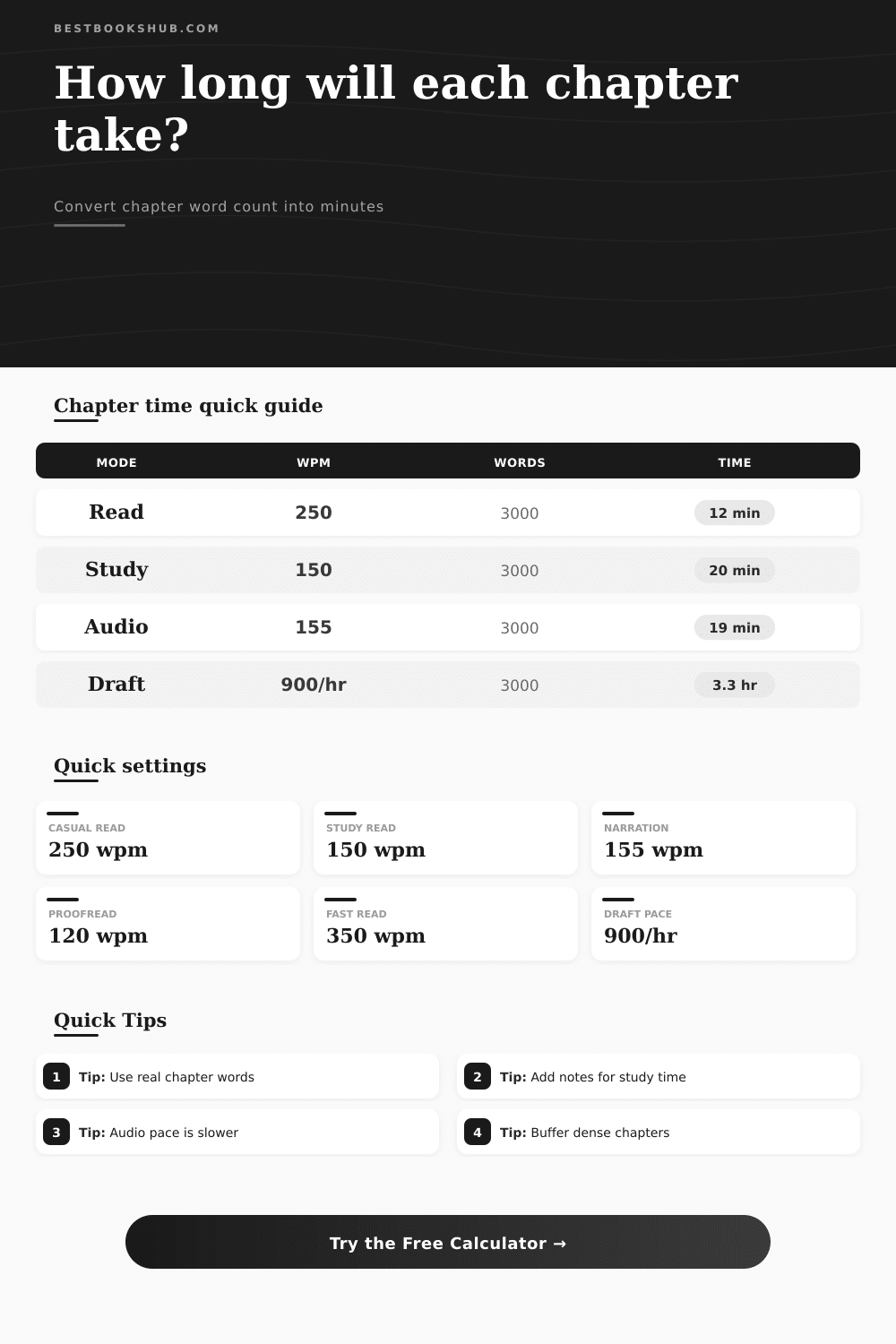
Knowing this saves you from feeling guilty when you don’t reach some random number of words you’ve decided to aim for every day. And it’s laid out in the reference table on the page, which shows what happens when you take a three thousand-word chapter and move it through various modes. It emphasizes that, depending on how you read, that same text might feel like a hefty meal or a speedy snack, which is important if you’re planning a study group or book club. You want to make sure everybody has had enough time to absorb the material according to their own speed. Fifty thousand words without context? That’s asking some folks to crawl, while others must sprint.
All in all, that’s what this comes down to: respecting the material, your energy, and your time. Knowing how long things should of take eliminates the stress of the unknown. It gives you a tangible map of what needs to go where on your Tuesday night (and when to step away). It breaks the wall of text into bite-sized chunks. And when you know something will only be twenty minutes, not an hour, you’re more inclined to pick up the book. Accurate information creates momentum.