📖 Reading level time lab
Reading level time adjuster calculator
Adjust a reading plan when the text moves from easy fiction to grade-level classwork, college nonfiction, technical prose, or dense academic material.
Start with a measured comfortable speed, then adjust for target reading level, page density, vocabulary load, note taking, and comprehension goal.
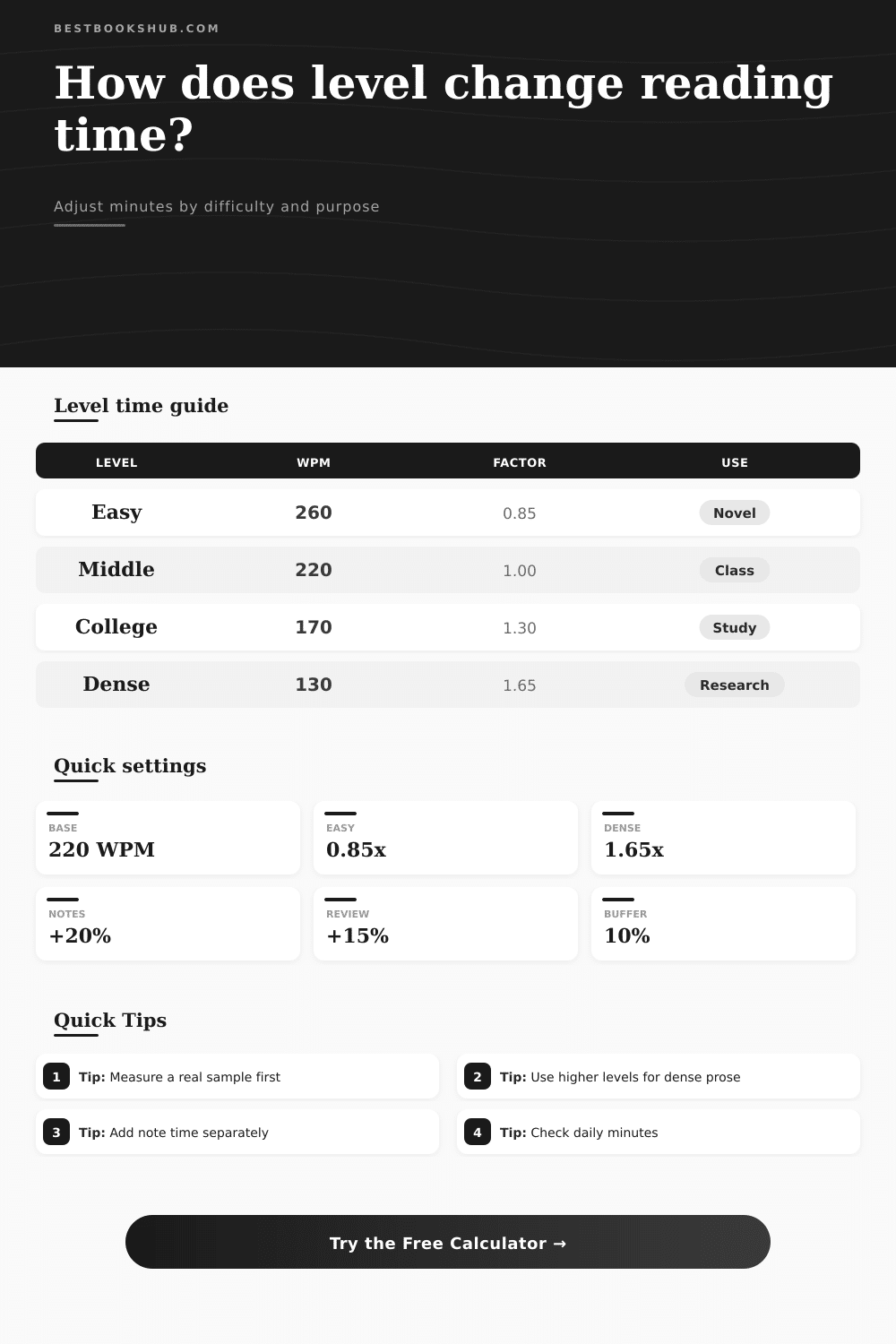
| Planning level | Typical WPM band | Time factor | Common reading task | When to raise it |
|---|---|---|---|---|
| Easy fiction or grade 4-5 | 240-320 WPM | 0.85x | Light narrative, rereads, simple chapter books | Raise if reading aloud, tutoring, or annotating every page. |
| Middle grade or grade 6-8 | 220-280 WPM | 0.95x | Class novel, youth nonfiction, guided reading | Raise if vocabulary is unfamiliar or the reader is learning English. |
| General adult or grade 8-10 | 190-260 WPM | 1.00x | Trade books, essays, practical nonfiction | Raise for heavy note taking, discussion prep, or dense typography. |
| High school or grade 10-12 | 170-230 WPM | 1.12x | Literature, source packets, exam reading | Raise if the assignment expects quotation-level recall. |
| College nonfiction | 140-200 WPM | 1.28x | Textbooks, theory chapters, scholarly summaries | Raise if formulas, charts, or citations interrupt flow. |
| Technical, legal, or medical | 110-170 WPM | 1.45x | Manuals, statutes, methods, documentation | Raise when errors matter or terms must be checked. |
| Research or theory | 90-150 WPM | 1.62x | Journal articles, philosophy, advanced criticism | Raise when you need citation notes or line-by-line analysis. |
| Text sample | Words | Easy level | General level | Research level |
|---|---|---|---|---|
| Short story | 4,000 | 15-18 min | 17-22 min | 28-38 min |
| Class chapter | 8,000 | 31-36 min | 35-45 min | 55-75 min |
| Book section | 20,000 | 1.3-1.5 hr | 1.5-1.9 hr | 2.4-3.2 hr |
| Research packet | 35,000 | 2.2-2.6 hr | 2.5-3.3 hr | 4.2-5.7 hr |
DISCLOSURE: This post may contain affiliate links, meaning when you click the links and make a purchase, I receive a commission. As an Amazon Associate I earn from qualifying purchases.
Time a 600- to 1,000-word sample from the same book or assignment. A real sample beats a generic WPM chart, especially for textbook pages.
Slow text and detailed notes stack together. Keep note minutes separate so you can see whether the bottleneck is comprehension or documentation.
If you have read many textbooks, then you know that some books with the exact word count can seem twice as long than a novel. Why? Because textbook are harder to read than novels. They don’t flow as smoothlyy. When you recognize this, you won’t get overwhelmed and won’t quit before finishing what you set out to do.
After plugging in your desired reading goal and text length, all you need to do is let the calculator do its thing. It will crunch numbers and spit out an answer.
How to Make a Realistic Reading Plan
Your reading speed isn’t static, it varies depending off how hard the material is to understand. When reading something like a novel for entertainment, your brain predicts what sentence will come next with ease. However, when you’re reading something difficult (e.g., reading for an exam), your brain has to check each statement to make sure it’s true, slowing everything down. To adjust for this, the tool factors in level of understanding you want to achieve and applies a multiplier to reflect difficulty of material.
For example, compare reading a news story to picking apart a research paper. News reading move faster: you recognize much of the vocabulary, so you scan at three hundred words per minute. More technical texts uses specialized terms and longer sentences, reducing your effective speed. Research prose can take over sixty percent more time. Even college-level non-fiction takes nearly thirty percent longer then general adult reading (see the reference table).
When studying, people plan time according to what they read during leisure hours. Because they haven’t accounted for the friction of difficult content, they gets off pace. Remember to account for time spent taking notes too. Summarizing and highlighting things take time… And adds up fast. To do this, the calculator lets you enter your note-taking speed separately from your reading speed. If you find that taking notes takes as long or longer then reading, you’re probably spending more time transcribing than understanding what is being said.
The tool also provides spaces for break minutes and reread percentage; nobody plows through a dense chapter without skipping around, getting hung up on a paragraph, or otherwise losing the thread. That’s why the estimate isn’t overly optimistic; it’s realistic. If you make a plan based off perfect focus, there’s a good chance it won’t work out. But if you factor in some buffer time for moments of confusion, then maybe it will.
The tricky part is knowing what you’re realy measuring. Words is how you measure. Attention is what you pay. If you adjust for page density or vocabulary load, then you’re effectively pricing your attention span. Visual fatigue set in when the going gets dense. Heavy terminology mean more mental translation. All of this drags down your clock.
You get an adjusted overall time out, but it tells you whether it’ll fit on your days as well. If the schedule fit percentage are above 100%, you’re going to have to either stretch the timeline (push back the deadline), cut the material, or reduce your comprehension goal. You should of planned for this.
Speed reading isn’t just about the speed of your eye movements. It’s about retention, what stays in your brain, and how easy the process was. Let the tool bring your expectations down to earth instead of up to heaven. Generic average times don’t reflect specific text. Test your actual read first. Then tweak for purpose and difficulty.
The final number may not be what you hoped, but it will be realistic. And only the realistic plan ever works. When you begin, you have a pile of unread books that seem insurmountable. You break the books into manageable chunks of time. You account for every confusing sentence, pause, and note along the way.