📝 Critique schedule lab
Critique turnaround calculator
Estimate critique hours, feedback sessions, return dates, reader workload, and deadline pressure for manuscript swaps, essay feedback, APA samples, thesis chapters, and full-draft critique reports.
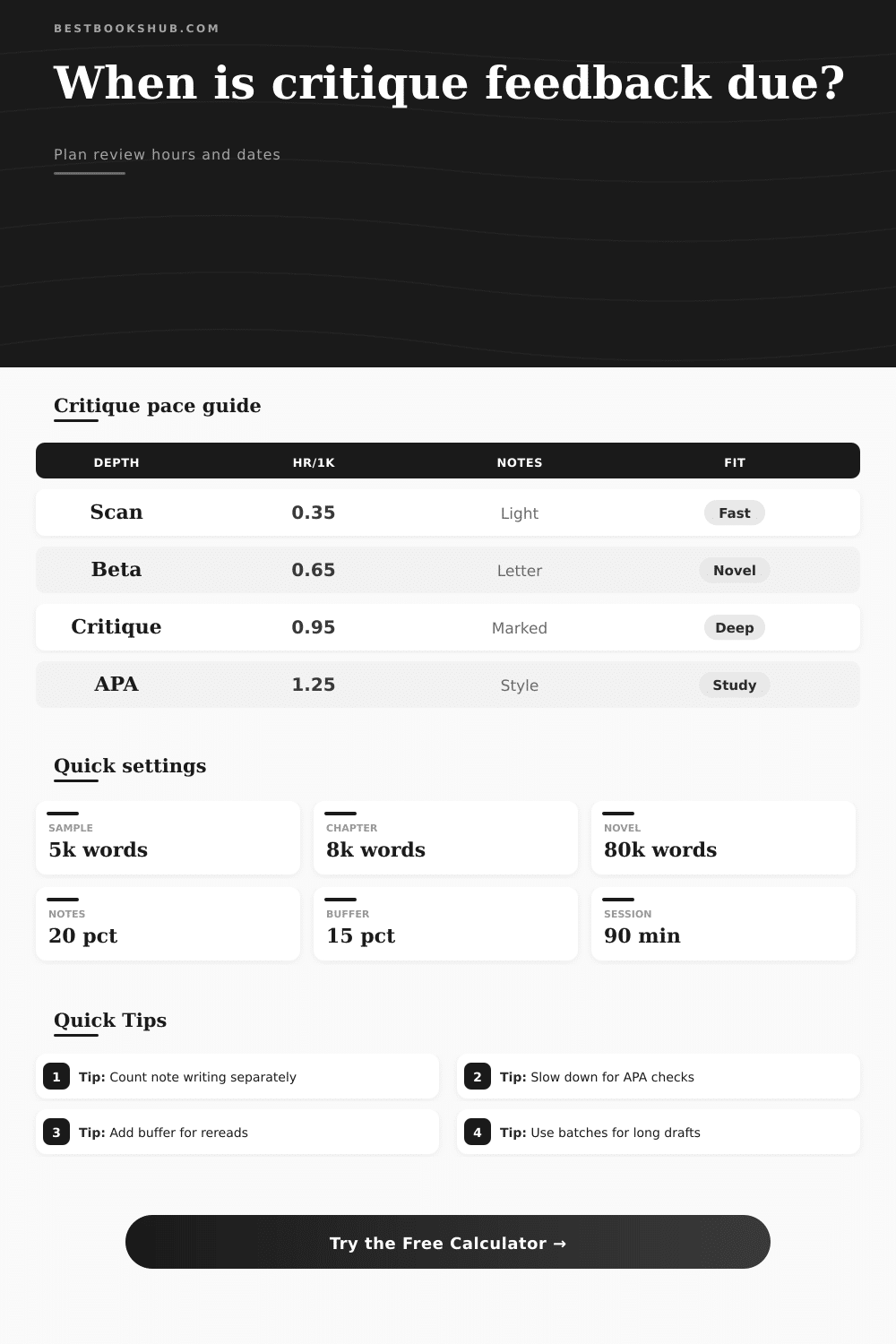
Choose a size mode, critique depth, draft condition, note package, and availability. The calculator separates reading, margin notes, summary letter, reread, style checks, batching, and schedule buffer.
| Project type | Typical size | Useful depth | Practical turnaround note |
|---|---|---|---|
| APA sample critique | 3,000 to 7,500 words | APA sample or standard critique | Style checks can add more time than reading when references are uneven. |
| Workshop chapter | 4,000 to 9,000 words | Standard critique | One or two focused sessions usually gives cleaner feedback than one long read. |
| Query package pages | 1,500 to 5,000 words | Line-level critique | Small samples move quickly, but opening pages invite close sentence attention. |
| Novel beta swap | 65,000 to 110,000 words | Beta letter or standard critique | Use batches if the author needs staged feedback before the final letter. |
| Developmental report | 50,000 to 120,000 words | Developmental report | Reread and synthesis time are major parts of the schedule. |
| Session length | Best use | Break assumption | Planning note |
|---|---|---|---|
| 30 minutes | APA references, opening pages, small samples | 5 minutes | Good for high-concentration style checks and dense comments. |
| 60 minutes | Workshop critiques and chapter feedback | 5 to 10 minutes | Keeps marginal notes sharp without losing continuity. |
| 90 minutes | Standard manuscript critique | 10 minutes | A strong default for reading, marking, and quick summary notes. |
| 120 minutes | Developmental pattern review | 15 minutes | Useful when plot, argument, or structure must stay in view. |
| 180 minutes | Rush reading only | 20 to 30 minutes | Use carefully; fatigue can weaken critique quality. |
| Schedule load | Label | Meaning | Adjustment |
|---|---|---|---|
| Under 70% | Roomy | There is room for rereads and slower sections. | Keep the buffer or use it for a final pass. |
| 70% to 90% | Workable | The deadline fits if planned sessions stay protected. | Batch feedback or reserve a wrap-up block. |
| 90% to 110% | Tight | One delay can affect return quality or timing. | Add daily time, lower note density, or move the deadline. |
| Over 110% | Overloaded | The requested turnaround exceeds available critique hours. | Narrow the scope, split the text, or extend the return date. |
DISCLOSURE: This post may contain affiliate links, meaning when you click the links and make a purchase, I receive a commission. As an Amazon Associate I earn from qualifying purchases.
How many times have you said yes to an author-friend who asked if you’d read through a chapter of their manuscript this week? Sure! But then you realize the file is longer than you thought. The draft is a bit rough. You are about to spend your free weekend making margin notes that you didn’t even plan for.
That critique time comes at a cost. We don’t budget for the work of actualy reading with intent. We just think it’ll be linear, instead of spiking as we slow down to decode a messy scene or catch up on a dense argument.
How to Plan Your Critique Time
Once you enter the word count and level of detail you prefer, the calculator does the math for you. No more guessing whether you can realistically get it done before the next pile of obligation land in your lap.
How do you define the kind of feedback you’re providing? Is it a quick diagnostic scan, or a line-by-line development report? That’s the main point. Depending on how deep you want to dive, you can switch between mode in the tool, which will adjust your hourly rate per thousand words.
For example, does your beta letter qualify as a “standard critique”? Yes, technically, it does. But is that split-hair distinction really relevant? If it isn’t, then we have moved from hunting for weak verbs to scanning for plot hole.
Tasks requiring focused attention add up fast; this is why the higher-level engagements estimates more hours. Structural analysis doesn’t lend itself well to multitasking. And that brings us back to the draft condition. While it makes sense to use clean, polished manuscripts, rough drafts destined for workshop require deciphering. Because bad syntax takes longer to read than good syntax, the calculator assumes extra time (aka “buffers”) for these types of uneven prose or densely academic writing.
In particular, there are certain kinds of headaches that come with academia (like having to use APA style). Switching over to checking format for headings or citations is a mental switch from assessing narrative flow. Reviewers tend to not factor the additional time it takes for these mechanical chores into their overall pass and end up rushing through the last read-through.
The program has dedicated options for where you want it to focus (e.g., on citations vs. Style), acknowledging that administrative aspects of critiquing take as much time off your clock as does analyzing the creativity. Your brain doesn’t like to do context switches; you may believe you can track the arc of characters while also making sure there’s no comma missing, but your brain disagrees. Best to set those apart in your head and make time for each separately.
Most folks don’t realize this until they’re tired: the length of your editing session also matters. Four straight hours of staring at words makes for poor-quality notes. Your eyes glaze over, and your commentary will be repetitious. Set realistic session lengths using the calculator (usually around ninety minutes) and take breaks. This approximates real-world professional editor behavior. They edit in blocks, not marathons.
Breaking up the task into doable chunks of time still takes longer overall because it involves context re-entry. But your feedback gets more accurate, and that’s well worth the trade-off between speed and quality.
For larger projects, batching also provides some strategy: Rather than saving all comments till end-of-book, go back chapter by chapter to leave notes. Both reader and writer will find this less daunting. That said, each batch represents extra administration. Summarize what you’ve said so far; write an email; maintain continuity between batches. The tool accounts for tiny admin minutes per batch, so that hidden work doesn’t eat up your weekend. It nudges you to remember that coordination always carries a (however slight) price.
And lastly, always build in some kind of time cushion (aka “buffer”). You’ll be surprised at how often life interferes: You fall ill. Your workload gets out of control. Or you realize your manuscript is thicker than expected. Fifteen percent isn’t gloom-and-doom, it’s professionalism. It means you have a chance to craft thoughtful comments even if something comes up unexpectedly. Without this buffer, one hiccup means that instead of being a constructive guide, you are frantically scanning for anything useful. In truth, anticipating the worst will help you do your best since you’re not scrambling to meet an unrealistic target.
And here, on the page, is a simple chart outlining which projects correspond with reasonable turnarounds. The key is recognizing where you’ve taken shortcuts well before the feedback suffers. In the end, it’s all about providing feedback that is, well, feedback, not just feedback that happens on time. If you want to write something useful, you must allow yourself the time to recognize those smaller patterns that is most helpful for developing as a writer. You’ll catch the big stuff, yes, but miss the larger structural issues at play.
These estimations give you a way to honor the work your colleague/friend has done on their draft, while protecting your own sanity. The point: to make feedback useful. Not merely timely. To set limits early in order to find the reserves of energy needed to really grapple with what they’ve written. That upfront honesty about how much you can do both saves the piece and the relationship.
A rested reader is still a good reader. And now she is well-rested, too.