✍ Review schedule lab
Review writing time calculator
Estimate the full time needed to plan, draft, support, revise, and finalize a book review, from a short reader post to an APA-style academic critique.
Start with the target review length and the amount of supporting work. The calculator separates planning, drafting, evidence checking, citation cleanup, revision, and deadline capacity.
DISCLOSURE: This post may contain affiliate links, meaning when you click the links and make a purchase, I receive a commission. As an Amazon Associate I earn from qualifying purchases.
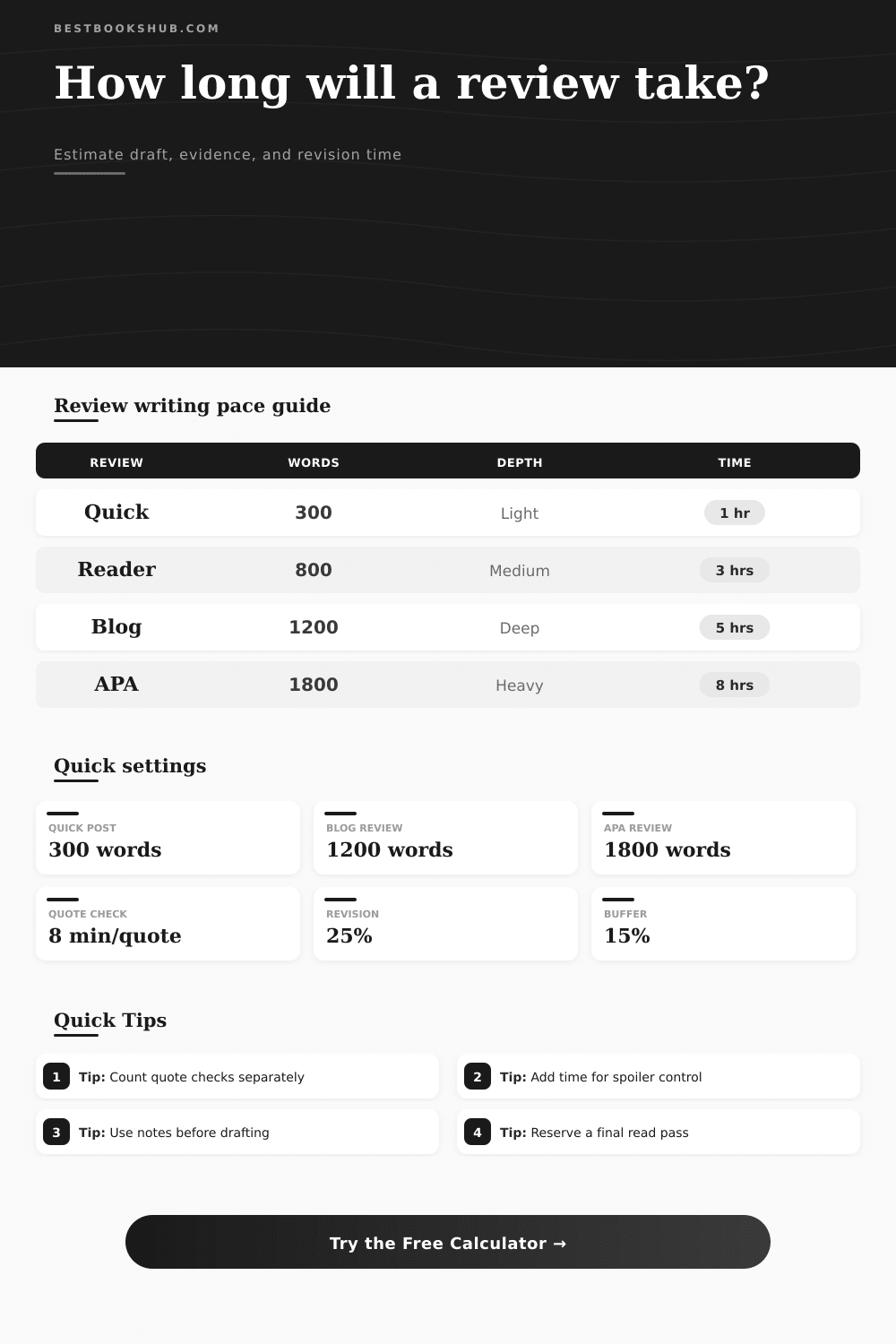
Use these tables to sanity-check the calculator result against common review-writing workloads.
| Review type | Typical length | Main time driver | Planning range |
|---|---|---|---|
| Short reader review | 150-500 words | Judgment and spoiler control | 30 min to 2 hrs |
| Blog or newsletter review | 800-1,500 words | Structure, voice, examples, headline | 3 to 7 hrs |
| Academic book review | 1,200-2,500 words | Argument, citations, context, style | 6 to 14 hrs |
| Comparative review essay | 2,000-4,000 words | Cross-text synthesis and evidence | 12 to 28 hrs |
| Evidence task | Time add-on | Use when | What it protects |
|---|---|---|---|
| Quote verification | 4-18 min each | Exact wording or page numbers matter | Accuracy and context |
| Source context scan | 10-25% extra | Claims compare author, genre, or field | Fair evaluation |
| APA reference cleanup | 5-12 min each | Formal citations are required | Reference consistency |
| Spoiler-safe pass | 8-15% extra | Public reviews should avoid plot reveals | Reader trust |
| Target words | Light review | Critical review | Academic review |
|---|---|---|---|
| 300 words | 0.5-1 hr | 1-1.5 hrs | 1.5-2.5 hrs |
| 800 words | 1.5-2.5 hrs | 2.5-4 hrs | 4-6 hrs |
| 1,500 words | 3-5 hrs | 5-8 hrs | 7-12 hrs |
| 3,000 words | 7-10 hrs | 12-18 hrs | 18-30 hrs |
| Deadline load | Status | Meaning | Schedule cue |
|---|---|---|---|
| Under 70% | Comfortable | Enough room for revision and rest | Use the margin for a final read. |
| 70% to 90% | Workable | Schedule fits if inputs are realistic | Protect daily writing blocks. |
| 90% to 110% | Tight | Deadline may fit but has little slack | Reduce scope or add daily time. |
| Over 110% | Overloaded | Required hours exceed capacity | Move the deadline or split tasks. |
On Tuesday morning, you remember you committed to a book review due Friday. You haven’t cracked open the book yet so you go wide-eyed in a panic. How many minutes will it take? You look at your computer cursor and guess: twelve hundred words typed should of took about two or three hours. But that’s just typing. That doesn’t account for time spent planning, collecting evidence, editing, and fixing citations. People makes this error… Equating their typing speed with the length of a whole project, most of the time. For that reason alone, most reviews is rushed (or never happen).
After plugging in the source difficulty and target length, the calculator (above) does the rest of the work for you, sparing you from underestimating the hidden effort required to write reviews. A review isn’t typically a linear endeavor where you just open up a doc and type away till completion. There are several separate tasks with varying levels of mental effort. High level synthesis is require for planning. Consistent output is necessary during drafting. Meticulous attention to detail occur when checking quotes. You can’t be doing all three simultaneously. Attempting to do so causes your brain to switch modes, resulting in slower performance across everything. The tool separates each step so it will show you where the actual time suck live.
How to Plan Your Time for Writing Reviews
What about existing note quality? Seems insignificant until you try this: Compare making plans from a list of clean notes vs. It is a pile of scribbles that you barely make sense of. If there’s nothing useful written down, you’ll have to add several minutes back to that planning process by scanning the book again to pick up your anchor points. That doesn’t even include any writing! You’re not just writing here. You’re mining.
For example, consider doing a review or critique of a scholarly article or book, which hinges on specific page numbers as part of its argument structure. In contrast, a Goodreads-type review require little more than a quick read-through plus personal opinions. That’s not even style, that’s depth: how much verifiable information do I have to put in? How many different sources will I cite? One source could take 0 minutes if you only have to look it up, another could take an hour-plus if it has to be formatted correcty. So those minutes multiply.
Controlling spoilers is another hidden way you lose time. When reviewing fiction, you have to be really careful about what you say so as to avoid spoiling the story for people who haven’t read it yet. That takes time, a mental filter on your writing process that slows down your draft speed a lot. If you turn on spoiler protection in the calculator, it adds a buffer to account for this. Yes, it’s a little thing, but still a thing.
Careful writing take a long time. Free writing goes fast. Know which mode you’re in before committing to a deadline.
These are useful sanity checks: the page includes a set of reference tables that give you a sense of how long typical kinds of work should take. Even when they’re shorter than your word counts, e.g., short reviews, there’s a larger amount of time involved because you have to do some processing (judgment), evaluation, beyond just typing out words. A 300-word summary is less daunting than a 500-word one. Yet it can be harder because you need to balance the themes, while a straight plot recap are easier. Length isn’t what matters more than depth.
If you’re posting on a blog where SEO is part of the deal, allow extra time for tags and creating headlines. These aren’t “writing” per se, but eat up precious blocks of focus.
Okay, lastly, let’s talk about the deadline fit feature. This tells you how well your schedule fits with the number of hours you expect this review to take up. Don’t just cross your fingers and hope for the best if the meter says that you’re overbooked. Take one for the team: Push back the end date or scale down the scope of the review. There’s no shame in confessing that you bit off more than you can chew within the given timeframe. Better to have something shorter but sharper (late) than a sprawling and unfinished mess (on time).
Knowing what you’re actualy measuring here is half the battle. When you get good at planning with actual cognitive costs instead of guesswork, your writing schedule won’t feel like a crapshoot anymore. You’ll know exactly when it’s time to crack the book open again.