📖 Pace projection desk
Current pace projection calculator
Turn your current page, start date, reading schedule, and deadline into a projection for finish date, pace gap, and pages needed to get back on track.
Use the last page you fully finished. The calculator compares your observed pace so far with the pace required from now through the deadline.
| Reading situation | Common current pace | Useful check-in | Projection note |
|---|---|---|---|
| Book club novel | 20-45 pages/day | Every 3 to 4 days | Small misses compound near the meeting date. |
| Long classic | 12-30 pages/day | Weekly | Dense chapters often need a buffer before the deadline. |
| Textbook unit | 8-20 pages/day | After each study block | Notes and rereads make page-equivalent workload larger. |
| Commute reading | 10-25 pages/day | End of workweek | Weekends may need to cover weekday misses. |
| Vacation book | 40-90 pages/day | Daily | Fast schedules benefit from a skipped-day cushion. |
| Mode | Primary answer | Best for | Main limitation |
|---|---|---|---|
| Deadline date | Needed pages per reading day | Book clubs, classes, and due dates | Depends on an accurate future schedule. |
| Current pace only | Projected finish date | Casual reading and habit tracking | Does not judge whether the date is acceptable. |
| Weekly target | Target gap per week | Reading challenges and monthly goals | Less precise than a fixed date. |
| Recent pace check | Momentum shift | Finding a slowdown early | Recent days can be noisy. |
| Buffered projection | Safer workload estimate | Dense reading with uncertain sessions | May feel conservative for easy pages. |
| Pages remaining | Current pace | Needed pace | Status |
|---|---|---|---|
| 120 pages | 30 pages/day | 24 pages/day | Ahead if schedule holds |
| 240 pages | 28 pages/day | 35 pages/day | Needs 7 more pages/day |
| 75 pages | 12 pages/day | 15 pages/day | Slightly behind |
| 500 pages | 40 pages/day | 38 pages/day | On pace with buffer |
| 180 pages | 18 pages/day | 45 pages/day | Revise schedule or add sessions |
| Adjustment | Typical value | What it changes | When to use it |
|---|---|---|---|
| Reread load | 5% to 35% | Adds page-equivalent work | Use for notes, review, citations, or close reading. |
| Difficulty factor | 0.90x to 1.60x | Raises or lowers future workload | Use when the unread part is clearly easier or harder. |
| Planning buffer | 5% to 20% | Adds cushion before the date | Use when one missed day would matter. |
| Skipped days | 0 to 30+ | Removes calendar capacity | Use for travel, exams, holidays, or known breaks. |
| Recent pace | Last 2 to 7 days | Shows momentum change | Use when the average pace hides a new slowdown. |
DISCLOSURE: This post may contain affiliate links, meaning when you click the links and make a purchase, I receive a commission. As an Amazon Associate I earn from qualifying purchases.
The best part is how you measure your reading speed so you never miss another deadline. You input starting page number and final page you read, and this tool will calculate your speed based off historical performance. It doesn’t tell you what pace you WANT to go; it tells you what your actualy pace has been.
Most people over estimate their ability because they forget about the non-reading days. This calculator relies on real life numbers, and it won’t let you ruin a deadline due to false confidence. If you want to shoot for 20 pages per day but end up with just 12, the calculator log the 12.
How to Measure Your Real Reading Speed
Distinguish between total elapsed time and active reading days. Every calendar day isn’t an equal opportunity to read. Plan to read only on weeknights? Then don’t include weekends in your daily average. Grounding the prediction in reality means adjusting for future days that you’ll skip.
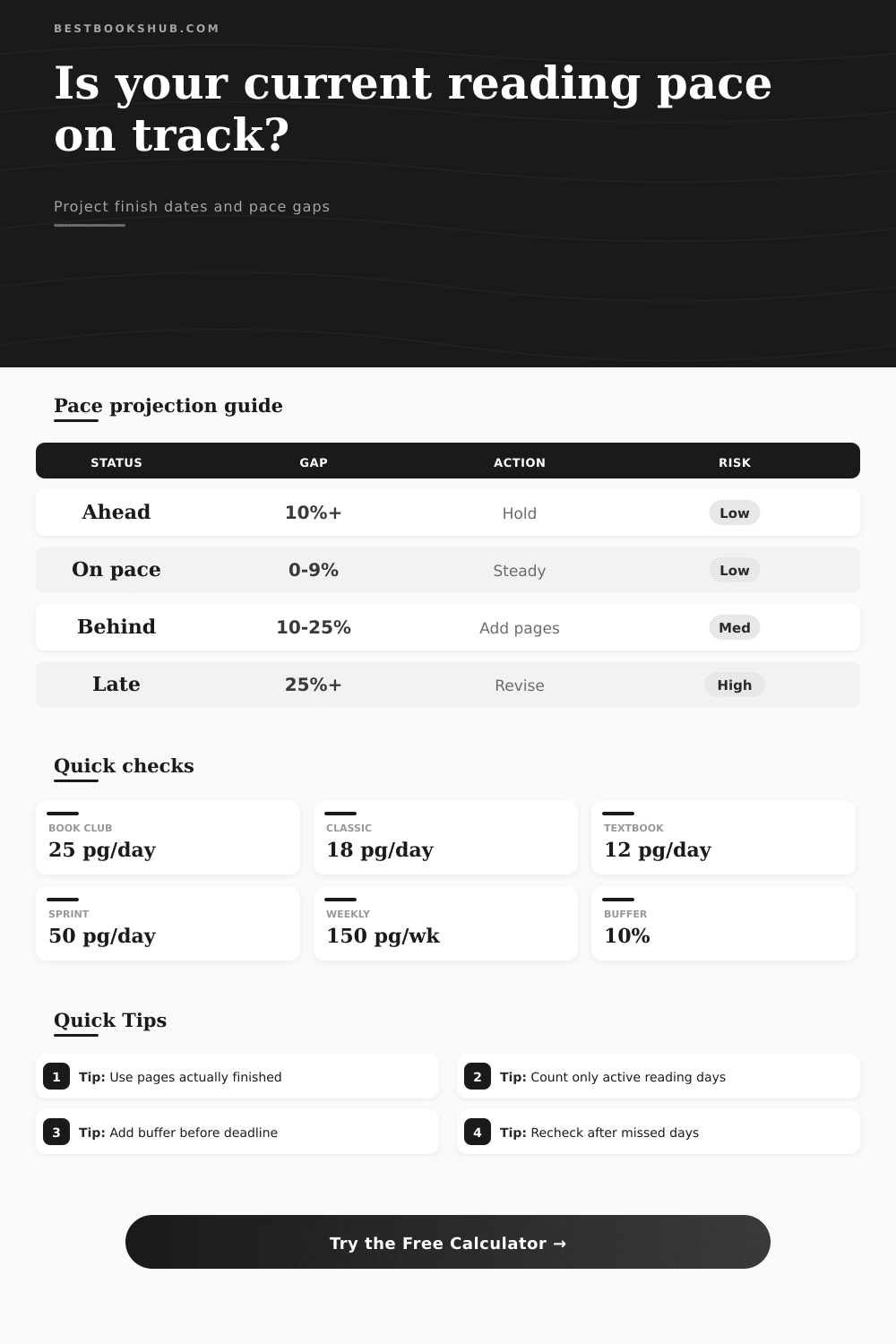
Adding a buffer is strategic planning, not pessimism. Add a ten percent cushion for nights when you’re too tired to focus. It also shows pace gap and provides finish date for output.
It’s depressing to know that you’re behind. But it’s actionable to know that you need to add an additional seven pages per day. That changes the mental load from “oh no, I’m worrying about it” to “here are my concrete targets.”
The risk level categories is on the reference table, showing how much behind means what kind of risk. That lets you determine whether slightly upping your efforts will suffice or whether you’ll have to do something differenter altogether.
Not every page takes an equal amount of time. That depends on context. Is it densely packed? Are you rereading a load of pages? A graph-heavy textbook will be slower then lightweight fiction (even if they have the same number of pages). To overlook these differences breaks plans. Account for the added resistance when calculating your daily quota now.
Why does this work? Because it replicate the way project managers deals with uncertainty in workflow. Reading is a habit, not a race, but if there’s something at stake, if we have to, then thinking of this as a project would of made us feel less stressed.
Don’t try to read faster. Know how fast you do read. Enter some honest numbers into the calculator, and let machine crunch its own numbers. You go ahead and do your thing: read the book. When you know how many pages are left it feels lighter.