📚 Publication pace lab
Issues per month calculator
Estimate the monthly release rate for comics, magazines, journals, newsletters, zines, and serial reading projects, then translate issue pace into pages, reading time, shelf growth, and backlog pressure.
📌Issue schedule presets
⚙Publication and reading inputs
Choose whether you know a counted span, a release frequency, or an annual issue count. Double issues, skipped months, special issues, and reliability are kept separate so the monthly rate is easy to audit.
Each double issue adds one issue-equivalent to the annualized count.
Ready to calculate issue pace.
Issues per month
-
monthly pace
Awaiting calculation.
Issues per year
-
annualized
Includes schedule adjustments.
Pages per month
-
reading load
Pages generated by the issue schedule.
Backlog status
-
catch-up check
Compares incoming issues with reading capacity.
Calculation breakdown
Input basis
Output model
Monthly planning snapshot
Backlog pressureAwaiting inputs
📊Issue format specs
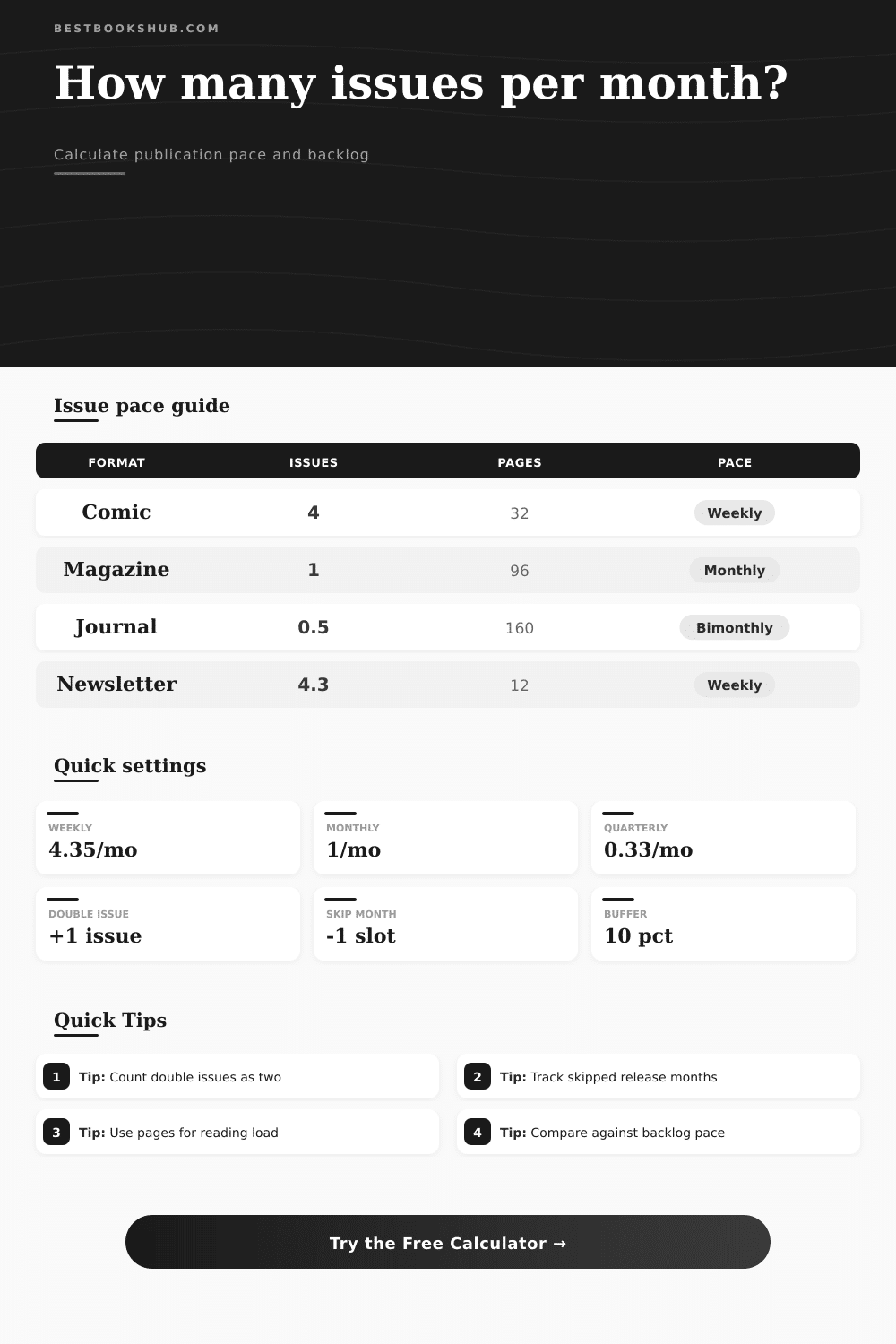
Comic single
32 pp
Common floppy issue estimate with a thin spine allowance.
Magazine
96 pp
Useful default for general monthly magazines and reviews.
Journal
160 pp
Academic issue estimate for articles, reviews, and front matter.
Newsletter
12 pp
Short issue model for digest-style serial reading.
📋Reference tables
| Schedule type | Issues per year | Issues per month | Use when |
|---|---|---|---|
| Weekly | 52 | 4.33 | A comic, newsletter, digest, or online serial has one release most weeks. |
| Biweekly | 26 | 2.17 | A title publishes every two weeks without a fixed day-of-month rhythm. |
| Semimonthly | 24 | 2.00 | A title usually publishes twice each calendar month. |
| Monthly | 12 | 1.00 | A magazine, journal issue, or serial installment arrives once per month. |
| Bimonthly | 6 | 0.50 | A title releases every two months or six times per year. |
| Quarterly | 4 | 0.33 | Academic journals, literary magazines, and society newsletters often use this cadence. |
| Format | Default pages | Spine width | Planning note |
|---|---|---|---|
| Comic single issue | 32 pages | 0.08 in | Low page count, high release count, and fast backlog swings. |
| Magazine issue | 96 pages | 0.18 in | Good default for one monthly issue with mixed articles and features. |
| Academic journal issue | 160 pages | 0.32 in | Dense reading load, slower pace, and often fewer issues per year. |
| Newsletter issue | 12 pages | 0.02 in | Frequent but light issues, useful for weekly reading plans. |
| Zine issue | 40 pages | 0.10 in | Irregular schedules benefit from counted-span mode. |
| Serial anthology issue | 220 pages | 0.48 in | Lower issue count but substantial shelf and reading growth. |
| Backlog pressure | Meaning | Signal | Adjustment |
|---|---|---|---|
| Catch-up | Monthly reading capacity exceeds incoming issues. | Unread count can shrink. | Keep the current reading target. |
| Holding | Reading capacity roughly matches new releases. | Backlog remains stable. | Add one extra issue per month to reduce old unread items. |
| Growing | Incoming issues exceed reading capacity. | Backlog rises each month. | Increase reading capacity or reduce active titles. |
| Archived | No reading target is entered. | Calculator reports growth only. | Enter a monthly read rate for catch-up timing. |
💡Issue pace notes
Use issue-equivalents for double issues. If a summer magazine combines two numbered issues into one larger mailing, count it as two issue-equivalents when you care about volume, pages, or backlog load.
Separate release pace from reading pace. A weekly newsletter may be easy to keep current, while a quarterly academic journal can add more pages in fewer calendar events.
DISCLOSURE: This post may contain affiliate links, meaning when you click the links and make a purchase, I receive a commission. As an Amazon Associate I earn from qualifying purchases.
{“text”: “three inches high”, “format”: “bold”},
{“text”: “Supply vs Consumption”, “format”: “bold”},
{“text”: “double-sized summer anthologies”, “format”: “bold”},
{“text”: “dozen-issues-a-year”, “format”: “bold”},
{“text”: “hundred-and-sixty-page issue”, “format”: “bold”},
{“text”: “four hours of concentrated study”, “format”: “bold”},
{“text”: “backlog pressure”, “format”: “bold”},
{“text”: “Catch-up mode”, “format”: “bold”},
{“text”: “two issues per week”, “format”: “bold”},
{“text”: “reference tables”, “format”: “bold”},
{“text”: “well-chosen collection”, “format”: “bold”},
{“text”: “frequency isn’t equal to volume”, “format”: “italic”},
{“text”: “reading rate”, “format”: “italic”},
{“text”: “production schedule”, “format”: “italic”},
{“text”: {“text”: “inflow of issues and the outflow of attention”, “format”: “italic”},
{“text”: “treat the issue as both a unit of space and time”, “format”: “underline”},
{“text”: “awareness will either help you pare down your list or add more to it”, “format”: “underline”},
{“text”: “let go of the fear and instead focus on the pages”, “format”: “underline”}
]