📚 Collection finish planner
Collection completion date calculator
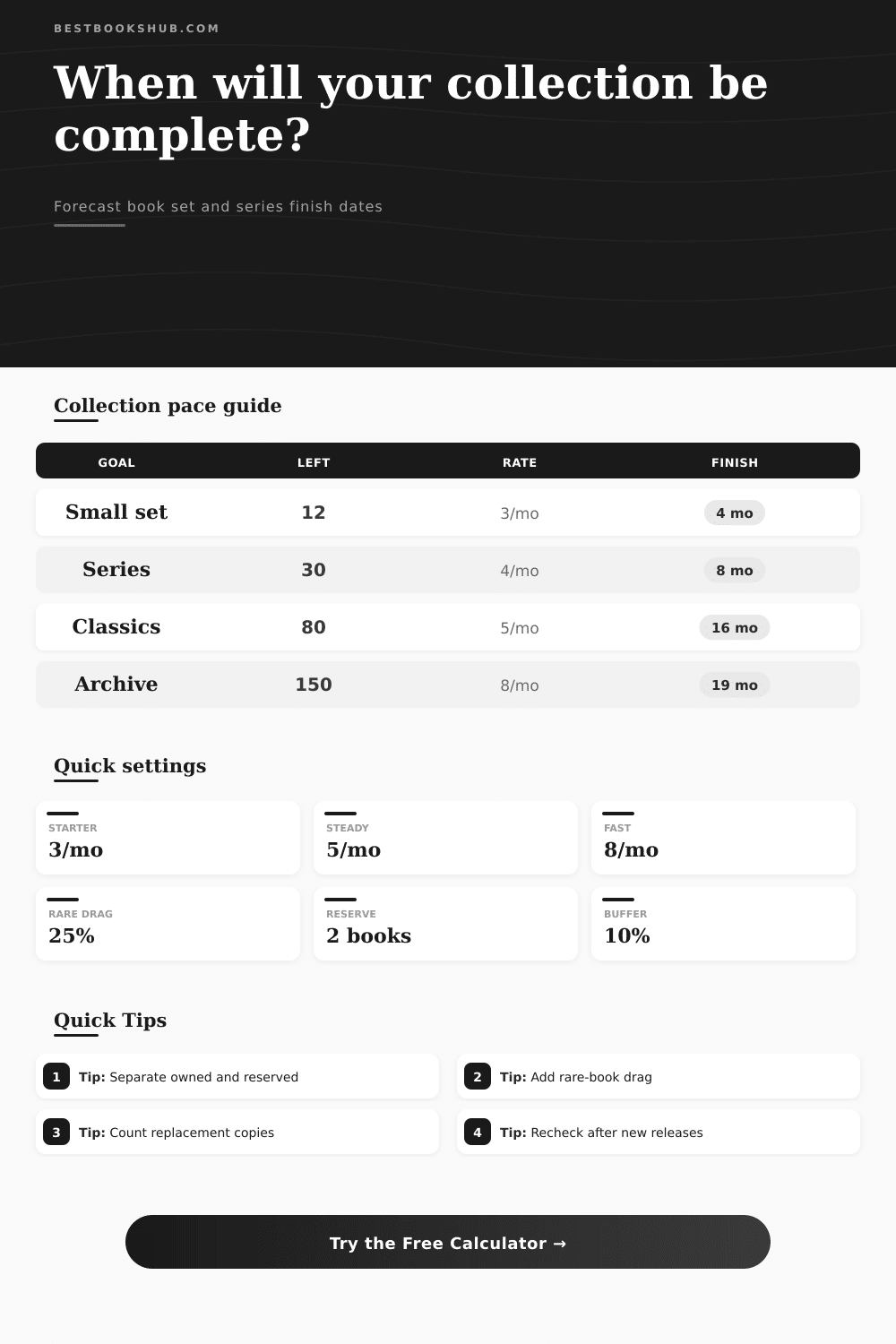
Forecast when a book collection, author run, boxed-set gap list, or ongoing series will be complete after owned copies, reserved books, releases, replacement copies, rare-book drag, and skipped months are counted.
Use the fixed target mode for a known list, ongoing mode when new volumes will be released during the hunt, and backlog mode when you are steadily clearing a wish list.
| Remaining books | 3 per month | 5 per month | 8 per month |
|---|---|---|---|
| 20 books | 7 months | 4 months | 3 months |
| 50 books | 17 months | 10 months | 7 months |
| 100 books | 34 months | 20 months | 13 months |
| 200 books | 67 months | 40 months | 25 months |
| Collection type | Typical drag | Replacement allowance | Forecast note |
|---|---|---|---|
| Current paperback series | 0-10% | 0-5% | Usually pace-driven |
| Mixed used hardcovers | 10-25% | 5-15% | Condition affects timing |
| Out-of-print classics | 25-45% | 10-25% | Availability adds waits |
| Small press archive | 45-70% | 15-25% | Expect uneven months |
| Scenario | Target | Owned | Practical setup |
|---|---|---|---|
| Author backlist | 35 books | 18 owned | Fixed list, low drag |
| Manga shelf | 96 books | 52 owned | Steady pace, reserves |
| Award archive | 140 books | 61 owned | Rare drag, pause months |
| Ongoing saga | 44 books | 29 owned | Release window included |
DISCLOSURE: This post may contain affiliate links, meaning when you click the links and make a purchase, I receive a commission. As an Amazon Associate I earn from qualifying purchases.
A major source of angst among book collectors is the gap on the shelf where another volume awaits. That is a promise waiting to be kept, but it must be kept at some point. When will that be? Will you fill out the set in time for next spring, or will it take you five years of hunting around?
Most collectors estimate the time frame based off a look at what they have and how they feel they’re making headway (without reference to any particular timeline). Having a plan give a sense of definite date, transforming a vague hope into something real.
How to Plan Your Book Collection Timeline
There is no need to guess how many book it takes to convert to another size. You plug in your current inventory, your desired size, and this handy-dandy calculator do the rest for you (see above). More importantly: it help explain the friction of the hunt. Because that’s really where you slow yourself down.
It is not the number of books remaining. Common titles are easy enough to come by when you’re starting out, and when you see one, you snatch it up. That gives you a false sense of momentum… Because 80 percent of the time spent on any given collection go into the final twenty percent. Most folks don’t realize that, and then they end up averaging their initial pace over the entire project and wondering why the finish line keeps inching further from further off. Scarcity changes the game, and you must take drag into account. The faster you deplete the low-hanging fruit, the slower your acquisition rate will be if you’re hunting out-of-print volume or first editions.
This little setting matter: It’s the calculator’s way of adjusting for its own difficulty curve. Without it, your prediction resembles a best-case scenario that never arrives. Because swaps and gifts count, too, you’ve got to consider what you’re actualy putting onto the shelf. Books on the watch list don’t count; only the books you actually get is worth considering. Until then, they’re just books someone else owns. This fact keeps your remaining workload honest when you separate the copies you own from those you reserve.
And what about editions? You can take whatever you get, or you can try to match certain criteria. That’s where replacement allowances comes into play. Sometimes you have to purchase the third book before getting one good enough to put on your shelf. So you’ve purchased three books to fill a single space on your shelf. And if you don’t include those additional store visits, the math start to add up quickly. People believe they’re just purchasing one book at a time when in fact, they’re frequently purchasing probability.
There is another wrinkle with ongoing series. When you’re running, the goalposts moves. New volumes comes out every few months, extending your target list naturaly. Do you count those future releases when figuring out what’s left? Or do you consider the collection to be a static snapshot in time? It is up to you. Are you trying to complete what we have today, or maintain a constant pace with the publisher? There’s no correct answer here; just one that fits your shelf space and budget.
If you really want to know how various paces will play out in terms of months elapsed, check out the reference table on the page. The distinction between five books a month versus three looks small. But after two years, you’re talking about hundreds of dollars and dozens of titles. Also consider that collecting is usually a weekend activity and therefore tends to get shoehorned around work commitments. Your schedule can’t keep pace with your ideal completion day if you’re only hunting vigorously for half the year. That’s not defeat, that’s realism.
The buffer adds a margin of error to compensate for the serendipity involved in snagging bargains: shipping delays, a seller’s cold feet, market fluctuations… these derailments can easily derail your plan. Keeping a 10% safety net prevents life from crushing the forecast.
Ultimately, knowing your completion date change how you collect. It shifts the activity from a passive accumulation to a managed project. What matters is that once you know, the way you collect changes: it is no longer passive collection, but a project with a deadline. Your behavior begin to change. You begin to prioritize according to what will fit into the timeline instead of whimsy. You no longer chase ghosts but do only those things that bring you one step nearer to zero. And those blank spaces on the bookshelf aren’t simply gaps anymore, but checkboxes with an expiration date.
And then, at last, that day comes and the reward isn’t just in having the books… It’s in having prepared to have them. The hunt ends; the story continues.