📚 Reading benchmark lab
Reading speed percentile calculator
Estimate your WPM percentile against a selected reader group, normalize for text difficulty, account for comprehension, and compare timed samples without mixing light reading with dense study material.
Enter a direct WPM score, pages and minutes, or a timed word sample. The calculator converts everything to WPM, then compares that pace to the selected reader group and material type.
| Measured WPM | Approx. percentile | Reading band | Common interpretation |
|---|---|---|---|
| 120 WPM | 5th percentile | Very careful | Often seen with dense study, annotation, second-language reading, or fatigue. |
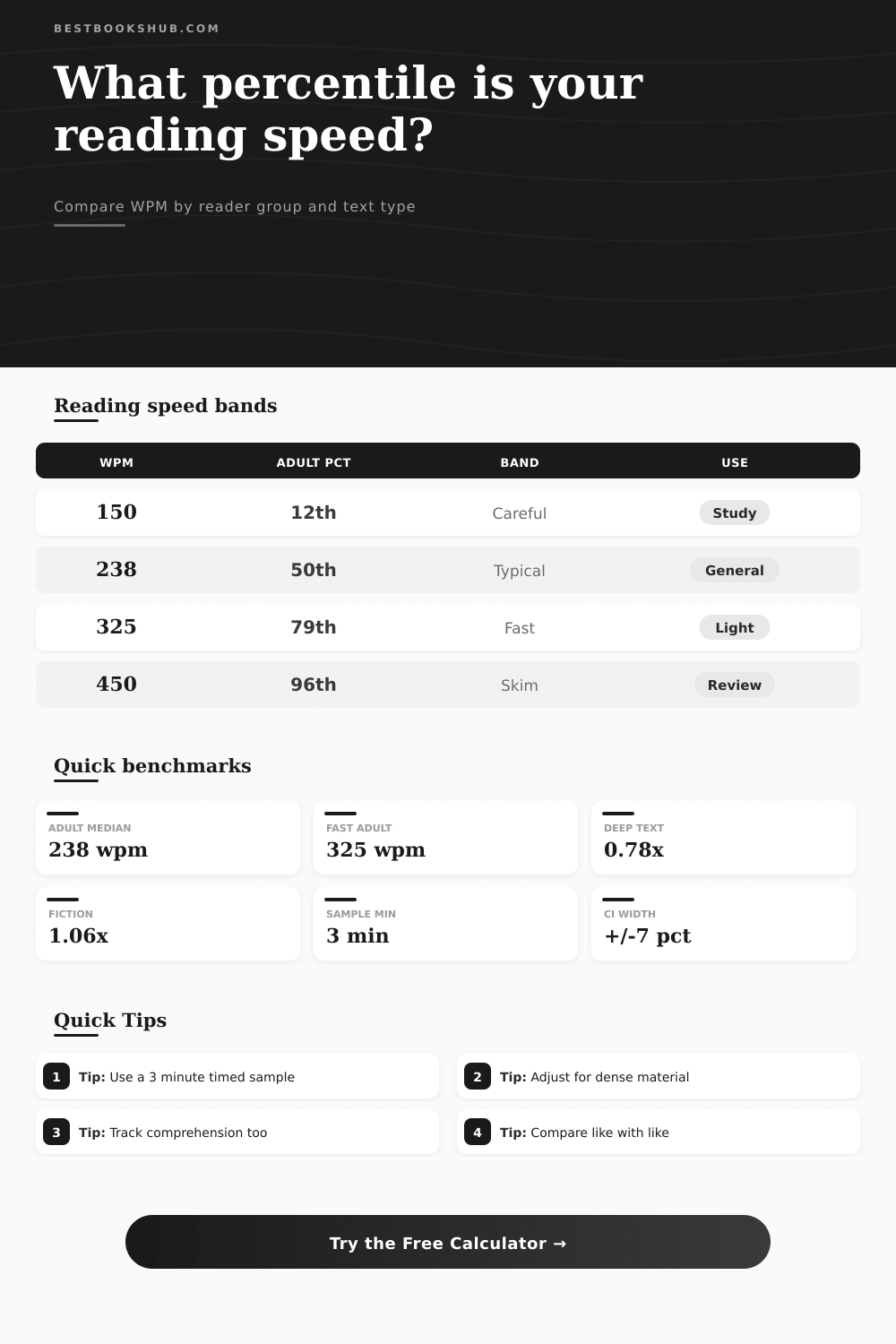
| 150 WPM | 12th percentile | Careful | Reasonable for technical pages, literary prose, or high-detail extraction. |
| 200 WPM | 29th percentile | Steady | Below the adult midpoint but common for nonfiction and note-taking. |
| 238 WPM | 50th percentile | Typical | Middle benchmark for general adult silent reading. |
| 300 WPM | 73rd percentile | Fluent | Comfortably above average for general books and articles. |
| 375 WPM | 91st percentile | Fast | Strong pace when comprehension remains good. |
| 450 WPM | 96th percentile | Very fast | Often skimming, rereading familiar material, or using a trained strategy. |
| Reader group | Median WPM | Typical middle range | Use this group when |
|---|---|---|---|
| Middle school readers | 170 WPM | 110 to 230 WPM | The sample is from a developing reader or grade-level classroom passage. |
| High school readers | 210 WPM | 145 to 280 WPM | The sample is teen silent reading of general prose. |
| Adults, general silent reading | 238 WPM | 170 to 310 WPM | You want a broad adult benchmark for books, articles, and essays. |
| College / graduate readers | 260 WPM | 180 to 345 WPM | The reader regularly handles academic material. |
| Trained speed readers | 430 WPM | 300 to 590 WPM | You are comparing against a speed-practice population, not general readers. |
| Audiobook narration pace | 155 WPM | 135 to 180 WPM | You are comparing listening pace or read-aloud pacing rather than silent reading. |
| Material type | Speed factor | Default words/page | Why it changes percentile |
|---|---|---|---|
| Light fiction or reread | 1.12x | 260 words/page | Familiar narrative flow usually reads faster than average prose. |
| General nonfiction or fiction | 1.00x | 300 words/page | Neutral benchmark for mixed adult reading. |
| Classic or literary prose | 0.88x | 330 words/page | Syntax, style, and inference slow the pace. |
| Textbook chapter | 0.78x | 520 words/page | Definitions, diagrams, and study checks add friction. |
| Research article or paper | 0.72x | 620 words/page | Methods, citations, and unfamiliar terms require detail attention. |
| Technical manual | 0.82x | 450 words/page | Procedural accuracy matters more than continuous pace. |
| Screen reading | 0.92x | 280 words/page | Scrolling, glare, and layout shifts often reduce sustained speed. |
| Skim or scan task | 1.65x | 300 words/page | Fast searching should be compared separately from comprehension reading. |
| Percentile | Band label | Practical meaning | Next check |
|---|---|---|---|
| 1st to 15th | Careful / slow | Your pace is below most peers in this comparison group. | Check text difficulty, focus, vision, and whether the task is detail-heavy. |
| 16th to 40th | Below midpoint | Slower than average, but often normal for study or dense material. | Retest with an easier passage and a three-minute sample. |
| 41st to 60th | Typical | Close to the middle of the selected group. | Track comprehension before trying to increase pace. |
| 61st to 85th | Above average | Faster than most readers in the same group. | Confirm recall with a short summary or quiz. |
| 86th to 97th | Fast | Strong pace, especially if comprehension is still high. | Separate true reading from previewing or scanning. |
| 98th to 99th | Exceptional | Very high compared with the selected benchmark. | Validate with longer samples and unfamiliar material. |
DISCLOSURE: This post may contain affiliate links, meaning when you click the links and make a purchase, I receive a commission. As an Amazon Associate I earn from qualifying purchases.
First of all, you might reason that reading is a race: The person who covers the most distance wins. But here’s the problem with this reasoning: The skills required to skim a tabloid differs from those needed to decode a dense research paper. How fast did your eyes moved? Did you understand what was written? Did you take it in? Your raw words per minute number will only indicate how quickly your eyes move. It won’t indicate if you were understanding what you read or if you were simply gliding over words without taking anything in.
Plug in your sample data into the calculator above, and the calculator do all the work for you. You will no longer fumble to figure out how much your pace is adjusted because of fatigue or text density. It adjusts your pace to that group. You’re not just seeing how fast (or slow) you are compared to some made up average, but instead how you stack up to people who face similar challenges.
Why Reading Fast Is Not The Only Thing That Matters
The catch? What does that benchmark realy represent? Three hundred words per minute sounds great on paper. But if you’re reading a technical manual, that pace could be a sign you’re missing critical safety instructions. If you’re reading a favorite novel, that pace could signal you’re rushing through the book and bored. To help explain this, the tool adjust for material type. That said, it accounts for the fact that people read super-dense texts like textbook much slower then they read light fiction. The point is to avoid tricking yourself into believing that you’re slow if what you read happens to be dense.
Comprehension is a wild card in every reading test, alongside other variables like text density and fatigue. Many speed-reading course claim you can double your reading rate. They say this happens once you master stopping subvocalization or expanding your peripheral vision. And yet, the second you start using these tricks, comprehension typicaly plummets. Sure, maybe you’ll go from 20 minutes per chapter to 10. But if three pages out of every four wash over your brain like water off a duck’s back and you end up having to reread them, then your effective speed isn’t any different. In fact, it’s probably worse. For this very reason, the calculator contain a comprehension slider. If your recall is only fair, the tool will lower your percentile rank. That seems far more realistic than a raw timestamp could ever capture. It recognizes that reading is a transaction between mind and eye, not simply based off eye and page.
But here’s the thing: Fast is relative. How “fast” you read depends on the context. A trained speed reader doesn’t read at the same average speed as a college grad student, and a college grad student don’t read at the same average speed as a middle-schooler. If you read more slowly because you’re part of a book club and you want to talk about it afterward, then comparing yourself to academic norms is going to make you feel like crap when you’re supposed to feel normal! This chart on the linked-to page makes it clear how the median shifts based off the kind of reader. It reminds us that norms are fluid. Something that looks fast in one context may be fast-and-loose (reckless?) in another context. Something that looks slow in one context may be careful in another.
You also need some self-discipline to time your own sample. A couple minutes here and there, below 2 minutes, will hardly provides a reliable estimate (you’ll be measuring spurts of adrenaline, not sustained focus). For a number you can trust, try to sustain three minutes or more of uninterrupted reading. Choose a passage comparable in difficulty to what you tend to read during the day. Don’t test yourself on a poem and assume you know how fast you read news articles. That mismatch adds noise to your data. You’re looking for a clean signal so that you can understand where you really stand.
In the end, your percentile isn’t so much about outperforming others as it is about adjusting your expectations. What does a good reading speed look like? Where do you want to be faster and where can you coast in order to retain information? A slower reading speed paired with strong comprehension is still winning if you’re preparing for an exam. Speeding through your emails to get to “inbox zero” means accepting slightly lower recall levels, but getting a higher score.
Your reading speed (unlike your height) is flexible; it’s a skill, not a set-in-stone trait. Discover your base level with the tool, then let your objective guide you toward the appropriate acceleration or deceleration. We want to read well, not fast!