📘 Reading reserve planner
Buffer chapters calculator
Estimate how many chapters ahead of schedule you are, how many buffer chapters you still need, and what daily chapter pace protects a book club, course, serial read, or study deadline.
Use chapter numbers rather than pages when the assignment, episode schedule, or club plan is chapter based. Time estimates still use pages per chapter and minutes per page so the result stays practical.
| Plan type | Typical buffer | Why it works | Watch point |
|---|---|---|---|
| Weekly book club | 2-4 chapters | Covers one missed evening or a busy weekend. | Discussion chapters may not be equal length. |
| Class novel unit | 3-6 chapters | Keeps margin before quizzes, seminars, or response papers. | Dense chapters need time adjustment. |
| Serial reading | 1-3 chapters | Maintains continuity when releases or posts arrive in batches. | Do not count unreleased chapters. |
| Research reading | 4-8 chapters | Protects annotation, citation checks, and rereading time. | Page count can understate difficulty. |
| Chapter format | Pages per chapter | Minutes per page | Planning note |
|---|---|---|---|
| Fast genre fiction | 8-14 pages | 0.9-1.5 min | A small chapter reserve can be rebuilt quickly. |
| Trade nonfiction | 12-22 pages | 1.5-2.5 min | Examples, endnotes, and charts add quiet drag. |
| Classic literature | 10-24 pages | 2.0-3.2 min | Sentence density makes chapter counts feel uneven. |
| Academic textbook | 18-40 pages | 2.4-5.0 min | Use a higher density multiplier for notes and review. |
| Schedule pressure | Reading days/week | Safety margin | Good buffer target |
|---|---|---|---|
| Open calendar | 6-7 days | 5% | 1-3 chapters ahead |
| Normal workweek | 4-5 days | 10% | 3-5 chapters ahead |
| Busy semester | 3-4 days | 15% | 4-7 chapters ahead |
| Travel or exams | 1-3 days | 20-25% | 6+ chapters ahead |
DISCLOSURE: This post may contain affiliate links, meaning when you click the links and make a purchase, I receive a commission. As an Amazon Associate I earn from qualifying purchases.
There’s a certain kind of anxiety that comes from knowing exactly how much you need to get done and having no cushion left over. You walk into a seminar room or gather around book-club table with your friends; and you’re about to open the chapter that you’ve never read before today. There’s not a single idea rattling around in your head, and whatever you say will come off as a knee-jerk reaction.
Most often, it’s not a matter of being able to read quickly enough. It’s a matter of buffer management; most people fails to make plans assuming they’ll get an average week. In reality, however, you don’t always gets an average week. One sudden meeting or traffic jam and you can blow through your margin within an afternoon. This is why a chapter reserve are more important than just on-time delivery.
Why You Need a Reading Buffer
After entering your deadline and book length, the calculator do the math. No need to guess if it’s safe to be three chapters ahead when you’re having a busy semester. Most readers forget to enter things like reading days per week and text density into equation, which the interface prompts for. You may think each chapter is equal, but every chapter isn’t. Light fiction pages takes only half as long to read as dense textbook sections packed with endnotes and charts. Adjusting for this difficulty are a feature of the tool. Crank up the difficulty multiplier if you’re reading classic literature or heavy nonfiction. This increases your estimate of how long it will take to read each page.
This shows you that your current reading pace is slower then expected. Small thing, but it keeps you from banking on speed you don’t really have.
Most people approach their reading schedule as a sprint. They’ll tackle as much as they can the night before assignment is due. There’s no margin for error. Work late? Get sick? You’re already behind. The key to the buffer concept is to turn the script upside down by front-loading extra chapters early in the cycle when your calendar is empty and your energy is up.
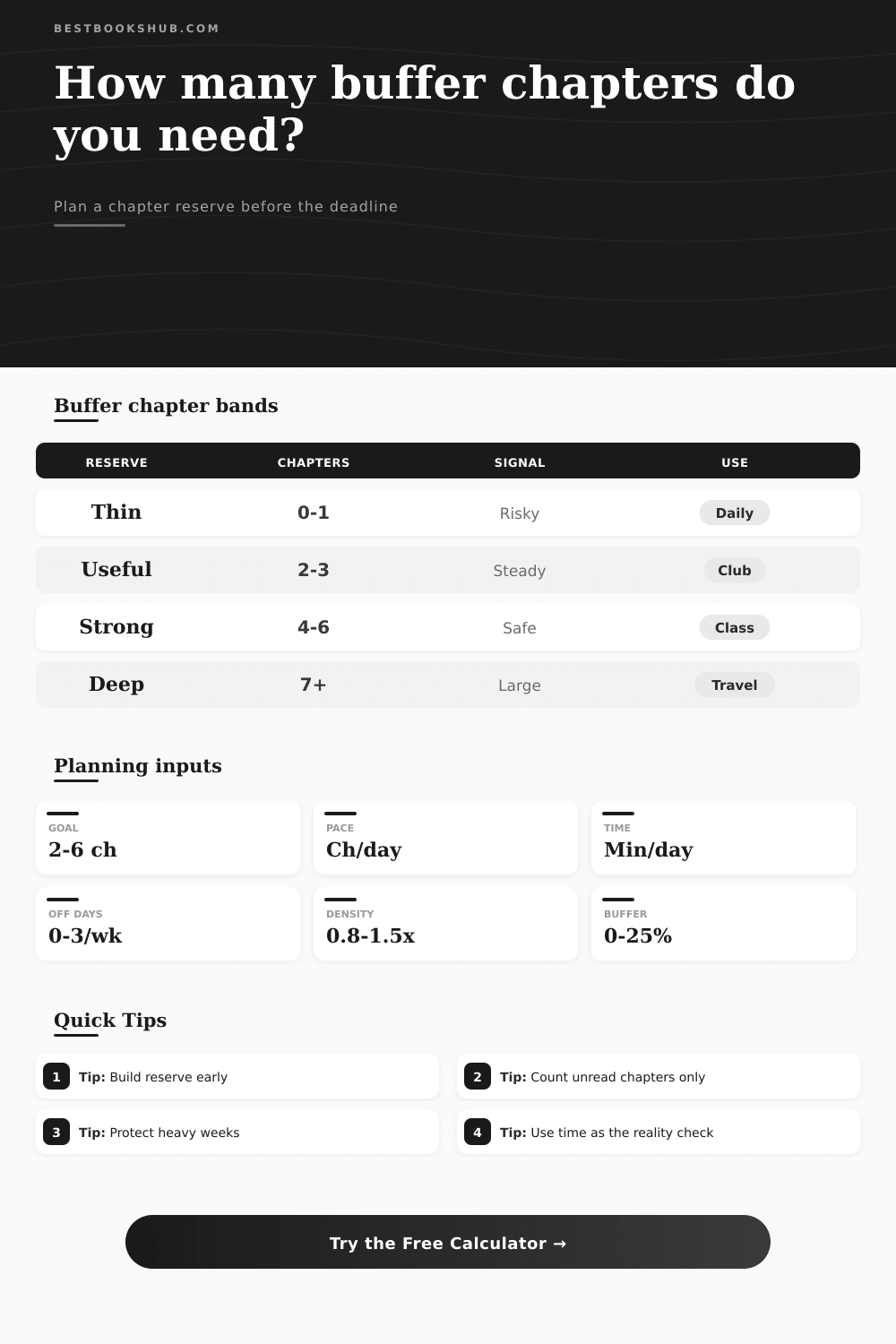
At week three, you’re not playing catch-up. You’re resting on a stack of completed chapter which serve as insurance against the unexpected. This is where the reference table come into play. Zero or one chapter is a small reserve, but it’s dangerous. Maybe you’re a daily reader with a steady schedule. But if there are exams on the horizon or a travel week, you’re going to need a deep reserve of seven or more chapters. That level of depth will buy you silence. It lets you sleep through the weekend without fearing Monday morning.
This is really the strategy: calculating your daily target. The tool provide you with two numbers. First: Your base pace… How fast do you have to read just to stay even? Second: The buffer-build pace… The pace plus how much cushion you’d like (your safety margin). Those two numbers ought to look similar, or else your plan is busted, you can’t sustain a double-time reading pace week after week. Find a rhythm where your buffer build feels like a gentle stretch, not a sprint. Aim to always be ahead by that number. Miss a day? Dip in the reserve; don’t fall off schedule. Let the reserve absorb the shock.
One mistake is assuming that you’re making progress just by reading, even if you haven’t read everything yet. Don’t fall for this. When the quiz begins, a partially-read chapter won’t save you from any tears. It’s stressful and confusing. Make sure to only count chapters that are truly finished in your reserve. This keeps you honest about how much you’ve really digested, but also helps clear your mind.
Knowing that there’s a solid number of completed units ahead of you reduces your mental effort. You’ll stop worrying about whether or not you’re going to make it. And instead enjoy the material for what it is.
And that’s the genius of this system: It makes reading part of a managed project instead of a chore. And now, you’re not at the mercy of the calendar. You’ve created slack in your life. Look at your results. How long did it ask for per day? If it says an hour and a half, but all you can give it is thirty minutes, then tweak either your deadline or your expectations. Capacity doesn’t lie about the math. The math simply shows you where you got lost in your assumptions.
That early reserve is how you protect your sanity down the road. You walk into that meeting ready and engaged. Everyone else is still flipping through first page.