📖 Serial calendar lab
Serialized release schedule calculator
Build an episode release calendar from launch date, cadence, preferred weekdays, buffer episodes, production pace, hiatus weeks, arc breaks, early-access lead, and finale timing.
Load a realistic serial launch pattern, then adjust cadence, buffer, production pace, hiatuses, and row output.
DISCLOSURE: This post may contain affiliate links, meaning when you click the links and make a purchase, I receive a commission. As an Amazon Associate I earn from qualifying purchases.
The first two tables are generated from your schedule. Reference tables below show common serial cadences and buffer expectations.
| Episode | Public date | Early date | Arc | Draft buffer | Schedule note |
|---|---|---|---|---|---|
| Run the calculator to generate release rows. | |||||
| Arc block | Episodes | First release | Last release | Pause after | Use |
|---|---|---|---|---|---|
| Run the calculator to generate arc rows. | |||||
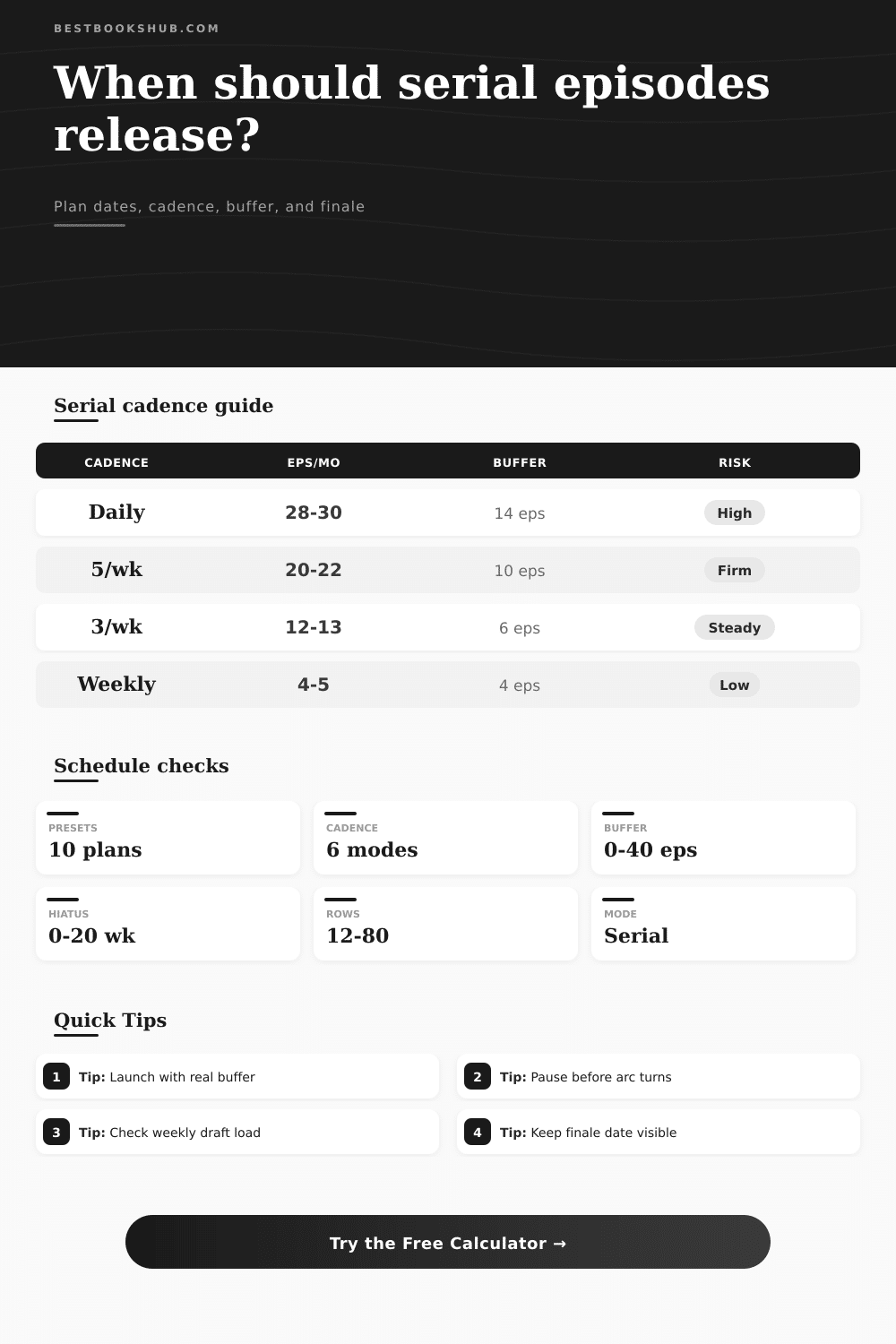
| Cadence | Typical monthly posts | Good launch buffer | Best fit | Watch point |
|---|---|---|---|---|
| Daily | 28-30 episodes | 14-30 drafted | App serials and short web chapters | Production misses compound quickly. |
| Five per week | 20-22 episodes | 10-18 drafted | Mobile-first habit reading | Leave at least one recovery week per arc. |
| Three per week | 12-13 episodes | 6-10 drafted | Web novels and newsletters | Good balance of rhythm and production. |
| Twice weekly | 8-9 episodes | 5-8 drafted | Mystery, romance, and chapter-sized scenes | Hooks need memory support across gaps. |
| Weekly | 4-5 episodes | 4-6 drafted | Premium serials and patron fiction | Each episode must feel substantial. |
| Biweekly | 2-3 episodes | 3-5 drafted | Dense arcs or illustrated releases | Use recap cues and strong arc signposts. |
| Planning signal | Healthy range | Warning range | What to adjust | Why it matters |
|---|---|---|---|---|
| Buffer floor | Target or higher | Below target | Delay launch, slow cadence, or draft more | Prevents missed releases from one hard week. |
| Draft pace | Above release pace | Below release pace | Add hiatuses or reduce public posts | The calendar should not consume the whole backlog. |
| Arc breaks | After major turns | Random pauses | Move breaks to block endings | Readers tolerate pauses better after payoff. |
| Finale target | Within 7 days | Over 14 days off | Change launch, cadence, or episode count | A known finale helps promotions and reminders. |
Starting with enthusiasm and a spreadsheet of optimism, you start a serial novel. Youve got a backlog so first few chapters flow easy. And then it hits you: Reality. Life happens. One sick day become one missed deadline. Your buffer dissapears. Your readers see this. That’s what trips up most serial fiction author. Their plans assume they’ll be at their best-writing self, never their worst.
With the calculator above, you can create a plan to survive real life, not just an ideal fantasy version of your productivity. This is the basic concept, but I think it really helps if people are open about what they’re doing. Know your release schedule and your draft pace. How many words/episodes/etc can you churn out without compromising quality? Unless you’ve got superpowers, most writer significantly overestimate this figure. This is again a small detail, but it are hugely important for sustainable long term writing. Don’t say you’ll publish 5 things if you only has capacity to put out 3 good-quality chapter each week. Eventually the math catches up to you.
How to Plan Your Writing Schedule
Put your realistic weekly draft count here. This determines your buffer size as time goes by, shrinking buffers are your biggest red flag in serial publishing. It means you’re burning through savings at a higher rate then you’re building them.
The risk profile changes when we start to consider cadence choices. Releases every day sound engaging and ambitious, but offer no margin for error. One bad week can wipe out two weeks of cushion. Three times a week is a more stable rhythm which let you have the occasional slow day without losing the trust of your audience. This can be made clear from the reference table in the tool which show you how deep your reserve needs to be per frequency. The higher the frequency, the deeper the reserve. It is not laziness; it is just risk management.
The strategy is here: Buffer. Imagine these draft episodes as money sitting in a bank account. How much do you need saved up? You need enough for when life happens, or you get sick, or hit a bout of writer’s block. Depending on how fast you work, that could mean six to ten episodes in the bank. The lower bound (the lowest your back log will go) is called floor projection and it’s what the calculator returns. This lets you know whether you’re flying too low to the ground. When the floor dips into your comfort zone, throttle down the release cadence or raise the launch date.
Strategic Hiatus Weeks are planned pauses that provide breathing room. Accidental hiatus weeks are emergency gaps that lead to abandonment. Add Hiatus Weeks after major reveals or arc turns. Readers is more forgiving of hiatuses immediately following a payoff. The tool does this for you automatically, it sets the rhythm according to your preferences even when you are away.
The second group of users (the part-time or early-access crowd) help fund you, but also test out new stuff. For patrons, a seven day lead is normal. That’s enough time for people to interact with something before the general public gets it. Maintain that lead. Switching up leads will confuse subscribers and make customer service inquiries more difficult. This delay is accounted for on the calculator so you can tell exactly when your supporters recieve content vs when the masses do.
Your marketing will revolve around that finale date. It’s also the final line in the sand you hold readers to; it’s the deadline for them to catch up (or else). You don’t want your story to drag on forever because of no ending point. Plan ahead: decide a reasonable end based off how fast you’re drafting and how often you post. Is the expected ending too distant? Maybe add more hiatus weeks. Or maybe pick up the pace so you can finish sooner.
These are all the moving parts. This is where it all comes together. This is the breakdown section. Where the lofty ambitions gets translated into calendar dates. Where you can see problems emerge before they become a problem. Tinker until it doesn’t just seem doable, but seems doable within your schedule. A solid plan will look mundane on paper but stand up to chaos in the real world. Pad the launch, take breaks deliberately, deliver what you promise. If that’s how you treat readers then they’ll be there for you.