📚 Reading payoff lab
Reading return on investment calculator
Estimate how many usable hours a book, course chapter, or research packet can return after reading time, notes, practice, follow-through, and the benefit window are included.
| Reading material | Typical words/page | Depth multiplier | ROI note |
|---|---|---|---|
| Trade non-fiction | 225 to 300 | 1.00 to 1.30 | Best when at least one process changes. |
| Academic textbook | 300 to 425 | 1.30 to 2.10 | Often needs practice time to turn into return. |
| Business framework book | 230 to 290 | 0.90 to 1.25 | High payoff if shared with a team workflow. |
| Research packet | 350 to 500 | 1.40 to 2.10 | Return usually comes from decision errors avoided. |
| Literary seminar novel | 250 to 330 | 1.10 to 1.80 | Use study gains rather than workflow savings. |
| ROI multiple | Interpretation | Best next move | Common cause |
|---|---|---|---|
| Under 1.0x | Below break-even | Skim, defer, or narrow the goal | Too little follow-through |
| 1.0x to 2.9x | Modest return | Extract one action and re-check | Useful but not repeated often |
| 3.0x to 7.9x | Good return | Schedule notes and practice | Clear process or study gain |
| 8.0x to 14.9x | Strong return | Share the notes or template | Reusable insight or team benefit |
| 15.0x+ | Exceptional return | Turn it into a checklist | High leverage decision improvement |
| Reading strategy | Time investment | Retention effect | Use when |
|---|---|---|---|
| Skim then select chapters | Low | Low to medium | You need a fast relevance check. |
| Careful read with margin notes | Medium | Medium | The book has direct workflow ideas. |
| Read plus summary memo | Medium high | High | You will reuse or share the lessons. |
| Read plus deliberate practice | High | High | The return depends on skill transfer. |
| Research synthesis grid | High | High | Several sources inform one decision. |
| Named preset | Pages | Main gain | Expected pattern |
|---|---|---|---|
| Atomic Habits Routine | 320 | Minutes saved weekly | Small repeated process improvements. |
| GTD Reset | 288 | Decision drag reduced | High return when reviewed monthly. |
| Make It Stick Study | 336 | Study hours protected | Return rises with practice sessions. |
| Lean Startup Sprint | 336 | Experiment cycles improved | Team sharing can multiply benefit. |
| SPIN Selling Notes | 224 | Meeting prep improved | Useful ideas compound across calls. |
DISCLOSURE: This post may contain affiliate links, meaning when you click the links and make a purchase, I receive a commission. As an Amazon Associate I earn from qualifying purchases.
The vast majority of us approach reading as if it were a moral virtue instead of a business decision. We purchase books with good intentions, we read them with some degree of attention, then we shove them onto a shelf where they collect dust. Few of us ever question whether we’re using our time wisely. It’s easy to feel productive while holding a book, but feeling productive is not the same as being effective. And this distinction become important when you’re trying to solve a workflow issue or improve your skill.
Consider the idea of reading as an investment portfolio with hours rather than dollars being your currency. Once you know the expected return, and you figure out how much you’re willing to pay, you can let the calculator above do the math for you. It require you to articulate the cost of acquisition: not only in terms of the time it takes to turn those pages, but also the time it takes to apply new ideas by taking notes and practicing them.
How to Get Better Results from Reading
Remember, reading is only half the equation. Application is the other half. Even if you highlight every page of a book on project management, you won’t see any return unless you use the lessons learned to change your approach to running meetings. This fact is shown in the inputs of the tool, which distinguish between raw reading time versus usable gains. To set the baseline cost, you put in your speed and number of pages. But then there’s an estimate for how many of these ideas you’ll actualy end up using.
Here is where most estimates go wrong; people are optimistic about their future self. Perhaps you think you’ll incorporate five new techniques? Life happens, and you only implement one. You can tweak down the usage rate on this calculator to account for reality. Be conservative here rather than surprised later. Volume of input doesn’t matter if follow-through are low. Speed isn’t as important as depth.
I used to skim through manuals of dense technical information. This saved me an hour in the moment, but cost me ten hours the next day when I forget a vital detail. This is why the tool includes a reading depth multiplier, which adjusts for your own depth preference. Taking margin notes and reading carefully makes it slower at first, but you typically have better retention and clearer application paths. You invest more time now to avoid wasting time later. That’s what return on investment thinking is all about.
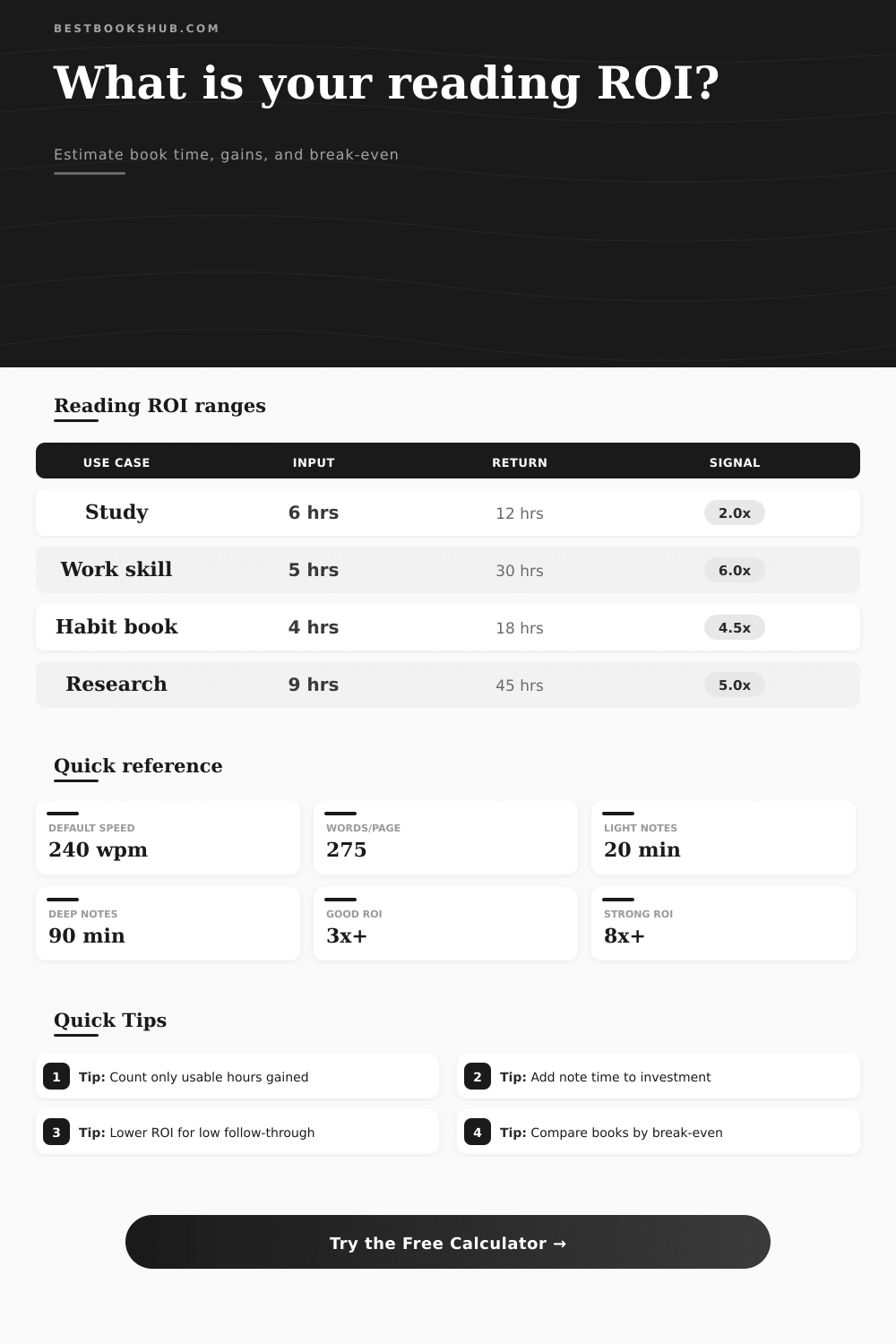
That’s where the output metrics come into play. They let you rate all sorts of content with objective criteria. While an entertaining fiction novel may offer hours of entertainment (which is valuable), it’ll seldom give workflow efficiency gains like a business strategy book will. On the page, there’s a reference table that plots out how various genres tend to perform. Study materials tend to have more of an up-front cost before breaking even, while practical habit books that prompt you to tweak one daily routine can start paying off pretty fast. It lets you focus your time on the books that deserve the most attention.
This is also where we consider the breakeven time: How long will it take for me to get my time’s worth? Ten years of gradual savings may sound nice from a book, but what if I’m in trouble right now and could use a fix? It wouldn’t do me any good if I can only get the rewards in the year 2030. When you’re desperate for an answer, you’d rather have something that pays off fast. What does the calculator tell you? How many months before you’ll recover the hours spent reading the guidebook? A book on correcting spreadsheet errors today might not be the best fit. Its breakeven period is 12 months out, so maybe there’s a faster way.
In summary: Reading isn’t the end; it’s what sticks and what gets applied that matters. This is the Information Age, a time with endless data but limited attention. When everything becomes “important,” we burn out and fail to really understand anything. When you put numbers on the cost (effort) and benefit (expected value), you build a filter that prevents low-value books from clogging up your calendar. And you stop reading just to say that you’ve read something. Instead, you begin reading to get results.
This change transforms your hobby from passive to active. A personal-growth strategy. You should of considered it earlier.