📖 Reading value lab
Book value per read calculator
Estimate how much lasting reading value a book delivers per completed read using length, completion, notes, retention, reread likelihood, and reference use.
| Format | Typical pace | Page density | Value pattern |
|---|---|---|---|
| Trade paperback | 40-55 pages/hr | 250-300 words/page | Balanced learning and enjoyment |
| Hardcover narrative | 38-52 pages/hr | 260-310 words/page | High reread potential for favorites |
| Textbook | 12-28 pages/hr | 400-600 words/page | Dense value when retained and reviewed |
| Reference guide | 10-24 pages/hr | 350-550 words/page | Value grows through repeated lookup |
| Graphic novel | 55-90 pages/hr | Variable visual density | Fast completion with strong reread appeal |
| Audiobook | 9,000 words/hr at 150 wpm | Converted to pages | Best measured by hours and retention |
| Value per read | Interpretation | Common signal | Next action |
|---|---|---|---|
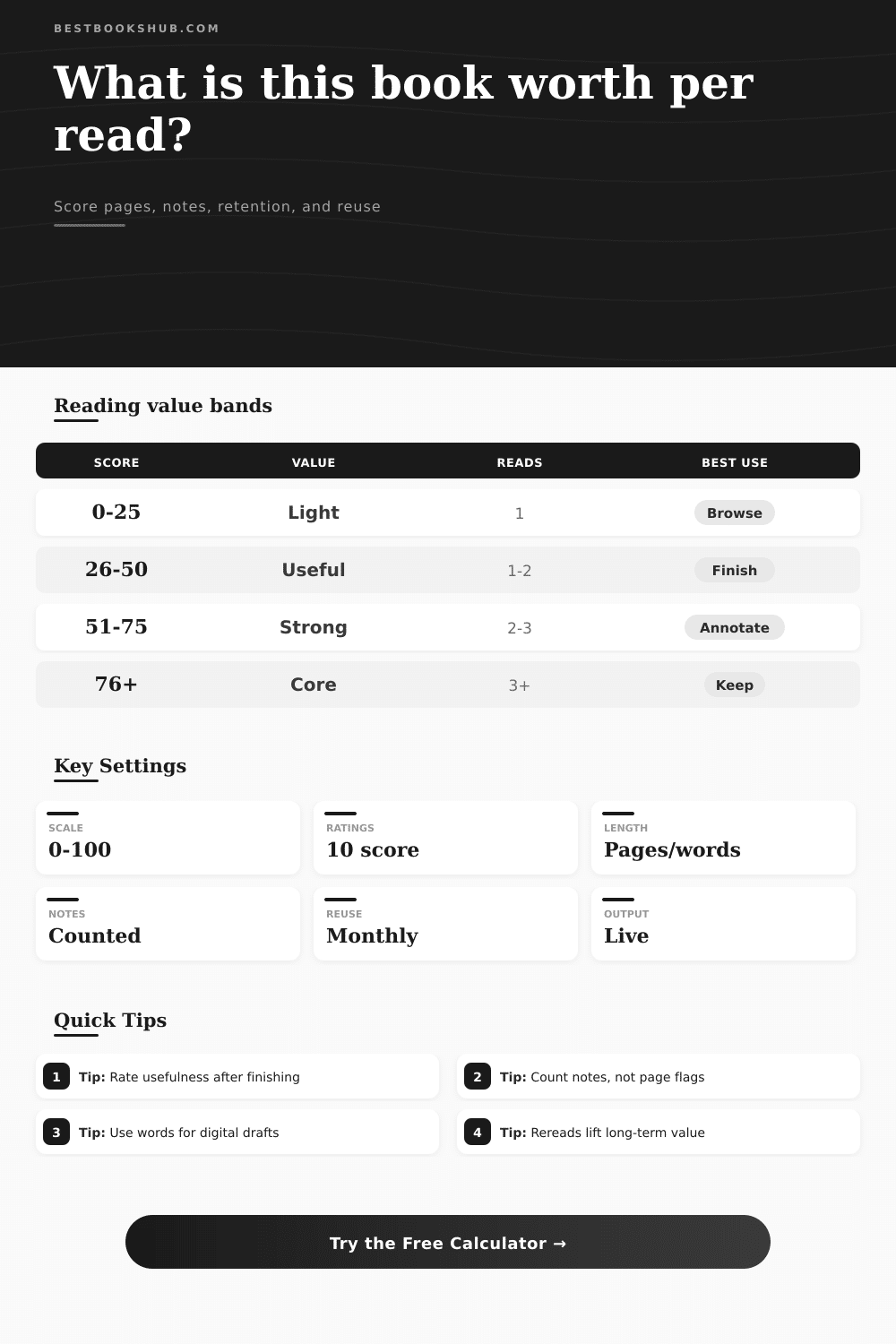
| 0-25 | Light value | Low completion, few notes, weak retention | Skim, sample, or pause |
| 26-50 | Useful read | Finished once with some learning | Keep notes if relevant |
| 51-75 | Strong read | High quality ratings and real reuse | Annotate and revisit |
| 76-100 | Core shelf book | Repeated use, durable ideas, high retention | Add to active reference shelf |
| 100+ | Exceptional value | Multiple reads plus ongoing reference use | Build a summary or study plan |
| Scenario | Length | Expected reads | Value driver |
|---|---|---|---|
| Weekend novel | 280-380 pages | 1 read | Enjoyment and completion |
| Book club nonfiction | 240-340 pages | 1-2 reads | Discussion notes and relevance |
| Professional manual | 300-700 pages | Partial reads | Reference touches per month |
| Course textbook | 500-1,000 pages | Chapter cycles | Retention and review notes |
| Annotated classic | 350-650 pages | 1-3 reads | Reread likelihood and depth |
| Short practical guide | 80-180 pages | 1 read | Actionable takeaways per hour |
DISCLOSURE: This post may contain affiliate links, meaning when you click the links and make a purchase, I receive a commission. As an Amazon Associate I earn from qualifying purchases.
It quantifies books’ usefulness relative to amount of time you spend reading them. Whereas other calculators measures “enjoyment” scores and stop there, this one aim to go deeper into measuring real-world benefit. Because, when it comes down to it, price tags don’t always reflect a book’s entire worth. You may have bought a cheap paperback that never gets opened. Meanwhile, an expensive manual could be saving you hours a month of troubleshooting.
The price doesn’t matter; it’s the value you get out of each read. So you begin with length and format of the book. For example, these could be the hours in an audiobook, the number of words, or the number of printed pages. Each one of those are going to give you a slightly different read speed, which is important to make sure you’re accurately comparing across mediums. You digest a graphic novel quickly but might retain fewer facts than from a slow-paced textbook, even though they are different medium. The calculator includes all this in terms of some sort of base unit of coverage. Now you know how many books of whatever type you can compare without getting confused.
How to Measure the Real Value of Books
Then it takes into account your completion rate, as well as how many times you’ve already reread that material. Sure, finishing a book once is simple. But making it relevant enough to crack open again six months later isn’t. On a basic scale, you’re asked to rate how much you liked it, learned from it, and how relevant it was. Immediately after closing the book, most people will tend to overrate all three. So there’s a retention question: if, a month later, you can’t recall at least half of what was in the book, then it entertained you but didn’t educate you. Retained information build up; forgotten pages simply represent burnt hours. That’s why this tool weights it heavily.
Usefulness of your highlights/notes You do count your useful highlights or notes. Not that you flagged every sentence that caught your interest, rather, what insights are you likely to refer back to when facing a problem down the road? A short book with ten solid takeaways might be more valuable than a long book stuffed full of passive fluff. But all of this shifts when reference use is involved. Suppose you retain a moderate number of points from your reading; but meet with a pro guide twice a month over two years? That’s worth more. The calculator also knows how often you expect to reuse something (and for how long)… And knows which books to live in vs read.
It spits out a score ranging from light, useful, strong, or core. A light value book may be more suitable for listening to as an audiobook on your drive to work instead of reading deeply. Core books should be kept within arm’s reach on your active shelf. To help put those numbers in context, we have created a reference table (on the page) that shows the expected scores of various types of books. Novels succeed based off how enjoyable they are and how many times you want to read them again; textbooks require a lot more information for you to retain to make up for their heft. Knowing what you want out of a book lets you know what to expect from it.
You won’t get a high score on “long term reference utility” from a thriller, because that’s just not why thrillers exist! But don’t be shocked when a very technical manual gets a low score for “initial enjoyment” and a high one for “overall value” (after all), you’re going to look things up in it a bunch. These tradeoffs is baked into the math, and now you get the whole picture.
It’s a strategy that makes you consider reading not as a form of consumption but as an investment portfolio. Every book is a stock that either pays dividends through repeated use or is a speculative bet that may or may not yield insight. Rate them accordingly, honestly, and stop buying stuff you don’t plan to read. In doing so, you begin to thin your collection and build a real working library of books you’ll get something out of. You realize which kinds of books actualy benefit your life versus those you feel obligated to keep around for appearance’s sake.
It’s not about reading more, it’s about remembering more of what you do read. Once you’re able to visualize the return on your reading hours, every single page becomes a conscious decision. There’s no guesswork anymore; there’s only knowing.