📚 Reading value lab
Cost per hour of reading calculator
Estimate the real hourly value of a book, ebook, library loan, subscription read, or audiobook using net spend, reading time, completion, and rereads.
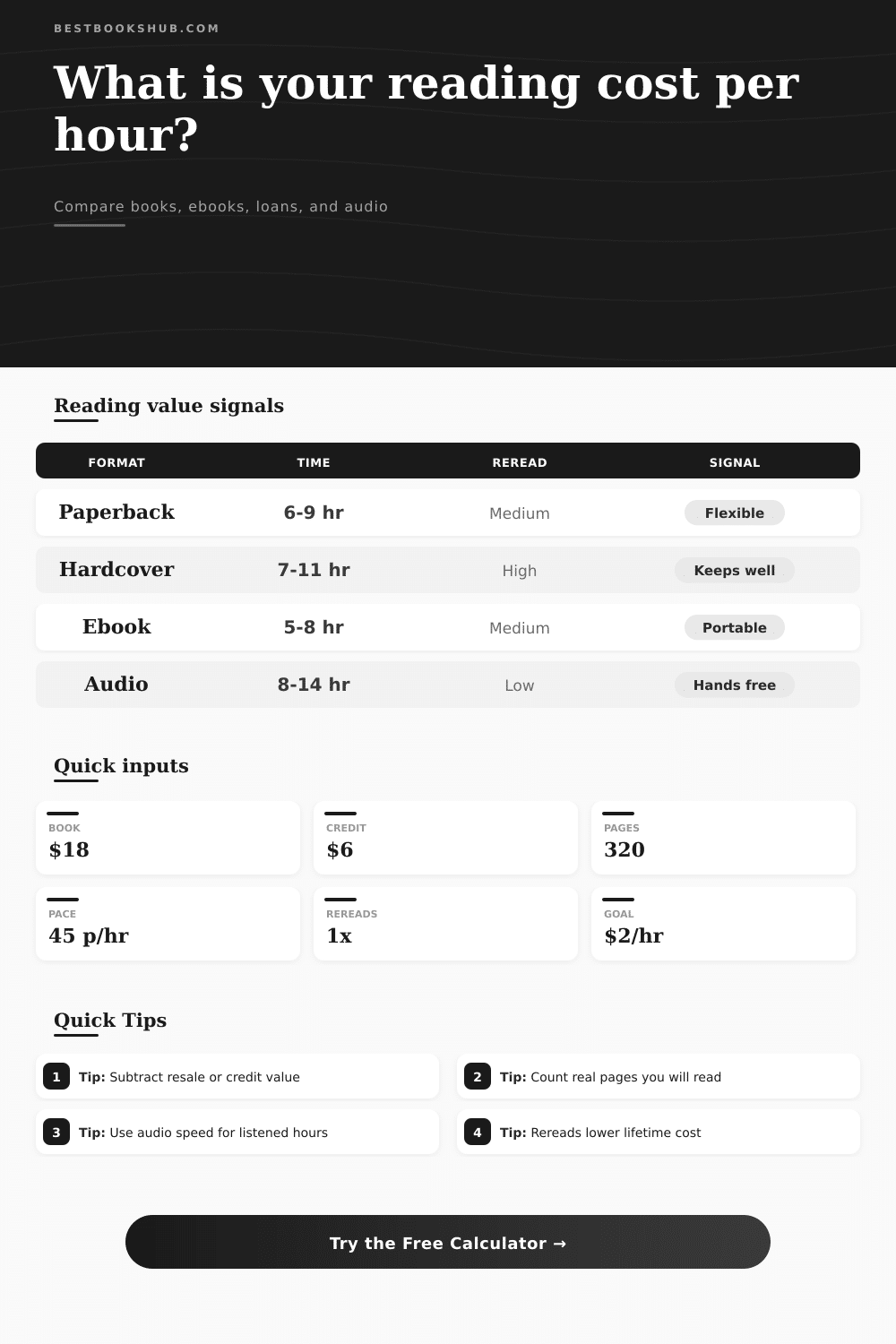
| Format | Best time basis | Common cost adjustment | When the hourly figure is most useful |
|---|---|---|---|
| Paperback | Pages divided by personal pace | Subtract resale or store credit | Comparing keepers, casual reads, and used copies |
| Hardcover | Pages divided by pace, then add rereads | Subtract expected retained value | Judging a higher upfront purchase against long use |
| Ebook | Pages, locations, or estimated hours | Use paid amount, usually with no resale credit | Checking sale buys and unread digital backlog |
| Library loan | Finished pages or audio hours | Add travel, hold, or replacement fees only | Measuring time value when cash outlay is near zero |
| Subscription read | Actual hours spent with one title | Allocate monthly fee across books read | Seeing which reads justify a monthly plan |
| Audiobook | Listed hours divided by playback speed | Use credit value or title-specific purchase amount | Comparing listening time with print reading time |
| Scenario | Net spend | Reading hours | Cost per hour |
|---|---|---|---|
| Used paperback, full read | $7 after credit | 6.5 hr | $1.08/hr |
| New hardcover, one reread | $20 after resale value | 18 hr | $1.11/hr |
| Short ebook sale | $4 with no credit | 4 hr | $1.00/hr |
| Audio credit at 1.25x | $15 credit value | 8.8 hr | $1.70/hr |
| Textbook chapter use | $42 allocated cost | 7 hr | $6.00/hr |
| Library loan plus travel | $3 travel share | 7.5 hr | $0.40/hr |
| Reading style | Pages per hour | 320-page book | Best use |
|---|---|---|---|
| Dense study with notes | 20-30 | 10.7-16 hr | Textbooks, academic reading, close analysis |
| Careful nonfiction | 30-40 | 8-10.7 hr | Ideas, business books, biography, history |
| Average leisure reading | 40-55 | 5.8-8 hr | Most novels and readable nonfiction |
| Fast fiction pace | 55-75 | 4.3-5.8 hr | Light prose, rereads, familiar genres |
| Skimming or reference | 75-120 | 2.7-4.3 hr | Partial use, lookup work, selective reading |
DISCLOSURE: This post may contain affiliate links, meaning when you click the links and make a purchase, I receive a commission. As an Amazon Associate I earn from qualifying purchases.
At some point, you probably has a shelf full of books you’ve begun but never completed. It happens a lot; it makes you feel guilty. You feel bad about wasting your time, sure, but mostly, you feel bad about spending all that cash. Most readers bases their purchasing decisions solely on sticker price. That’s a misstep. The value of a given book isnt represented by its cover cost.
Perhaps a twenty dollar hardcover took you three weeks to read. Maybe an eight dollar ebook was skimmed in an afternoon and later forgotten. One of these books costs less per hour of enjoyment then the other. When we buy a book, what realy matters is not the price but how much it costs per hour of reading.
Stop Worrying About Unread Books
After plugging in your estimates for how long it takes you to read a book and what your pace is (the calculator does the math for you, above), you can see result without having to guess at conversions. No need to guess at conversions. First, it calculates your net spend, which is a better number than raw price, since it factors in any resale value/credits. If you’re getting books through an audio service, you’ll have to estimate some portion of that monthly cost per title. But if you purchase a used book and sell it later, that resale value reduce your net spend. That’s the top half of the value equation.
A lot of folks gets this wrong on the bottom half of the equation. The speed you’re reading depend on what you’re reading and why you’re reading it. A thriller isnt read at the same speed as, say, a history textbook. If you treat both the same, then you distort the cost-per-hour calculation. You can also tweak for difficulty with the tool. This will slow down your page count per hour if you’re dealing with heavy material. That way a shorter academic piece doesn’t appear cheap just due to having fewer pages. Instead it honors the effort needed to understand the material, not simply skim over the ink.
What about audiobooks? That’s where the tool come in. You can play back books at different speeds and many people do: They listen at 1.5x or even 2x. So now a fixed-cost book (a credit) require less time. If it takes twelve hours to listen to an audiobook at normal speed, listening at double speed cuts the cost per hour in half. When you input your speed of listening, that benefit is captured by the calculator. It turns the feeling of “I’m getting more done” into an undeniable monetary win.
A neglected factor in the economics of reading are rereading. Rereads are like free hours you earn on the back end of an earlier purchase. Re-reading a beloved book? You recieve the value with no additional cost. Enter the expected rereads into the tool. Your upfront expense will now be spread across more time spent with it. A book read three times is a third as expensive per hour as a book read once. It changes the game to acquiring excellent books you’ll want to return to.
Stop purchasing bargain-bin books you’ll eventually grow bored of. The exception are library loans. The monetary cost is near zero, but there is still a time investment. But there is time spent. And we know the value of time. If you’re careful with these borrowed items, you can charge a minor fee for your risk. For example, you can assign a small fee for travel or replacement risks. So how does it look? You’ll notice the very low rate per hour. This is why borrowing things is such good bang for your buck, financially speaking, provided you take care of them.
The format reference chart on the page lets you contrast different format types based off what type of time makes the most sense. If you want to account for the wait to get a book off hold, then yes, maybe libraries are not the cheapest. But otherwise they are. How much do you want to know? Or how much entertainment do you seek? Your goal determines your habit, which dictates your cost-per-hour of reading. Want maximum entertainment? Read fast (audio) or read again (rereading). Studying for exams? Accept that your time has a higher cost and learn to live with it. It’s all up to you. What you choose reveals what you value most in a book.
Once you track the figures, you’ll realize there’s no reason to feel guilty over an unread pile. You’ll make thoughtful decisions about your time. You’ll buy books because they’re worth the hours you invest in them.