📚 format value lab
Ebook vs physical cost calculator
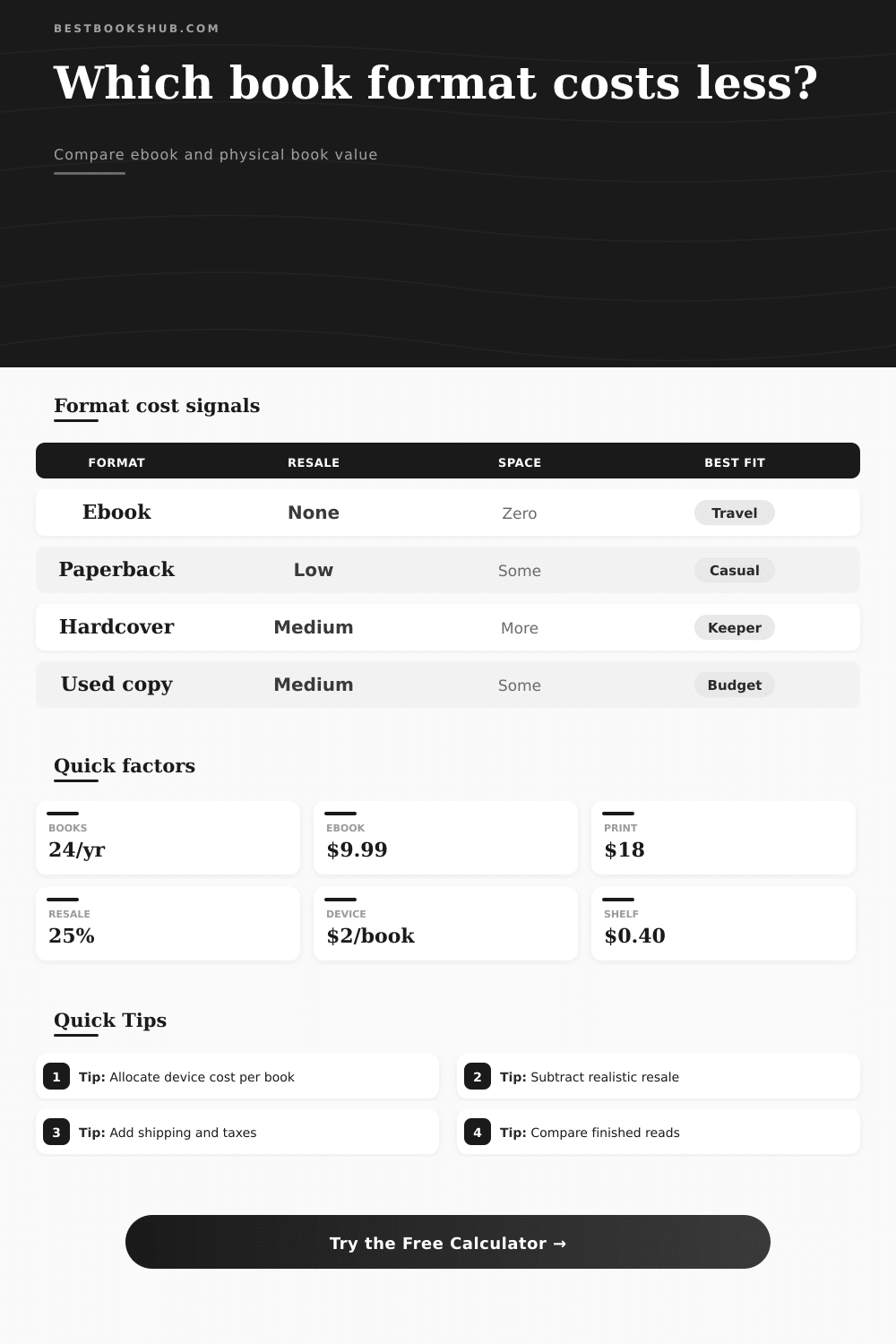
Compare ebook and print book ownership with device allocation, resale value, shipping, shelf space, rereads, completion rate, and cost per finished read.
| Format | Typical size | Spine width | Weight | Cost notes |
|---|---|---|---|---|
| Mass market paperback | 4.2 x 6.8 in | 0.8 in | 0.35 lb | Low purchase amount, modest resale. |
| Trade paperback | 5.5 x 8.5 in | 0.9 in | 0.75 lb | Common fiction and nonfiction comparison baseline. |
| Hardcover | 6.2 x 9.2 in | 1.1 in | 1.25 lb | Higher shelf weight, often better gift or keeper value. |
| Textbook | 8.5 x 11 in | 1.4 in | 2.8 lb | High resale can make used print competitive. |
| Graphic novel | 6.7 x 10.2 in | 0.55 in | 0.9 lb | Visual layout can favor print for some readers. |
| Art book | 9 x 12 in | 1.2 in | 3.5 lb | Large-format print carries storage and shipping impact. |
| Cost item | Ebook treatment | Physical treatment | Why it matters |
|---|---|---|---|
| Purchase amount | Per download | Per copy | Usually the largest direct input. |
| Tax and fees | Percent of ebook amount | Tax plus shipping | Small charges can swing close comparisons. |
| Device allocation | Reader cost divided by books | Not applied | Important when buying few ebooks. |
| Shelf space | None | Kept books times years | Turns space into a consistent comparison value. |
| Resale credit | Usually none | Books resold after fees | Can make print cheaper for active resellers. |
| Rereads | Lower cost per read | Lower cost per read | Keeper books become more efficient over time. |
| Scenario | Books per year | Ebook pattern | Physical pattern | Likely swing factor |
|---|---|---|---|---|
| Casual reader | 6 to 12 | Device allocation is high | Used print can compete | Existing device ownership |
| Frequent reader | 24 to 60 | Device allocation falls | Shelf space builds | Resale discipline |
| Student | 8 to 20 | Access codes may matter | Resale can be meaningful | Edition churn |
| Collector | 12 to 36 | Convenience copy only | Kept rate is high | Long-term keeper value |
| Traveler | 20 to 50 | Strong portability value | Shipping and luggage add up | Device already owned |
DISCLOSURE: This post may contain affiliate links, meaning when you click the links and make a purchase, I receive a commission. As an Amazon Associate I earn from qualifying purchases.
If you want an ebook, fine. If you want a physical copy, great. But either way, here’s what happens: you acquire a problem. It is not because of the money. It is because of accumulation.
A book occupies space on your shelves. And it need something to read it on. It also take up space. Or do you plan to return it? Are you planning to sell it back to someone else? At what price? How much square footage does a book consume in your apartment? What percentage of your device should be given to books?
The Real Cost of Buying Books
Enter the ebook vs. It is a physical cost calculator. This thing will run some numbers for you. It will remove the emotional bond between you and paper, replacing it with pure net ownership values. It’ll calculate cost of owning a book. But most people don’t do this math. The sticker price becomes their cutoff point.
At checkout, an ebook is often less expensive then a paperback copy. That’s a bargain! This continues until you realize all of the unseen costs of owning stuff digitaly. You need a tablet or a reader to access those files. You paid for that reader… Or maybe you bought a Kindle specifically to read books.
Now you have to spread out cost of the reader over every book you’ve downloaded. In some sense, you’re being asked to pay for hardware upfront, then pay it off over time through the purchases you make. Why? Because you can’t have the first hundred books look super-cheap while you keep your new Kindle collecting dust in your dresser. It equalizes things between guy who has a Kindle and the guy purchasing one today.
On the flipside, there’s some hidden tax on physical books. You see shipping costs, sure, but the silent killer is shelf space. For every volume that you own, this calculator gives it an imaginary price tag for how much shelf space it takes up in inches. Seems abstract? Try being a casual reader who keeps half their library. Those books adds up; they’re earning a rent charge which eats away at the benefit of purchasing inexpensive used copies.
To put it another way, look at this reference table from the page, measuring weight and spine width between formats. Why are mass-market paperbacks less of a blow to your space budget than a hardcover or art book?
The other variable is resale. You can sell physical copies of a book. You’re buying them at a certain amount, then selling them back at some fraction of that amount (which reduces how much it actualy “costs” you to read that copy). This assumes that you’ll get something for that book when you’re done. If you resell a book, your actual cost of owning it are reduced by whatever you get back from the sale.
The calculator allows you to plug in an expected resale rate and take into account the fees incurred through a resale platform. In addition, the calculator takes into account the fact that while some books will be sold, others won’t, instead, they’ll languish on your shelves collecting dust and adding to the overall square footage of the books taking up space in your life.
People tend to over- or under-estimate this variable in most casual calculations. They imagine either keeping all their books, or getting rid of them all. Usually, the truth lies somewhere in between: a combination of kept favorites and regrettable dissapointments.
These are linked through the final metric: completion rate. A book you buy but never finish costs you its full price for zero entertainment value. So the tool accounts for this by dividing the price paid by how much of the book was actualy consumed. If you find it hard to concentrate when staring at a screen, your ebook completion rate may decline. This means the digital version end up being more costly, even though its initial price is lower.
On the flipside, say you own several books that you return to again and again, well, the initial expenditure is spread out over scores of hours of enjoyment, which makes the cost-per-read go plummeting down. For keeper titles, rereading completely change the equation.
There are also different presets within the tool that allow you to model different lifestyles without having to enter them manually. For someone who travels, having something portable with no shelving cost is a benefit. Someone who collects may be willing to pay more space for the tangible value of a carefully curated bookshelf. Students who read a lot for school have high turnover. Textbook expenses requires resale as part of the equation. All these scenarios adjust the balance between physical ownership vs digital convenience.
This isn’t to say one is “better” than the other in all circumstances. Rather, it’s about finding out what format makes sense given your particular livig situation and reading habits. In other words: the most affordable book is the one that you’ll end up reading. That might be one printed on paper, or one displayed on your screen, it all depends on what’s most important to you, like the feel of the paper. Do you care about resale value? Space?).
By removing some of the subjectivity of personal preference, this calculator helps you understand the price of each. If you consider everything, you can buy more than you realize. Keep in mind that we’re talking about money spent on completed stories, not bound books or bought files. You should of considered this before.