📚 Shelf capacity planner
Books Per Shelf Calculator
Estimate how many books fit on each shelf by shelf width, usable spacing, book format, depth, double-row storage, shelf count, target books, and weight load.
| Clear shelf width | Paperback estimate | Hardcover estimate | Metric width |
|---|---|---|---|
| 24 in shelf | 27-29 books | 18-20 books | 61 cm |
| 30 in shelf | 34-37 books | 23-25 books | 76 cm |
| 36 in shelf | 41-44 books | 28-30 books | 91 cm |
| 48 in shelf | 55-59 books | 38-40 books | 122 cm |
| 72 in shelf | 83-88 books | 57-60 books | 183 cm |
| Book format | Average spine | Average depth | Average weight |
|---|---|---|---|
| Mass market paperback | 0.65 in / 1.7 cm | 7 in / 17.8 cm | 0.45 lb / 0.20 kg |
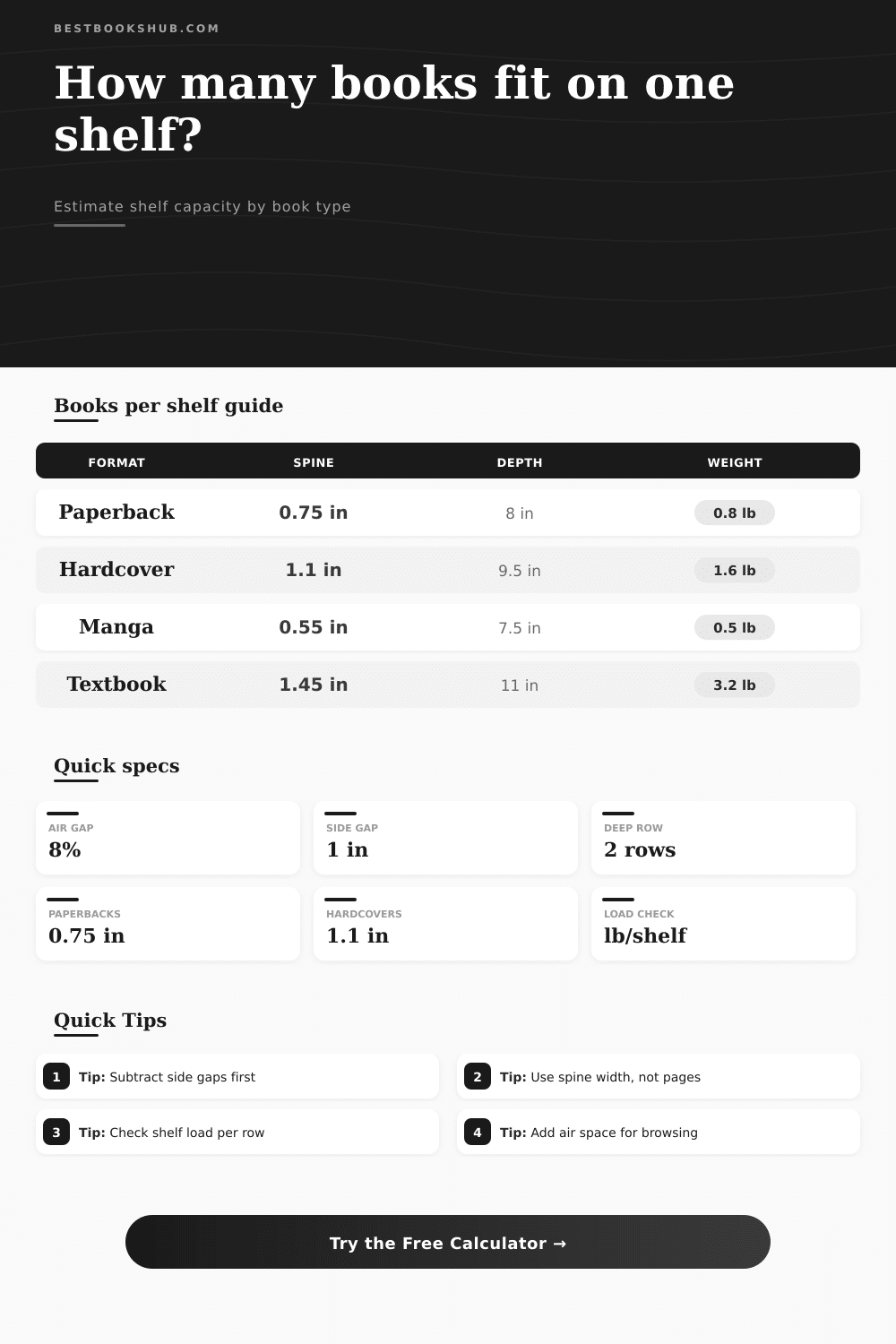
| Trade paperback | 0.75 in / 1.9 cm | 8 in / 20.3 cm | 0.80 lb / 0.36 kg |
| Hardcover fiction | 1.10 in / 2.8 cm | 9.5 in / 24.1 cm | 1.60 lb / 0.73 kg |
| Graphic novel | 0.38 in / 1.0 cm | 10.5 in / 26.7 cm | 0.85 lb / 0.39 kg |
| Textbook or reference | 1.45 in / 3.7 cm | 11 in / 27.9 cm | 3.20 lb / 1.45 kg |
| Shelf setup | Common dimensions | Best fit | Watch point |
|---|---|---|---|
| Small floating shelf | 24 x 8 in | Paperbacks | Wall anchors and load rating |
| Cube shelf bay | 13 x 13 in | Manga or small paperbacks | Short width limits row count |
| Standard bookcase shelf | 30 x 10 in | Mixed reading shelf | Sag on long unsupported spans |
| Wide wall shelf | 48 x 12 in | Hardcovers and double rows | Bracket spacing and total load |
| Deep storage shelf | 36 x 15 in | Double paperback rows | Hidden back row access |
Side panels, bookends, brackets, and decorative gaps reduce the actual row available for spines.
DISCLOSURE: This post may contain affiliate links, meaning when you click the links and make a purchase, I receive a commission. As an Amazon Associate I earn from qualifying purchases.
Large hardcovers and textbooks may reach the shelf rating before they run out of linear width.
Stand in front of an empty shelf of BOOKS and ask yourself: How many will I be able to fit? Sounds like a straightforward geometry exercise, doesn’t it? Horizontal space plus a pile of book spines equals number on paper.
Except as any enthusiastic librarian will tell you, it’s messier than that. Before the shelf fills up, its frame droop under the load of heavy hardcover books. You buy your next favorite novel only to discover there’s no room for it without tipping entire row into a dangerous arc.
How to Fit Books on Your Shelf
The act of estimating capacity isn’t so much about lining up spines one after another. It’s about knowing the invisible variables that gobble up space and strain wood. Plugging your measurements into the calculator above (which does all the work for you) spares you any guesswork; will an additional inch of depth be sufficient? The calculator know.
People tend to take exterior measurements of their bookcases and then become giddy over how many books they can potentially hold. They attempt to load them up and discover that two inches of width instantly dissapear because of side panels. Those two inches cannot be negotiated away. Measure the distance inside the shelves, between the inner faces of your shelving unit.
Any other measurements assume fixed losses without accounting for them, this makes your overall estimate bloated right out of the gate. It may not seem like much but when you’re cramming three hundred books into a tiny apartment, it’s important.
Another problem is depth. In principle, a basic ten-inch shelf should be large enough for two rows of paperbacks. But in practice? You’re going to have to dig through the first row to get to the second one and that’ll result in dog-ears and spine-knockdowns.
To help visualize this trade-off, the tool includes an option to view the shelf either with or without the second row. Double up and you increase capacity… But you also decrease accessibility. For frequent browsing, it’s better to go with a single row. For out-of-the-way reference books you only dig into every once in a while, double up make more sense.
Depending on what you pick, the calculator will adjust the width of the usable space, letting you know exactly how much space you’re giving up for convenience.
Weight is the silent killer of bookshelves. Until we see the shelf bending outward from the strain, we tend to think of bookshelves in volumes. Textbooks and hardcovers are far heavier than manga or paperbacks. Forty-five-pound shelves will support either fifty copies of light novels or twenty copies of heavy academic texts.
It’s not just a question of how many you can get on there; it’s a question of whether they’ll stay there. That gradual descent into spine-crushing horror could of been prevented by adding a safety buffer to your load estimate. Quick: books in. Slow: sagging shelf out. It is an expensive lesson.
Your ultimate number will depend on spacing preference, too. You might be someone who likes to pack ‘em in like sardines; no breathing room between any of them. Or maybe you’re more into an art-gallery-type display, with every book standing proud as a solo work of art. A happy medium is about 8% airgap: enough so that you’ll easily be able to pull things out, but not so much that it’s a jumble.
To account for that when we divide by spine thickness, first we take away that % from whatever total width you have available. Then the answer you get back from the calculator represents what you *actualy* want to put there (as opposed to just what could fit physically).
The page has reference tables which gives you an immediate idea of how many books fit on a typical 36” wide bookshelf. These tell me I can get about 40 paperbacks or 28 hardcovers in a row. So that explains why it’s difficult to plan around mixed collections. One set of rules won’t work for your whole collection. It requires breaking down your planning based off format type.
In conclusion: You won’t have any regrets if you know your boundaries. Dream as big as you’d like to fill it up, but leave yourself breathing room so that you can continue buying things without immediately renovating. If you plan out what you want exactly, then your beloved books will have a comfy place to livig instead of being propped unsteadily on a stack. Know how much it weigh and arrange accordingly.