📚 Bookcase load planner
Shelf Weight Load Calculator
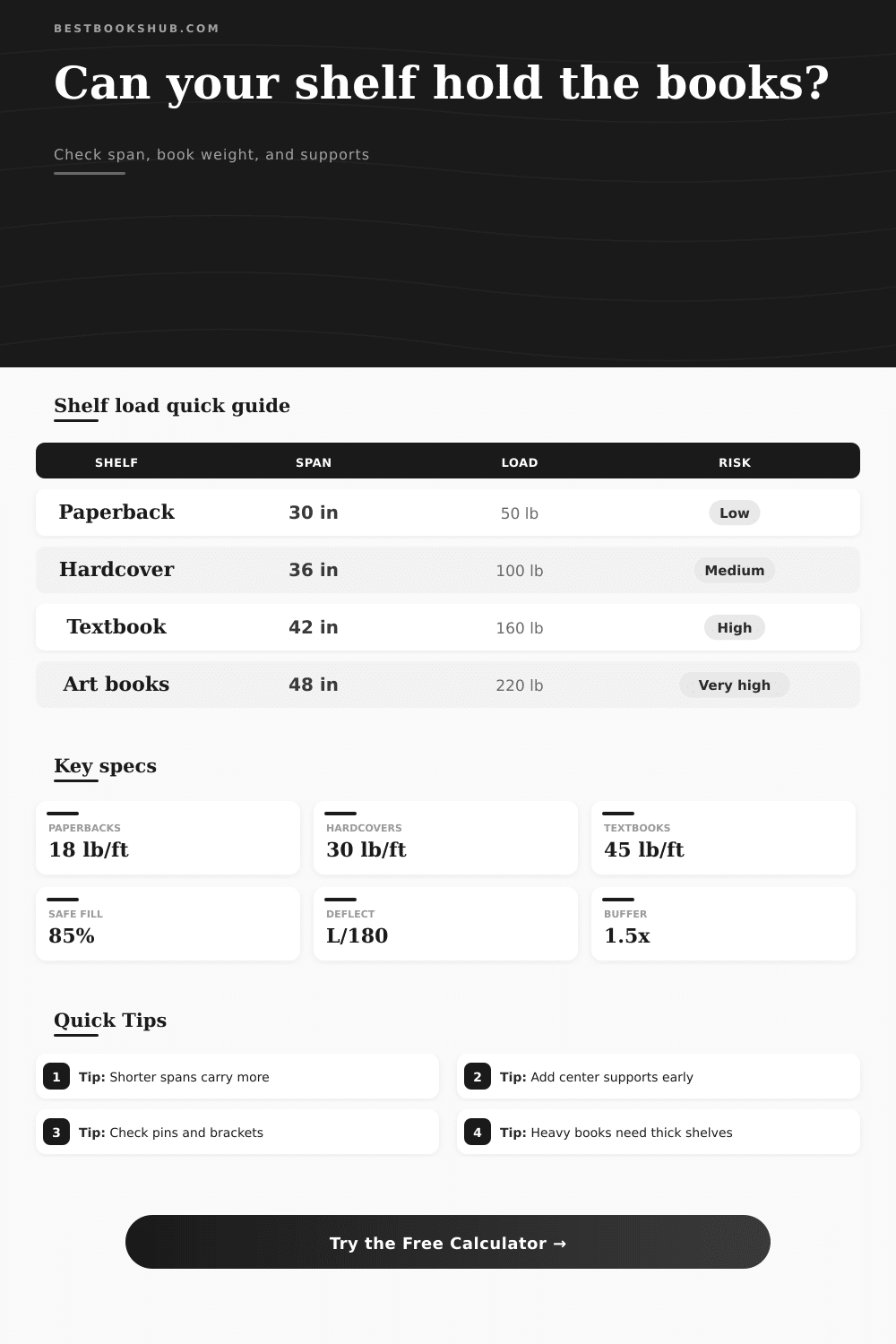
Estimate whether a bookshelf can carry a planned row of books by combining shelf span, material, thickness, book weight per linear foot, supports, deflection limit, and safety factor.
| Book profile | Estimated row load | Common depth | Use case |
|---|---|---|---|
| Mass market paperbacks | 16 to 20 lb per linear foot | 6 to 7 in | Light fiction shelves, paperback collections, compact bookcases. |
| Trade paperbacks | 20 to 26 lb per linear foot | 8 to 9 in | General nonfiction, modern paperbacks, mixed reading shelves. |
| Standard hardcovers | 28 to 34 lb per linear foot | 9 to 11 in | Home libraries, book club shelves, display rows with heavier bindings. |
| Textbooks and manuals | 40 to 50 lb per linear foot | 10 to 12 in | Study shelves, technical manuals, law books, medical references. |
| Graphic novels and comics | 26 to 36 lb per linear foot | 10 to 12 in | Glossy paper collections, omnibus editions, manga rows. |
| Oversized art books | 45 to 60 lb per linear foot | 12 to 15 in | Large-format photography, art, architecture, and design books. |
| Shelf material | Typical modulus used | Relative sag resistance | Planning note |
|---|---|---|---|
| Pine or fir board | 1.2 million psi | Medium | Works for short spans; choose thicker stock for hardcovers. |
| Oak or maple board | 1.6 million psi | High | Stiffer than softwood at the same thickness and depth. |
| Cabinet-grade plywood | 1.4 million psi | High | Stable choice when face grain runs along the shelf span. |
| Baltic birch plywood | 1.55 million psi | High | Good for deep shelves, built-ins, and strong edge-banded spans. |
| MDF shelf board | 0.55 million psi | Low | Needs short spans or strong edging for book loads. |
| Particleboard or melamine | 0.45 to 0.50 million psi | Low | Common in flat-pack shelves; avoid long unsupported rows of heavy books. |
| Common shelf scenario | Dimensions | Book load estimate | Load concern |
|---|---|---|---|
| Small paperback shelf | 24 in x 7 in x 0.75 in | 30 to 40 lb | Usually controlled by hardware or shelf pins. |
| Standard bookcase shelf | 36 in x 10 in x 0.75 in | 80 to 110 lb | Hardcover rows may sag over time without a stiff material. |
| Long wall bookcase shelf | 48 in x 11 in x 0.75 in | 120 to 180 lb | Often needs a center divider, front nosing, or thicker shelf. |
| Textbook shelf | 36 in x 12 in x 1 in | 130 to 160 lb | Check both board capacity and side-panel support strength. |
| Floating book shelf | 32 in x 10 in x 1.5 in | 55 to 90 lb | Wall fasteners, stud placement, and rod rating dominate. |
| Deep art-book shelf | 42 in x 14 in x 1 in | 160 to 220 lb | Depth increases shelf self-weight and support leverage. |
DISCLOSURE: This post may contain affiliate links, meaning when you click the links and make a purchase, I receive a commission. As an Amazon Associate I earn from qualifying purchases.
The third box of hardcovers goes on top, and the slightest creaking noise come from the wood beneath. The wood will tell you when physics has taken over. Gravity doesn’t care if you love the books. That is just what gravity does.
Shelves are deceptive thing. When they sag, it doesn’t feel like anything has actualy changed, other than them looking bent out of shape. And soon enough, the entire system seem ready to fall apart. But sagging shelves never do it all at once. They gradually become warped, and suddenly everything you own appear warped too; or else the anchors pull away from wall entirely.
How to Stop Shelves From Sagging
Knowing the load capacity isn’t panic mode. It’s anticipating where the weak link are before you try to fill in the holes. Once you know how far apart your supports are and what kind of wood you’re using, plugging into calculator above will do all the work for you. No more need to guess if particle board can support an encyclopedia.
The key variable in any shelving is usually unsupported span, which is distance from one support to another (i.e., from bracket to bracket, or side panel to side panel). What’s interesting is that typical way most folks size their space is by measuring from wall to wall, but what really matters is the distance between the side panels or brackets where wood is actually holding itself up. Doubling your length means the bending force multiply significantly, so while a three foot span might seem like no big deal, it’s much harder on the wood than you’d think. That’s why long shelves can look fat but still sag.
Wood also plays a huge part in this. Solid oak seems sturdy, but plywood can actualy be stronger for shelves than oak. This is because plywood lacks grain variation and tends not to warp when loaded. Most failed DIY projects aren’t due to the wrong materials, but rather hardware itself. Even buying thickest shelving boards possible won’t save you from a disaster if your rods or brackets can’t hold weight. That’s why it’s important not to think that the board itself is the limiting factor; the real limitation is what anchor points can support.
Even if you screw into wall, but don’t hit any studs, no matter how thick your wood is, it’s never going to stop you from ripping right through the plaster. To account for this, the tool lets you specify a hardware rating independent of material strength. Because once supports has been maxed out, upgrading the shelf boards isn’t going to do anything to save you.
Another perspective on deflection as beauty vs. Durability: There’s a limit to how far beams can bend before they appear unsightly. This is expressed by an engineer’s ratio (e.g., L/180) defining what’s too much. That number may strike us as random, but it’s realistic: beyond this point, you’re starting to see some sag that’s visually evident, and also possibly harmful to whatever’s sitting below. A tighter definition flattens things out, but requires heavier material or narrower support spans.
Where you’re storing sensitive equipment or glassware, it makes sense to go for that stiffer mark. If your books are paperbacks in a laid-back reading nook, maybe a little less rigidity is OK. The lesson: Go for a stiffness appropriate to your cargo; don’t over-build just for the sake of it.
How Much Does A Book Weigh? Different genres has very different weights. Technical manuals and art books are heavy, while mass market paperbacks are feather-light. Even though a graphic novel might occupy exactly as much space as a legal reference, it’s going to weigh far less per shelf. The only way to get an accurate weight estimate is to understand what’s inside that particular library.
This also illustrates how useful center support can be. A single horizontal bracket or divider midway through your bookshelves effectively halves their length. That significantly decreases the strain on both hardware and wood. And, before you finish filling out that last shelf, double-check your numbers. Are you getting close to capacity? Add a bit of support earlier rather than later, or adjust down the fill-rate instead. Bowed shelves and pulled-out wall anchors are better prevented than repaired. A small amount of planning today will mean upright books for years in the future. Get the basics right, and I bet you wouldn’t of hear that quiet groaning sound again.