📋 donation value lab
Book donation tax value calculator
Estimate the fair market value of donated books, compare the actual itemized deduction benefit, and flag the IRS recordkeeping band for receipts, acknowledgments, Form 8283, and appraisal review.
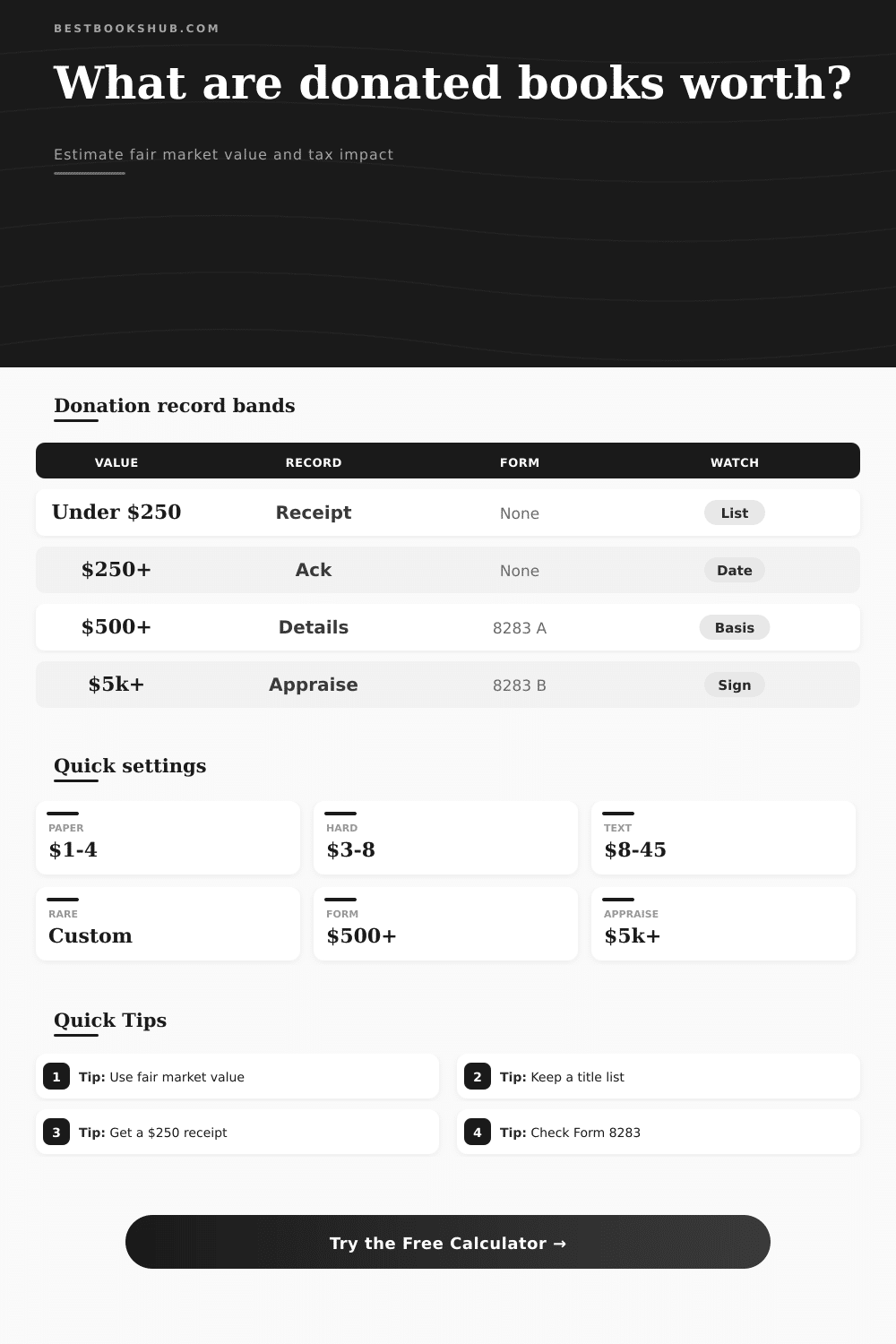
| IRS value band | Typical support | Tax form signal | Book-donation action |
|---|---|---|---|
| Less than $250 | Receipt or reliable written record | No Form 8283 unless total noncash gifts exceed $500 | Keep title/category list, date, charity, and location. |
| $250 to $500 | Contemporaneous written acknowledgment | No Form 8283 if total noncash gifts stay at $500 or less | Make sure the acknowledgment says whether goods or services were received. |
| More than $500 | Detailed acquisition and valuation records | Form 8283 Section A usually applies | Track categories, counts, condition, value method, and how you acquired the books. |
| More than $5,000 | Qualified appraisal review for similar items | Form 8283 Section B warning | Do not rely on a rough shelf estimate for high-value similar property. |
| Book type | Useful FMV evidence | Common markdown reason | Calculator field to adjust |
|---|---|---|---|
| Mass-market paperback | Thrift shelf or library sale bin | Creases, tanning, common title saturation | Condition and FMV each |
| Trade paperback | Used bookstore shelf or sold marketplace results | Highlighting, damaged spine, older nonfiction | Market method and condition |
| Hardcover | Comparable used hardcover listings that actually sold | Missing dust jacket, library marks, stale bestseller | Hardcover FMV and condition |
| Textbook | Current-edition resale or campus used-book price | Old edition, access-code dependency, workbook use | Edition status and FMV each |
| Rare or signed book | Sold auction, specialist catalog, qualified appraisal | Unverified signature, poor provenance, condition flaws | Rare FMV and support level |
| Scenario | Book count | Likely value pattern | Recordkeeping focus |
|---|---|---|---|
| Small home shelf clearout | 20 to 60 | Low per-book value, broad category list | Receipt, count, condition photos |
| Classroom or school donation | 30 to 150 | Children's books and curriculum books | Qualified organization confirmation |
| College textbook stack | 3 to 25 | High variance by edition and demand | Edition proof and sold-price support |
| Estate book donation | 100 to 1000 | Mostly ordinary books plus possible outliers | Separate ordinary books from rare books |
| Collector donation | 1 to 50 | Custom values from specialist evidence | Appraisal timing and Form 8283 review |
Tax-note: This calculator is an estimate, not tax advice. Confirm charity status, deduction limits, substantiation rules, and final filing treatment with IRS guidance or a qualified tax professional.
DISCLOSURE: This post may contain affiliate links, meaning when you click the links and make a purchase, I receive a commission. As an Amazon Associate I earn from qualifying purchases.
Giving away books is a win-win: we clear out some clutter; we get to feel good by supporting libraries! Before you donate them though, here is what you should of know about how book donations affect your taxes. It is a lot less than you think. The IRS doesn’t care about how much money you paid for a book a decade ago. They cares about the fair market value, which is usually a fraction of the cover price and often closer to a dollar or two.
The error most folks fall into is that they value their books by how much they paid when they bought them. “I’m giving away my 12-dollar book!” Nope! That 2015 mass-market paperback is only as valuable as somebody else think it’s worth today, which is usually more like one or two bucks if the spine has any ding marks.
How Book Donations Affect Your Taxes
Plug in your condition estimates and quantity; the calculator does the math. Tax rules treats rare collectibles very differently then ordinary reading copies. But it do depend highly on the condition. Books that are highlighted or have cracked spines loses value quickly. If your books were in good shape but have been gently used, the tool will factor that in. If they are in good donation condition but not quite gift-worthy, the tool will factor that in too.
Be conservative, overestimating is the fastest way to set off an audit flag. The IRS wants to find patterns, and donating too many books is one of those easy-to-spot patterns. Underestimate slightly. Do not claim you donated thousands of dollars’ worth of paperbacks that would only be worth a penny in a thrift store bin.
And speaking of bands: Thresholds exist too. If all your noncash contributions are below $500, keeping track is fairly straightforward. You’ll need a list (and a receipt from the charity), but no fancy forms required. As soon as you cross over that threshold though, Form 8283 comes into play. The calculator is smart enough to alert you to that transition, to let you know when you’ve moved from a receipt-based process to one requiring detail-filled declarations. It’ll also monitor your total noncash value (including other contributions you may give during the year) so you always know what band you’re in.
You should also be extra-vigilant about rare books (and signed copies). Anything worth five thousand dollars or more usually needs a qualified appraisal. As the tool explains, it differentiates between collector-grade lots and ordinary shelf clearout, so when the dollar signs start to add up, think about getting someone to do an appraisal. A copy in fine condition with a dust jacket? That’s not something you can guesstimate. Those things has to come with dealer estimates or documented similar sales.
The page has some helpful reference tables that make all this very clear: match the level of your donation with what IRS form(s) and proof will be needed. Also note: Your true tax break will hinge on whether you itemize deductions or not. For many taxpayers, standard deduction applies, and then they don’t get any real tax break from their book donations at all. The calculator factors this in for you, it tells you exactly what part of your donation really decreases your taxable income, vs. What part just adds to your bucket of itemized write-offs.
You’re right on the cusp? The pile of textbook may nudge you over the line, into itemization land. This is a critical decision point. And there’s timing as well: You have to get those donations in before the end of the year if they’re going to apply to that year’s taxes. If you drop them off in January, they count towards next year, not this year. You can use the interface to mark out your year-end batches (or plan ahead for future years) and see how it will affect your taxes this year compared to next year.next. A little thing, but it keeps you from getting frustrated in April.
Giving away books is an act of generosity, not a tax move. But it’s better for everyone, both the recipient charity and yourself, when the value are calculated properly. Nobody wants to stuff a pile of paperbacks in someone else’s hands, then force them to do paperwork on their end (or incur one themselves). This tool helps fill the gap there, making a stack of paperbacks into a neat line item at the bottom of your return form. Snap some pictures if necessary, keep your receipts, and have the math be done for you. It’s not about nickel-and-diming, it’s about doing it right the first time.